

Volatility is one of the most important slot concepts, but also one of the easiest to misunderstand.
In simple terms, volatility describes how a slot tends to distribute payouts. A lower-volatility slot usually spreads returns more evenly through smaller, more frequent results. A higher-volatility slot usually concentrates more value into fewer, larger outcomes.
This does not mean one type is always better. It means the slot may feel very different from one session to another depending on how its payout structure is built.
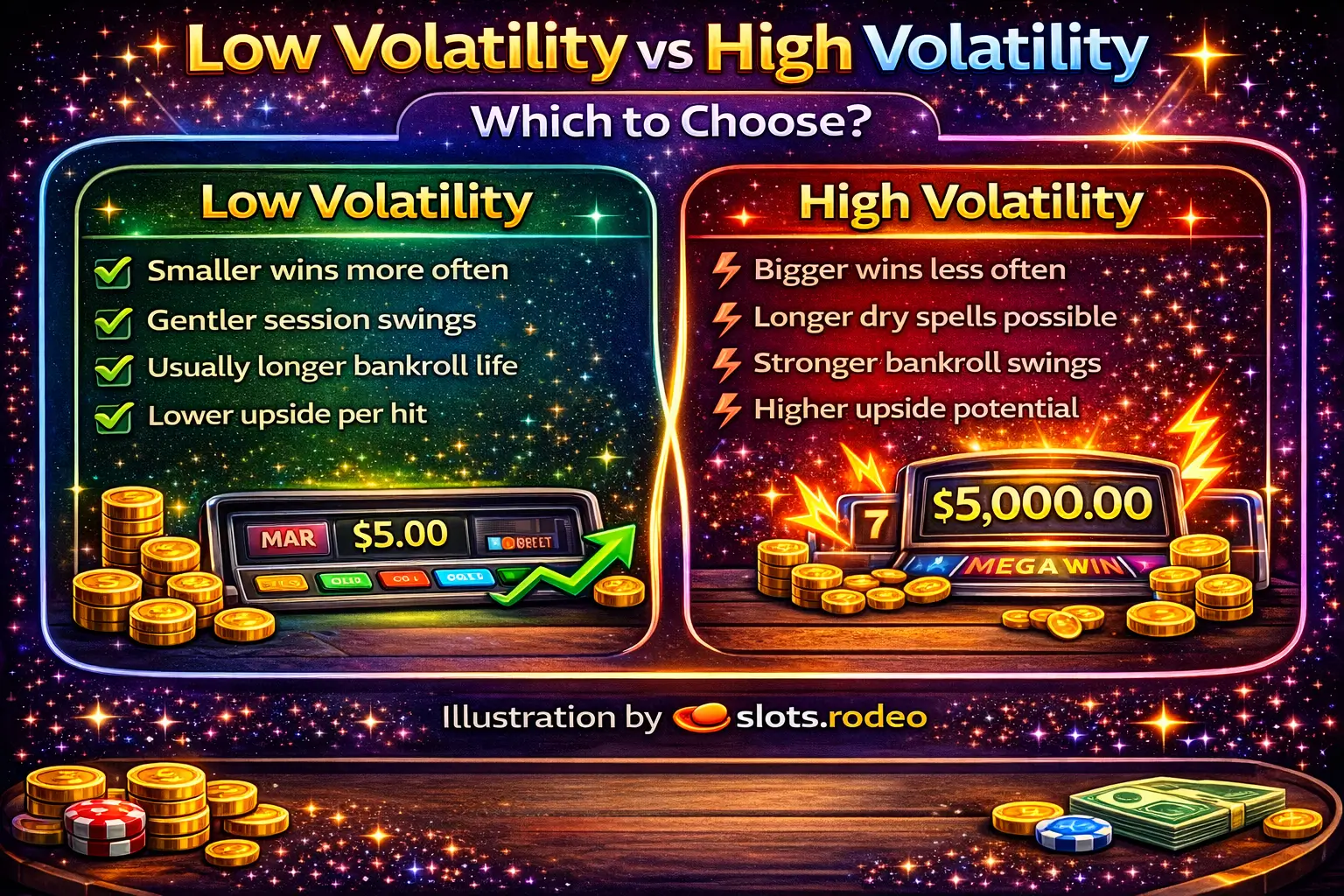
What volatility means in simple terms
Volatility is about payout distribution, not just payout size.
A lower-volatility slot usually aims to return value in a smoother way. That often means:
- more frequent smaller wins
- shorter dry stretches
- less value concentrated in rare top-end outcomes
A higher-volatility slot usually places more value into less frequent, stronger results. That often means:
- longer losing stretches
- fewer meaningful hits
- more dependence on bonus rounds, multipliers, or larger feature outcomes
This is why volatility often shapes the feel of a session more directly than RTP.
Low volatility and high volatility are not value judgments
A common mistake is to read volatility like a quality label.
That is wrong.
- Low volatility does not mean weak
- High volatility does not mean better
- Medium volatility does not automatically mean balanced in every practical sense
Volatility is a structural description. It helps explain how the slot may return value, not whether the slot is "good" or "bad."
The core difference at a glance
| Feature | Low Volatility | High Volatility |
|---|---|---|
| Win frequency | Often more frequent | Often less frequent |
| Typical win size | Usually smaller | Often more uneven, with stronger peaks |
| Dry spells | Usually shorter | Often longer |
| Session feel | Smoother | Sharper and more swing-heavy |
| Value concentration | More spread out | More concentrated in fewer outcomes |
| Bonus dependence | Often lower or more moderate | Often higher |
Win frequency
Low Volatility
Often more frequent
High Volatility
Often less frequent
Typical win size
Low Volatility
Usually smaller
High Volatility
Often more uneven, with stronger peaks
Dry spells
Low Volatility
Usually shorter
High Volatility
Often longer
Session feel
Low Volatility
Smoother
High Volatility
Sharper and more swing-heavy
Value concentration
Low Volatility
More spread out
High Volatility
More concentrated in fewer outcomes
Bonus dependence
Low Volatility
Often lower or more moderate
High Volatility
Often higher
This is the broad pattern. Real slots can vary, but this table explains the usual logic.
What low-volatility slots usually feel like
A lower-volatility slot often feels more active during ordinary play.
You may notice:
- more visible wins
- fewer long empty stretches
- smaller returns that keep appearing
- less dependence on one major hit
This does not mean the slot is generous in a strong practical sense. Many of those wins may still be smaller than the total bet. It means the slot often spreads more activity across the session.
For some players, this feels easier to follow because the game stays more visibly engaged.
What high-volatility slots usually feel like
A higher-volatility slot often feels less even.
You may notice:
- many spins with no meaningful return
- longer quiet periods
- more importance placed on free spins or feature triggers
- bigger jumps when strong outcomes do happen
This is why high-volatility slots are often described as more "swingy." A large part of the slot's visible value may be tied to fewer moments.
That can make the session feel more dramatic, but also more uneven.
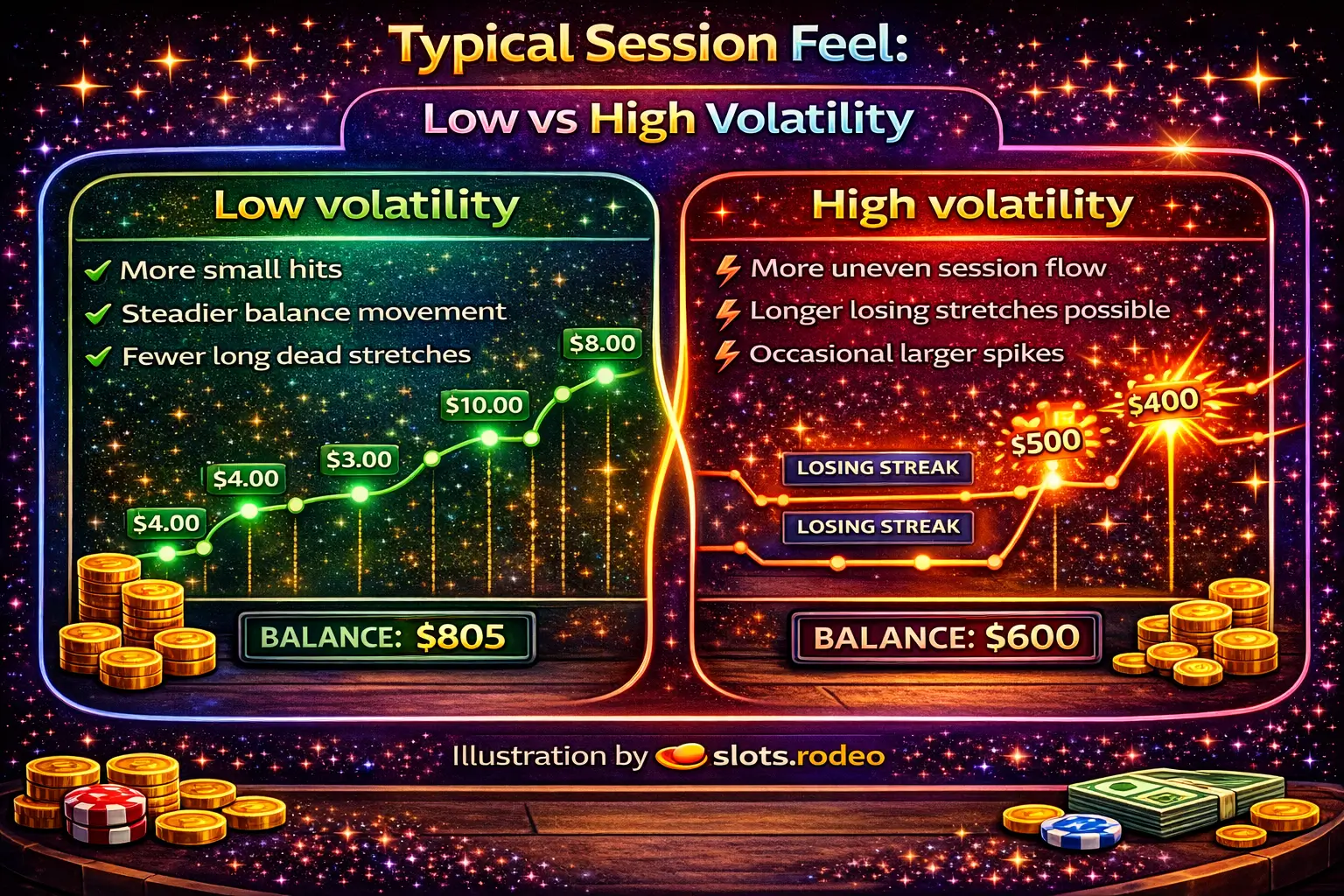
Volatility changes session feel more than many beginners expect
Two slots can have the same RTP and still feel completely different because of volatility.
For example:
| Slot | RTP | Volatility | Possible session feel |
|---|---|---|---|
| Slot A | 96.0% | Low | More frequent smaller returns |
| Slot B | 96.0% | High | Longer dry periods, more top-heavy |
Slot A
RTP
96.0%
Volatility
Low
Possible session feel
More frequent smaller returns
Slot B
RTP
96.0%
Volatility
High
Possible session feel
Longer dry periods, more top-heavy
This is one of the most important points in slot comparison.
The long-term theoretical return may be similar, but the path to that return can be very different.
Low volatility may suit players who want a steadier rhythm
A lower-volatility slot may suit players who prefer:
- more regular visible wins
- less dramatic balance movement
- a clearer sense of base-game activity
- fewer long quiet stretches
This does not mean the slot is risk-free. It means the return pattern may feel more even and easier to track during short play.
For beginners, lower-volatility slots are often easier to read because the session rhythm is usually less extreme.
High volatility may suit players who accept a rougher path
A higher-volatility slot may suit players who are specifically interested in:
- bigger top-end potential
- stronger contrast between ordinary and feature play
- more concentrated payout events
- bonus-heavy designs
But that structure usually comes with trade-offs:
- longer dry stretches
- more dependence on rare events
- fewer meaningful wins during some parts of the session
So the choice is not about which type is universally stronger. It is about which payout pattern fits the kind of session you want to evaluate.

Low volatility does not mean low return
This is an important correction.
A low-volatility slot is not automatically a low-return slot. It simply tends to spread value differently.
Likewise, a high-volatility slot is not automatically more rewarding overall. It may simply put more value into fewer events.
That is why volatility should never be read in isolation from:
- RTP
- hit frequency
- feature structure
- max win
- where the slot places most of its value
High volatility does not automatically mean bigger wins in practice
A higher-volatility slot often has more top-end focus, but that does not mean every short session will show that clearly.
In practical terms, a player may see:
- long quiet stretches
- weak bonuses
- little visible return in a short sample
The large upside is part of the structure, but it is not something the session has to show quickly.
This is why high-volatility slots are often misunderstood. Players notice the ceiling, but not always the cost of reaching for it.
The base game often feels different between low and high volatility slots
This is one of the clearest practical differences.
Low-volatility base game often looks like:
- more small hits
- more regular movement
- less reliance on one feature outcome
High-volatility base game often looks like:
- quieter reel action
- more empty spins
- stronger dependence on bonus entry or multiplier moments
That is why players often describe high-volatility slots as "feature-driven."
Bonus features often carry more weight in high-volatility slots
In many higher-volatility slots, much of the game's value sits inside:
- free spins
- multiplier features
- expanding symbol events
- stacked wild outcomes
- rare bonus combinations
This does not mean low-volatility slots have no features. It means the importance of those features is often greater in higher-volatility designs.
If a slot depends heavily on feature access, that usually matters more than the volatility label alone.
Which should a beginner choose?
For many beginners, lower-volatility slots are easier to understand and less confusing in short play.
Reasons include:
- more visible action
- shorter dry stretches
- easier-to-read session flow
- less dependence on one rare feature event
That said, the best choice still depends on what the player is trying to understand.
If the goal is to learn how slots behave in a clearer, more readable way, lower-volatility structures are often easier to study.
If the goal is to understand bonus-heavy, top-end-focused slot design, higher-volatility slots can show that clearly too, but they usually feel less even.
The better question is not "which is better?" but "better for what?"
This is the most useful way to frame the choice.
| Question | Lower Volatility Often Fits Better | Higher Volatility Often Fits Better |
|---|---|---|
| Want a steadier session rhythm? | Yes | Less often |
| Want fewer long dry stretches? | Yes | Less often |
| Want more top-end concentration? | Less often | Yes |
| Want a more bonus-heavy feel? | Sometimes | More often |
| Want a simpler short-session read? | Yes | Less often |
Want a steadier session rhythm?
Lower Volatility Often Fits Better
Yes
Higher Volatility Often Fits Better
Less often
Want fewer long dry stretches?
Lower Volatility Often Fits Better
Yes
Higher Volatility Often Fits Better
Less often
Want more top-end concentration?
Lower Volatility Often Fits Better
Less often
Higher Volatility Often Fits Better
Yes
Want a more bonus-heavy feel?
Lower Volatility Often Fits Better
Sometimes
Higher Volatility Often Fits Better
More often
Want a simpler short-session read?
Lower Volatility Often Fits Better
Yes
Higher Volatility Often Fits Better
Less often
This gives a much stronger comparison than trying to rank one type above the other.
Common bad reasons for choosing a slot by volatility
Players often make poor choices because they use weak logic such as:
- "high volatility means better wins"
- "low volatility means safe"
- "high volatility is for serious players"
- "low volatility is boring"
- "one strong session proves the label"
These ideas are too simple and often wrong.
Volatility should help you understand the payout pattern, not act as a shortcut for status or quality.
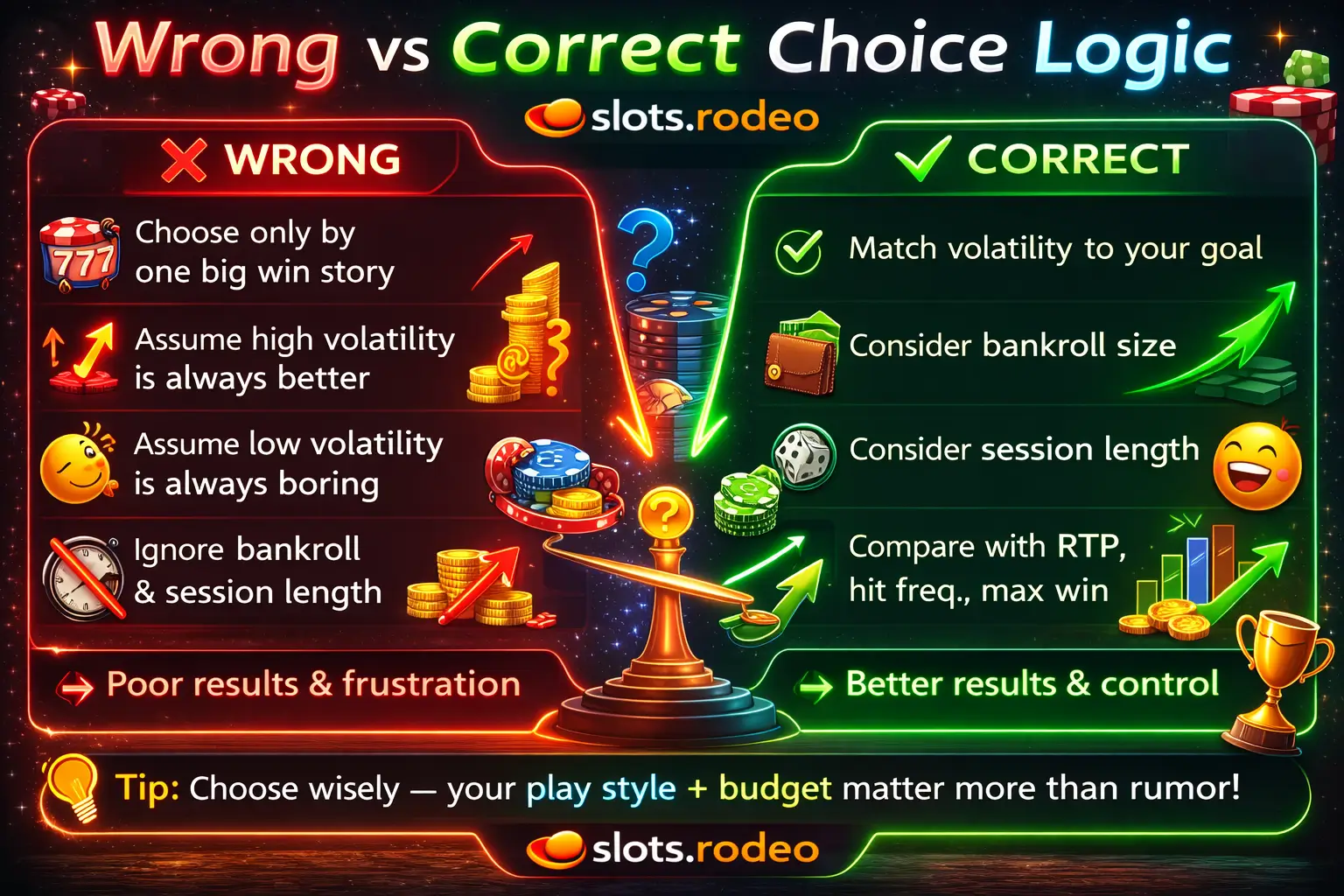
What volatility does not tell you
Volatility is important, but limited.
It does not tell you:
- the exact RTP
- how often the bonus triggers
- how large the average win is
- how high the max win is
- how the paytable is structured
- whether the slot uses paylines, ways, or clusters
- whether a short session will go well or badly
That is why volatility should always be read together with the rest of the slot profile.
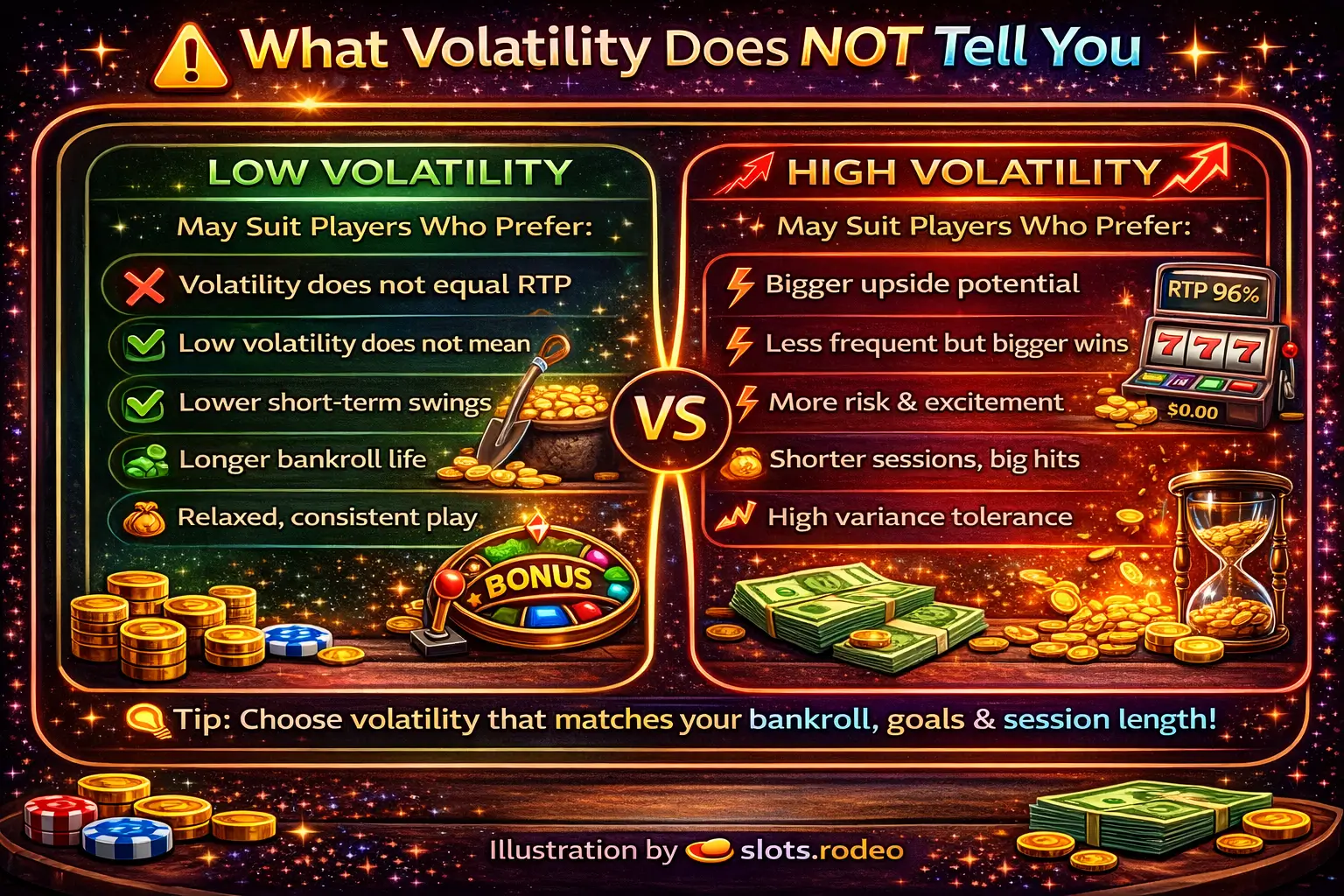
Low volatility vs high volatility in practical comparison
A useful comparison should ask:
- How active does the base game look?
- Does the slot rely heavily on free spins or major features?
- Are visible wins frequent but small, or less frequent and more concentrated?
- Does the session feel smooth or sharp?
- Is the top-end value likely to sit far above normal play?
These questions are more useful than treating volatility as a simple ranking.
Common beginner mistakes
Thinking low volatility means guaranteed comfort
It may feel smoother, but it can still produce many losing outcomes or weak returns.
Thinking high volatility means automatic big wins
It often means bigger top-end focus, not guaranteed strong short-session results.
Using volatility without checking RTP
The payout pattern and long-term return are different things.
Ignoring feature dependence
Some slots owe much of their practical value to bonus features, regardless of label.
Treating one short session as proof
A short sample cannot fully prove how the full volatility profile behaves.
What to check before choosing between them
Before deciding whether a lower- or higher-volatility slot is the better fit, check these points:
| What to check | Why it matters |
|---|---|
| RTP | Long-term return still matters |
| Bonus structure | Shows how feature-dependent the slot is |
| Win system | Helps explain how the slot feels spin by spin |
| Max win | Shows whether the game has a modest or large ceiling |
| Hit rhythm | Helps explain how active the session may feel |
| Base game vs feature balance | Important for understanding how the value is distributed |
RTP
Why it matters
Long-term return still matters
Bonus structure
Why it matters
Shows how feature-dependent the slot is
Win system
Why it matters
Helps explain how the slot feels spin by spin
Max win
Why it matters
Shows whether the game has a modest or large ceiling
Hit rhythm
Why it matters
Helps explain how active the session may feel
Base game vs feature balance
Why it matters
Important for understanding how the value is distributed
FAQ
Common questions about this topic.
Low volatility usually spreads returns more evenly. High volatility usually concentrates more value into fewer, larger outcomes.
Often yes, because the session usually feels smoother and easier to read.
No. Volatility and RTP are different metrics.
No. They often have stronger top-end concentration, but that does not mean better short-session results.
The better choice depends on whether you want a steadier session feel or a more top-heavy payout structure.


