

Demo mode is one of the easiest ways to understand how a slot works before looking at real-money play.
It lets you inspect the game's structure without financial pressure. You can check the paytable, symbol rules, win system, free spins, bonus flow, and how the slot feels over a sample of spins. Used correctly, demo mode is a practical research tool.
Used badly, it becomes guesswork.
A common beginner mistake is to spin randomly for a few minutes and treat that as a full test. That is not enough. A useful demo test needs a clear method.
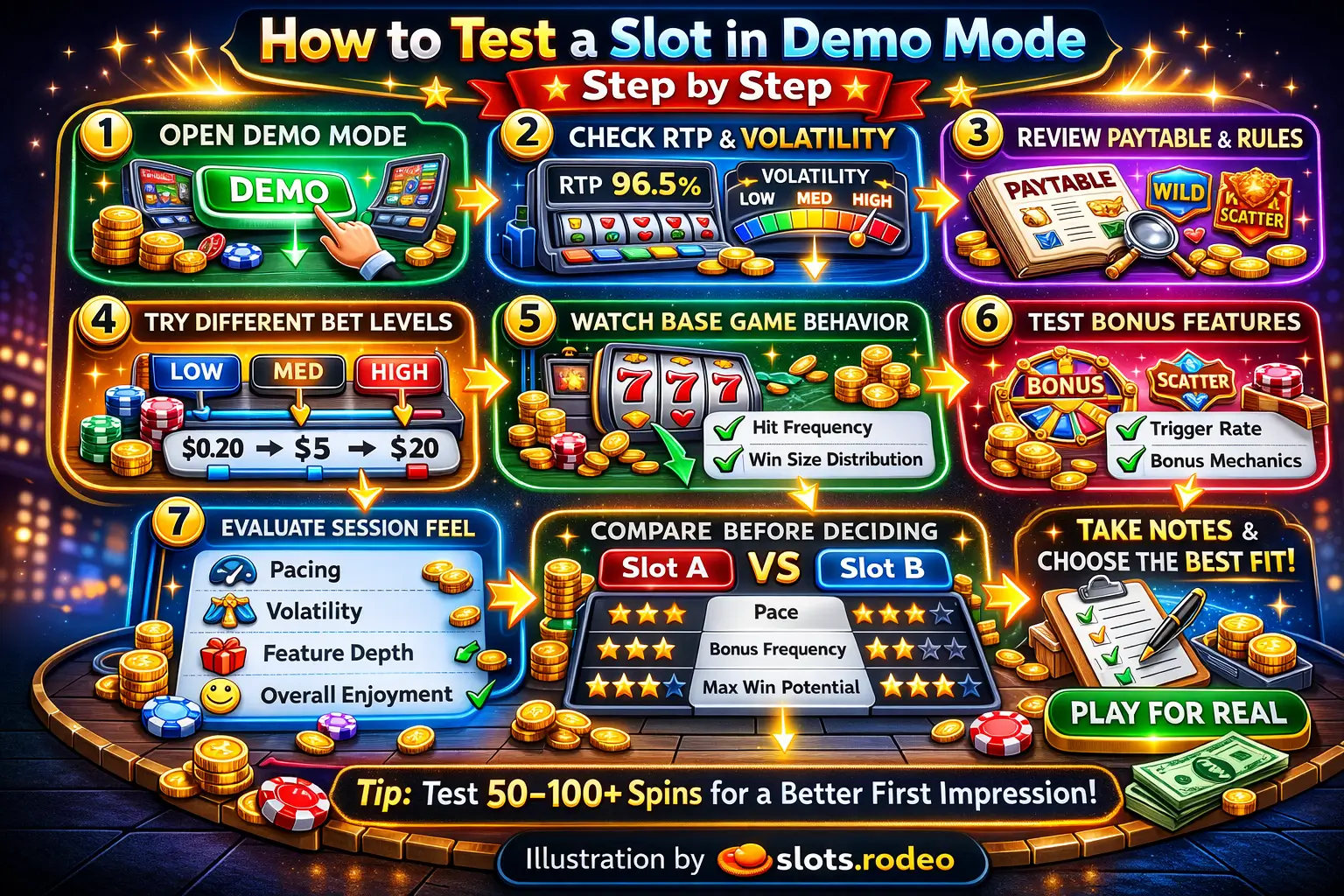
What demo mode is actually useful for
Demo mode is best for understanding the slot's design.
It helps you check:
- the win system
- symbol values
- wild and scatter rules
- bonus triggers
- free spins structure
- multiplier behavior
- reel layout
- general session feel
- how much the slot seems to depend on features
That makes demo mode useful for analysis, comparison, and simple slot literacy.
What demo mode is not for
Demo mode is not a reliable tool for proving:
- how the slot will behave in a real-money session
- how often you will win in live play
- whether the game is "hot" or "cold"
- whether one short sample proves the slot is good or bad
- whether the bonus is easy or hard to trigger in practice from a tiny sample
Those are common misunderstandings.
Demo mode helps you understand structure, not predict your next outcome.
Start with the paytable before spinning
This is the first step most players skip.
Before you press spin, check:
- what win system the slot uses
- which symbols pay the most
- what the wild does
- what the scatter does
- how free spins are triggered
- whether there are multipliers, respins, or other special rules
- whether the game uses fixed paylines, ways to win, Megaways, or clusters
If you skip this step, you may watch the reels without understanding what the game is actually doing.
What to check first in demo mode
A simple first-pass review should focus on the core structure.
| What to check first | Why it matters |
|---|---|
| Win system | Tells you how wins are formed |
| Symbol values | Shows premium vs low-value symbols |
| Wild rules | Explains substitution and multiplier logic |
| Scatter rules | Shows feature trigger conditions |
| Bonus structure | Helps you understand where the game's value may sit |
| Bet display | Prevents confusion between coins, credits, and money values |
Win system
Why it matters
Tells you how wins are formed
Symbol values
Why it matters
Shows premium vs low-value symbols
Wild rules
Why it matters
Explains substitution and multiplier logic
Scatter rules
Why it matters
Shows feature trigger conditions
Bonus structure
Why it matters
Helps you understand where the game's value may sit
Bet display
Why it matters
Prevents confusion between coins, credits, and money values
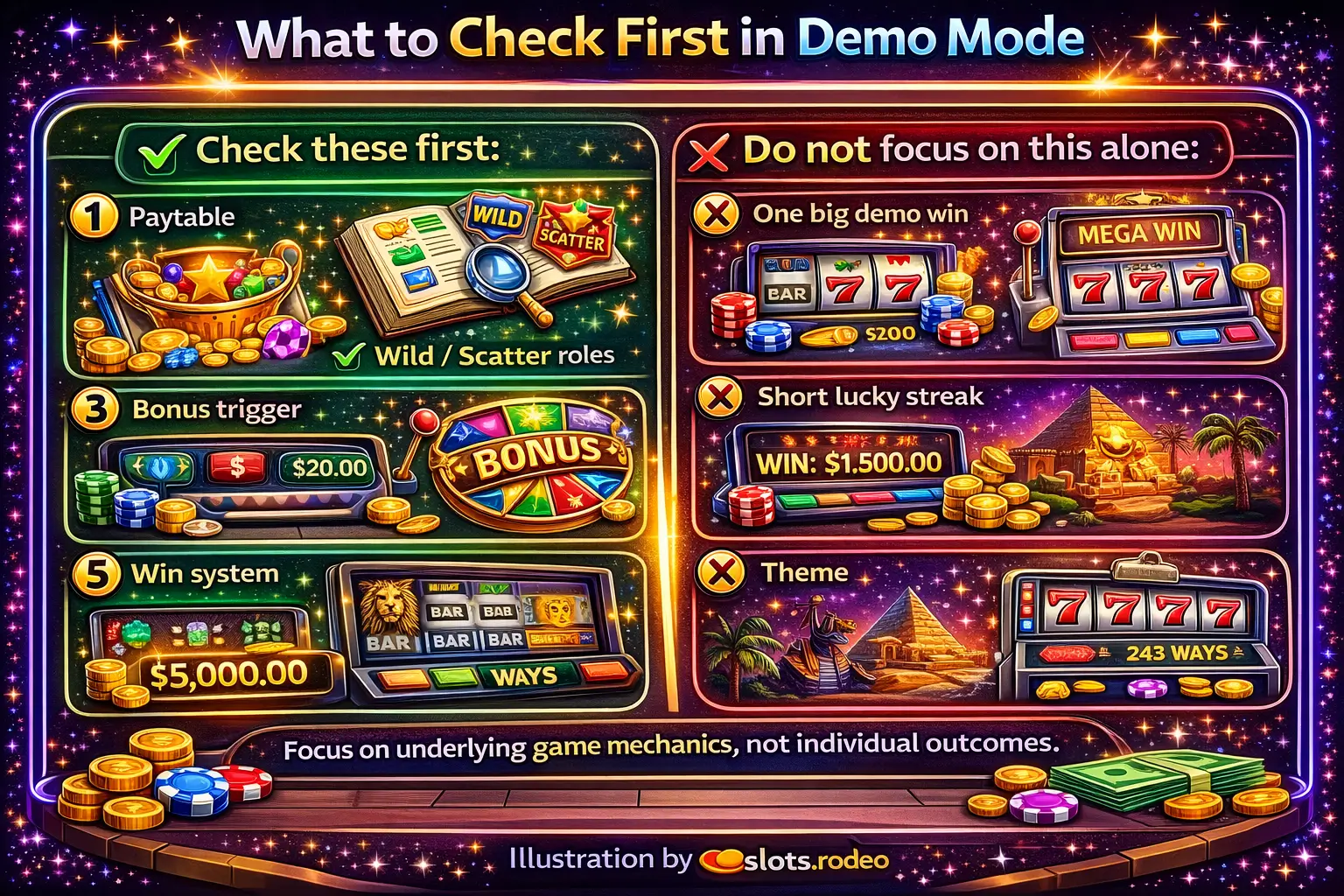
Step 1: Identify the win system
First, confirm how the slot forms wins.
Ask:
- does it use fixed paylines?
- does it use ways to win?
- is it a Megaways slot?
- does it use cluster pays?
This matters because it changes how you read the screen. If you do not know the win system, you may misread normal results from the start.
Step 2: Read the symbol ladder
Next, check the paytable and identify:
- low-value symbols
- premium symbols
- wild symbols
- scatter symbols
- bonus symbols
A good demo test is not only about watching wins happen. It is also about learning which symbols really matter.
Step 3: Watch the base game without rushing
Now start spinning, but do not spin blindly.
During the first sample, focus on the base game:
- how often does the slot produce visible wins?
- do many wins look small?
- does the base game feel active or quiet?
- do special symbols appear often or rarely in the sample?
- does the slot rely on cascades, expanding reels, or other ongoing mechanics?
At this stage, the goal is not to predict statistics. The goal is to observe structure and rhythm.
Step 4: Pay attention to losing stretches and small hits
A useful demo test should include attention to non-exciting outcomes too.
Watch for:
- long stretches without meaningful hits
- frequent small wins below stake
- repeated partial returns
- whether most visible activity comes from low symbols
- whether the base game seems to build toward a feature or stay flat
This helps you understand how the slot behaves between stronger moments.
Step 5: Test the special symbols properly
Once you have seen some normal spins, focus on the special symbols.
Check:
- does the wild only substitute, or also multiply?
- does the scatter pay directly, or only trigger features?
- can bonus symbols appear on all reels?
- do special symbols behave differently in bonus mode?
This step matters because many modern slots are shaped more by special symbols than by regular line hits.
Step 6: Inspect the feature if it triggers
If free spins or another bonus feature triggers during demo play, do not just watch the final total.
Check what changes inside the feature:
- do multipliers appear?
- do wilds change behavior?
- can the feature retrigger?
- do symbols upgrade?
- does the reel layout change?
- does the feature seem to carry much of the slot's value?
The point is to understand feature structure, not just whether one bonus paid well or badly.
Step 7: Compare the base game and the feature
This is one of the most useful parts of demo testing.
A strong comparison should ask:
| Comparison point | Base game | Feature mode |
|---|---|---|
| Win activity | More or less frequent? | More or less concentrated? |
| Wild behavior | Standard? | Improved? |
| Multipliers | Limited or absent? | Added or stronger? |
| Reel modifiers | Basic? | Expanded or changed? |
| Value concentration | Spread out? | More feature-heavy? |
Win activity
Base game
More or less frequent?
Feature mode
More or less concentrated?
Wild behavior
Base game
Standard?
Feature mode
Improved?
Multipliers
Base game
Limited or absent?
Feature mode
Added or stronger?
Reel modifiers
Base game
Basic?
Feature mode
Expanded or changed?
Value concentration
Base game
Spread out?
Feature mode
More feature-heavy?
This helps you see whether the slot is mainly base-game-driven or bonus-driven.
Step 8: Test more than one short sample
One short burst of spins is rarely enough.
A better approach is to test the slot in separate small phases:
- first sample for basic structure
- second sample for rhythm and base-game feel
- later sample for bonus observation if possible
This gives you a broader picture than one random run.
That said, even several short samples are still just samples. They help you understand the game's layout and feel, not prove exact frequencies.
Demo mode testing checklist
A practical checklist makes testing more useful.
| Checklist item | Done? |
|---|---|
| Checked win system | Yes / No |
| Read symbol values | Yes / No |
| Confirmed wild rules | Yes / No |
| Confirmed scatter and bonus rules | Yes / No |
| Observed base-game rhythm | Yes / No |
| Watched size of common wins | Yes / No |
| Checked whether feature triggered | Yes / No |
| Compared base game vs feature | Yes / No |
| Noted whether slot seems feature-heavy | Yes / No |
| Avoided drawing conclusions from one short sample | Yes / No |
Checked win system
Done?
Yes / No
Read symbol values
Done?
Yes / No
Confirmed wild rules
Done?
Yes / No
Confirmed scatter and bonus rules
Done?
Yes / No
Observed base-game rhythm
Done?
Yes / No
Watched size of common wins
Done?
Yes / No
Checked whether feature triggered
Done?
Yes / No
Compared base game vs feature
Done?
Yes / No
Noted whether slot seems feature-heavy
Done?
Yes / No
Avoided drawing conclusions from one short sample
Done?
Yes / No
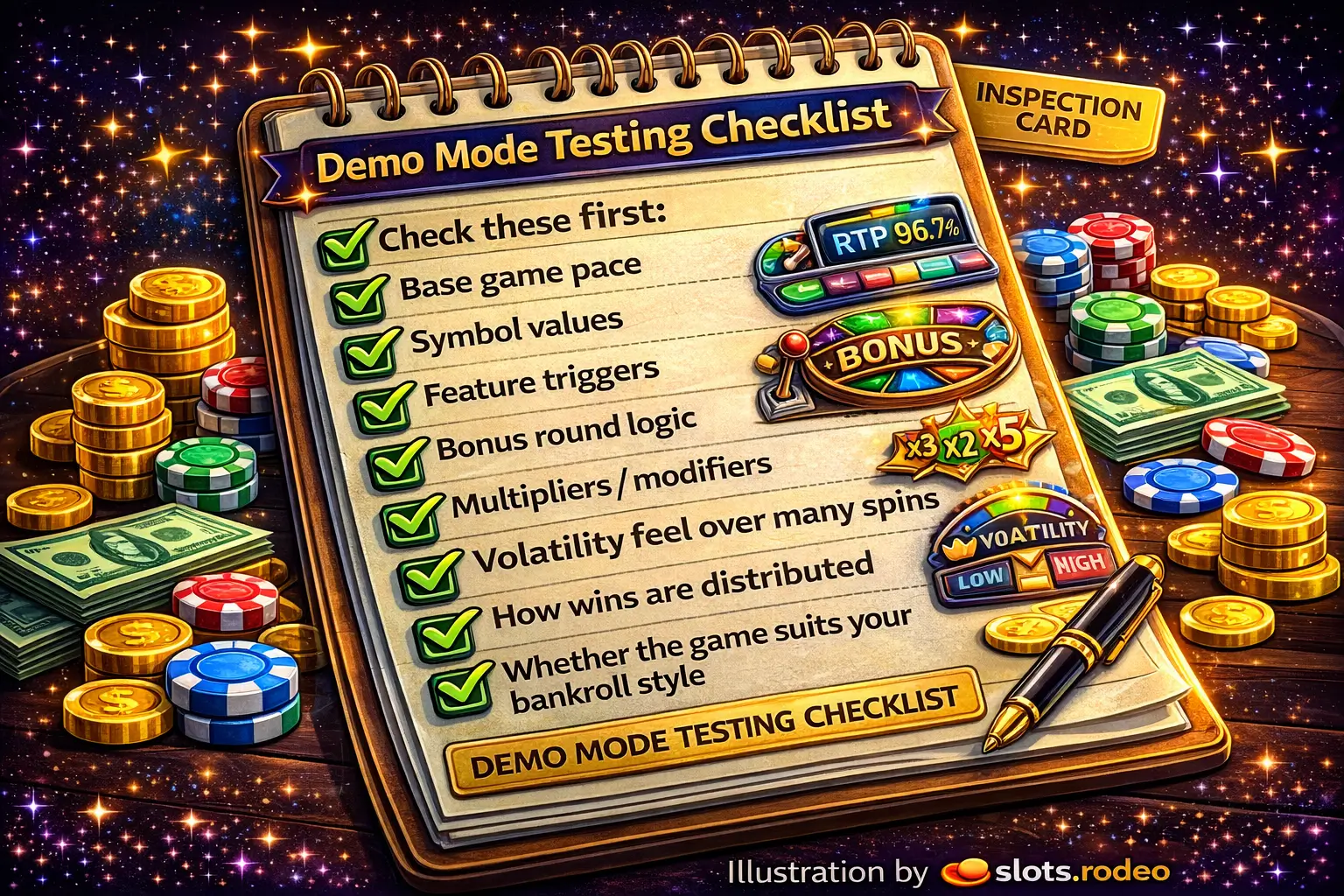
What demo mode can tell you well
Demo mode is good for the following:
- how the win system works
- whether the slot is simple or layered
- how the paytable is structured
- how special symbols behave
- whether the feature changes the game significantly
- whether the base game looks active or quiet
- whether the slot seems heavily bonus-driven
These are strong uses of demo mode.
What demo mode cannot tell you reliably
Demo mode has limits.
It cannot reliably tell you:
- how a real-money session will feel psychologically
- whether the next live session will be better or worse
- exact bonus frequency from a small sample
- exact hit frequency from a quick test
- whether the slot is "due"
- whether the game is worth playing just because one demo bonus paid well
This is where many weak tests go wrong.
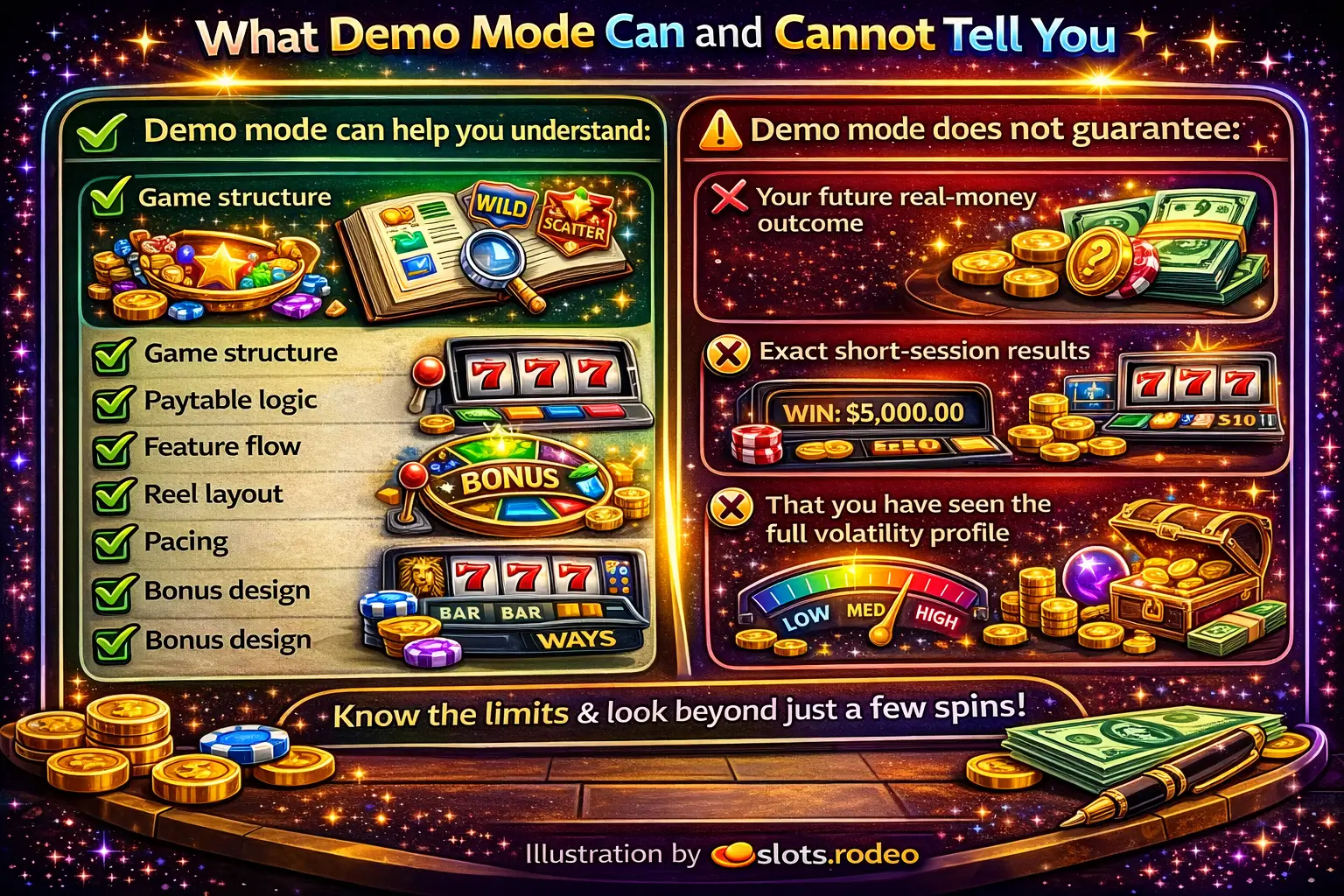
One good demo test is better than many random spins
A common mistake is to treat volume as analysis.
Spinning fast without tracking what you are seeing often teaches less than a slower, more structured test.
A good demo test should answer questions such as:
- how does this slot form wins?
- where does the value seem to sit?
- what do the special symbols actually do?
- how different is the feature from the base game?
- does the slot look simple, layered, or heavily feature-dependent?
If you can answer those clearly, the test was useful.
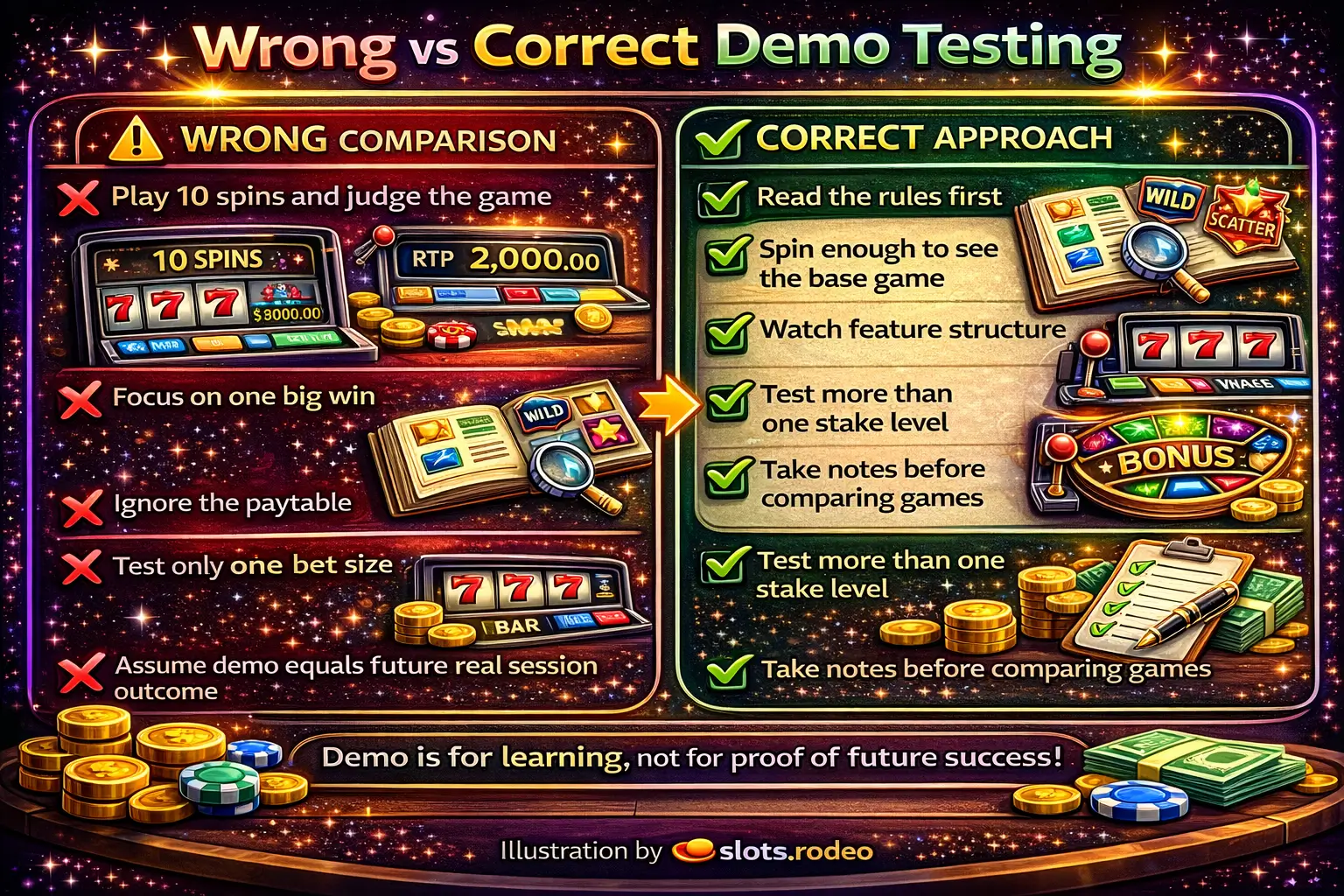
Wrong way vs correct way to test a slot in demo mode
A weak demo test looks like this:
- spin quickly for five minutes
- hope for a bonus
- see one good or bad result
- make a final judgment
A better demo test looks like this:
- read the paytable first
- identify win system and special symbols
- observe the base game
- note how common wins look
- inspect the feature structure
- compare the base game to the bonus mode
- avoid turning one short sample into a full claim
Common beginner mistakes in demo testing
Spinning before reading the paytable
This causes basic misunderstandings about symbols and triggers.
Judging the slot from one bonus result
One feature result does not define the whole game.
Treating demo mode as a prediction tool
Demo mode helps explain structure, not forecast live outcomes.
Ignoring the base game
Many players focus only on whether free spins appear, but the base game matters too.
Watching wins without checking their size
A slot can look active while still producing many weak returns.
Confusing "many hits" with "good value"
Frequent visible wins do not automatically mean strong returns.
A simple method for testing any slot in demo mode
Use this order:
- read the paytable
- identify the win system
- review the special symbols
- observe the base game
- note the size of typical wins
- inspect the feature if it triggers
- compare base game vs feature
- write down simple conclusions about structure
This method is enough for most practical demo testing.
What conclusions are reasonable after a demo test
After a useful demo test, it is reasonable to say things like:
- the slot is bonus-heavy
- the base game looks quiet
- the feature changes the reel behavior a lot
- the win system is easy or harder to read
- the slot depends strongly on multipliers
- the paytable is simple or layered
It is not reasonable to say things like:
- this slot definitely pays well
- this slot is cold
- this slot always gives weak bonuses
- this slot will behave the same in live play
That distinction matters.
FAQ
Common questions about this topic.
The main purpose is to understand the game's structure, symbols, win system, and feature design.
Yes. That is one of the most important steps.
It can show whether the slot is simple, feature-heavy, active, or quiet, but it cannot fully prove overall value from a short sample.
Usually no. It is better to use more than one short sample and focus on structure instead of outcome.
No. It can help you understand the slot, but not predict live outcomes from a small test.


