

A slot review can help you compare games quickly, but only if you know which parts actually matter.
Many reviews mix useful facts with filler. They may spend too much space on theme, story, or general claims like "great winning potential" without explaining the mechanics behind those claims. That makes comparison harder, especially for newer players.
A better approach is to treat a slot review as a practical reading tool, not as entertainment copy. You are there to find the parts that help you judge how the game is built, how it may feel in play, and whether it fits what you are looking for.
Start with the parts that change how the game actually plays
When opening a slot review, the first goal is simple: ignore the decorative parts and find the information that affects session behavior.
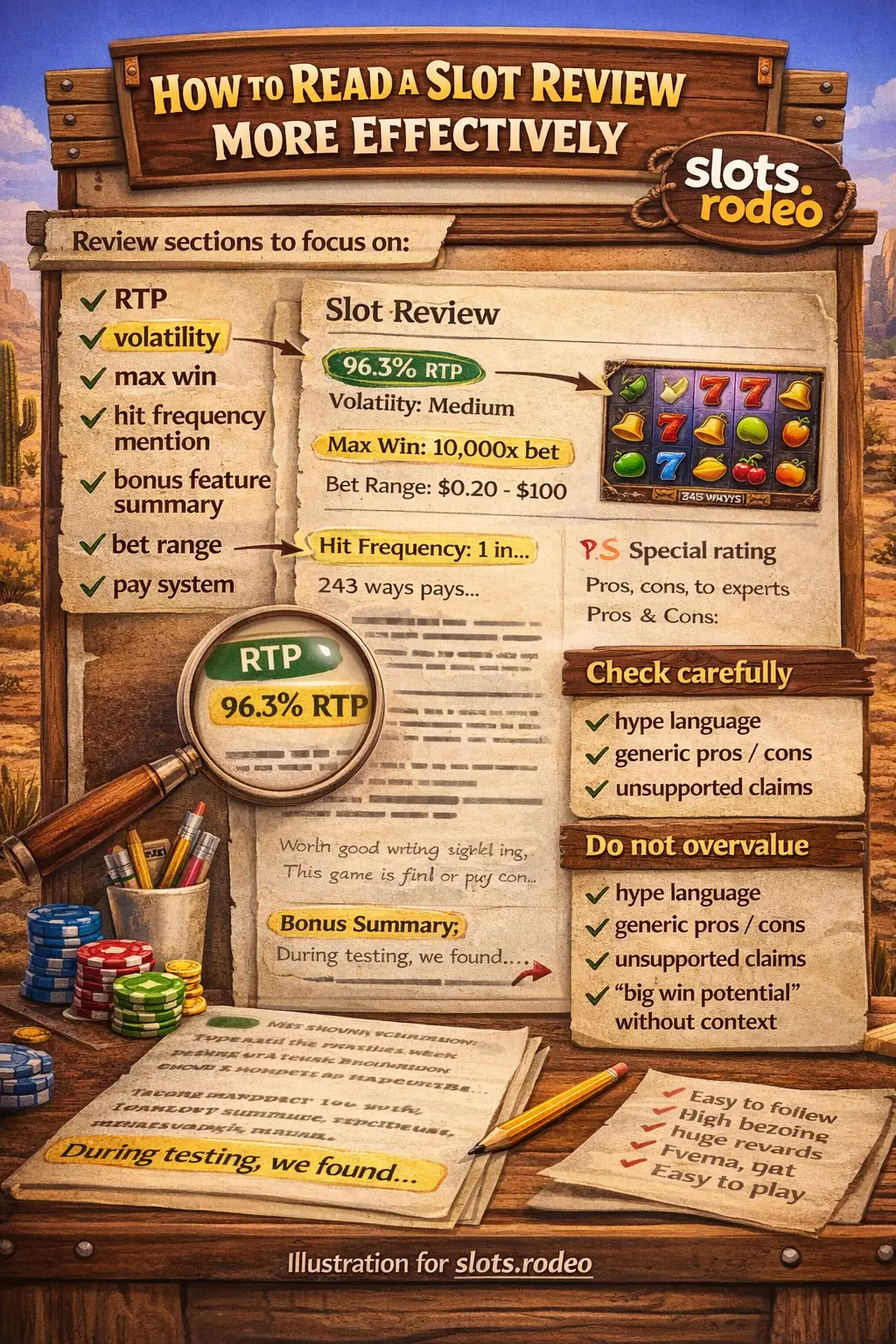
That usually means checking these areas first:
- RTP
- volatility
- max win
- bonus structure
- bet range
- pay system
- special mechanics that change win formation
These points tell you much more than a paragraph about graphics, soundtrack, or "immersive experience."
A good slot review should answer practical questions fast
A strong review should help you answer questions like these within the first part of the article:
| Question | Why it matters |
|---|---|
| What is the RTP? | Helps you understand the theoretical return setting being discussed |
| What is the volatility level? | Gives context for session swings and bankroll pressure |
| What is the max win? | Shows the game's published upside, even if it says nothing about short-term outcomes |
| How do wins form? | Confirms whether the slot uses paylines, ways, or clusters |
| What triggers the bonus? | Helps you see where much of the game's value may sit |
| What is the bet range? | Tells you whether the slot matches your session budget |
| Are there multiple RTP versions? | Important when the same title may differ across casinos |
What is the RTP?
Why it matters
Helps you understand the theoretical return setting being discussed
What is the volatility level?
Why it matters
Gives context for session swings and bankroll pressure
What is the max win?
Why it matters
Shows the game's published upside, even if it says nothing about short-term outcomes
How do wins form?
Why it matters
Confirms whether the slot uses paylines, ways, or clusters
What triggers the bonus?
Why it matters
Helps you see where much of the game's value may sit
What is the bet range?
Why it matters
Tells you whether the slot matches your session budget
Are there multiple RTP versions?
Why it matters
Important when the same title may differ across casinos
If a review takes too long to answer these, it is harder to use for comparison.
RTP is useful, but only when it is handled properly
One of the first things to check is how the review presents RTP.
A useful RTP section should do at least one of these:
- state the RTP clearly
- explain that multiple RTP versions may exist
- show where the RTP figure comes from
- avoid treating RTP like a promise for one session
That last point matters. A review becomes weaker when it uses RTP as if it predicts what the player should expect in a short run. RTP is a long-term theoretical measure, not a session forecast.
So when reading a review, check whether RTP is being used carefully or just dropped in as a number without context.
Volatility tells you more about session feel than many review intros do
A review intro often says a game is "exciting" or "balanced," but those words are vague. Volatility is usually more useful.
If the review states that a slot is high volatility, that gives you a much clearer signal than general praise. It suggests that stronger outcomes may be less frequent and that the session may place more pressure on the bankroll.
If it says low or medium volatility, that helps you understand whether the game may feel steadier.
A good review does not just name the volatility level. It connects it to what that means in practical terms.
| Review wording | More useful interpretation |
|---|---|
| "High volatility" | Bigger swings and longer weak stretches may happen |
| "Medium volatility" | More mixed session pattern |
| "Low volatility" | Smaller swings and steadier pacing are more likely |
| "Exciting gameplay" | Too vague on its own |
| "Great winning potential" | Too vague unless tied to max win, volatility, or bonus design |
"High volatility"
More useful interpretation
Bigger swings and longer weak stretches may happen
"Medium volatility"
More useful interpretation
More mixed session pattern
"Low volatility"
More useful interpretation
Smaller swings and steadier pacing are more likely
"Exciting gameplay"
More useful interpretation
Too vague on its own
"Great winning potential"
More useful interpretation
Too vague unless tied to max win, volatility, or bonus design
Bonus structure often matters more than theme
Many reviews spend a lot of space on visual style, but the bonus structure is usually the part that matters more for game comparison.
Check whether the review explains:
- what triggers free spins or bonus rounds
- whether there are multipliers
- whether features are frequent or rare
- whether value is concentrated in one main feature
- whether a bonus buy option exists
This helps you understand whether the slot is feature-active throughout the session or heavily dependent on one bonus event.
That is more useful than long sections describing symbols one by one unless those symbols directly explain a mechanic.
Learn to separate useful review signals from filler
Not everything in a slot review deserves the same attention.
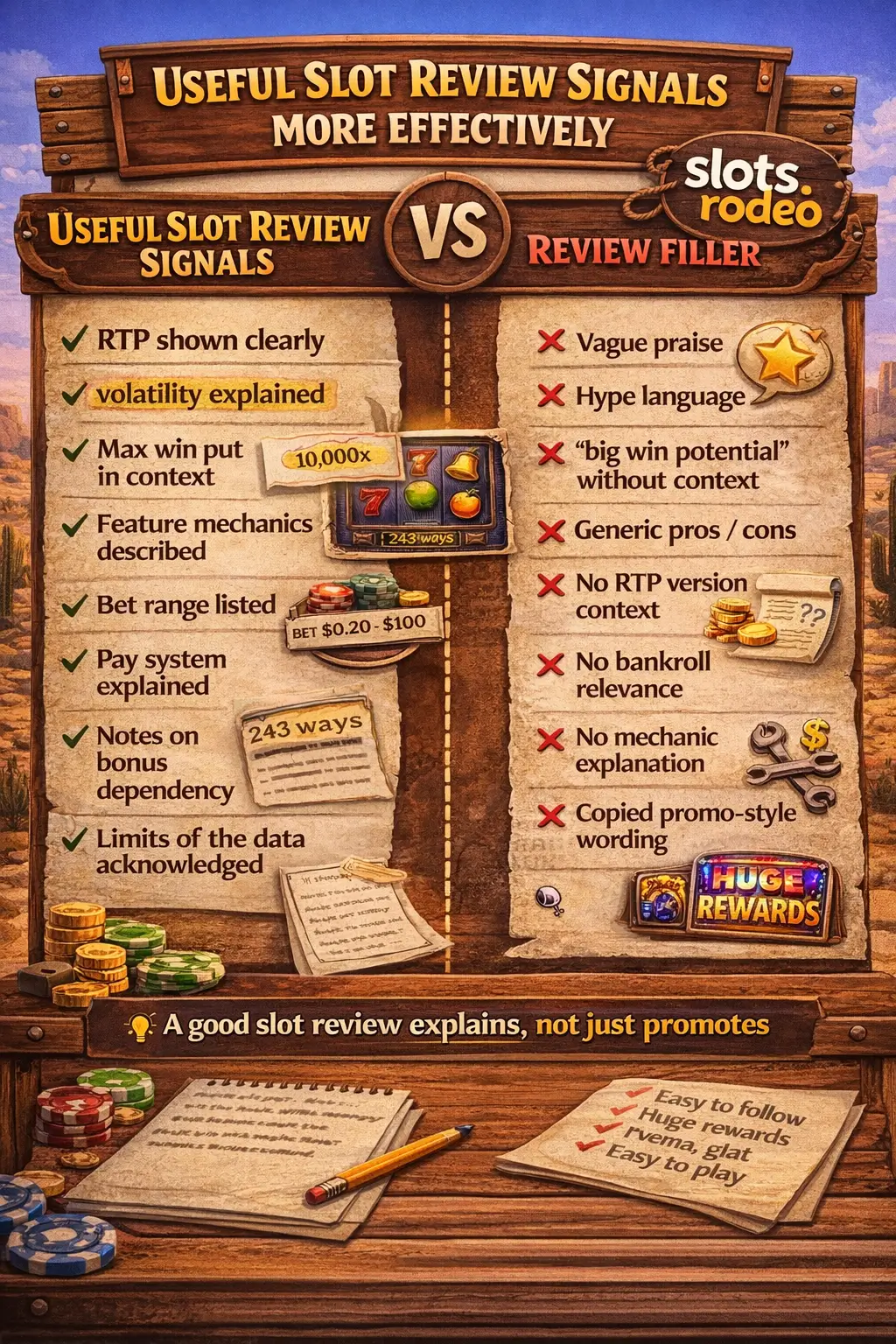
Here is a simple way to separate strong signals from weaker material:
| Useful review signals | Review filler or weak signals |
|---|---|
| RTP with context | "This slot is amazing" |
| Volatility label | "Beautiful graphics" without gameplay relevance |
| Max win figure | Repeated praise without explanation |
| Clear bonus explanation | Long theme summary |
| Bet range | Generic claims about big wins |
| Pay system explanation | Empty phrases like "must-play title" |
| Mention of multiple RTP versions | Unclear statements about "hot" or "cold" games |
RTP with context
Review filler or weak signals
"This slot is amazing"
Volatility label
Review filler or weak signals
"Beautiful graphics" without gameplay relevance
Max win figure
Review filler or weak signals
Repeated praise without explanation
Clear bonus explanation
Review filler or weak signals
Long theme summary
Bet range
Review filler or weak signals
Generic claims about big wins
Pay system explanation
Review filler or weak signals
Empty phrases like "must-play title"
Mention of multiple RTP versions
Review filler or weak signals
Unclear statements about "hot" or "cold" games
This does not mean theme and presentation are worthless. They just do not help much when your goal is to compare slot structure.
The best review sections for comparing two slots
When you are using reviews to compare games, focus on sections that stay measurable.
The most useful comparison points are usually:
- RTP
- volatility
- max win
- bonus structure
- bet range
- win system
- feature mechanics
These points make it easier to compare two reviews side by side without getting lost in tone or writing style.
For example, if one review explains that most value comes from a volatile free spins round and another shows more frequent smaller feature activity, you already know something meaningful about the difference between those games.
Watch for terms that sound strong but say very little
Some review language looks useful at first, but has low value unless the review explains it properly.
These terms deserve extra caution:
- "high winning potential"
- "big payouts"
- "frequent wins"
- "balanced gameplay"
- "player-friendly"
- "rewarding bonus round"
These phrases are not automatically wrong, but they are incomplete. A useful review should support them with facts such as volatility, hit frequency discussion, bonus mechanics, or max win data.
If the explanation never arrives, the phrase is doing more promotional work than analytical work.
A short reading order that works well
When reading a slot review, this order usually gives the fastest practical picture:
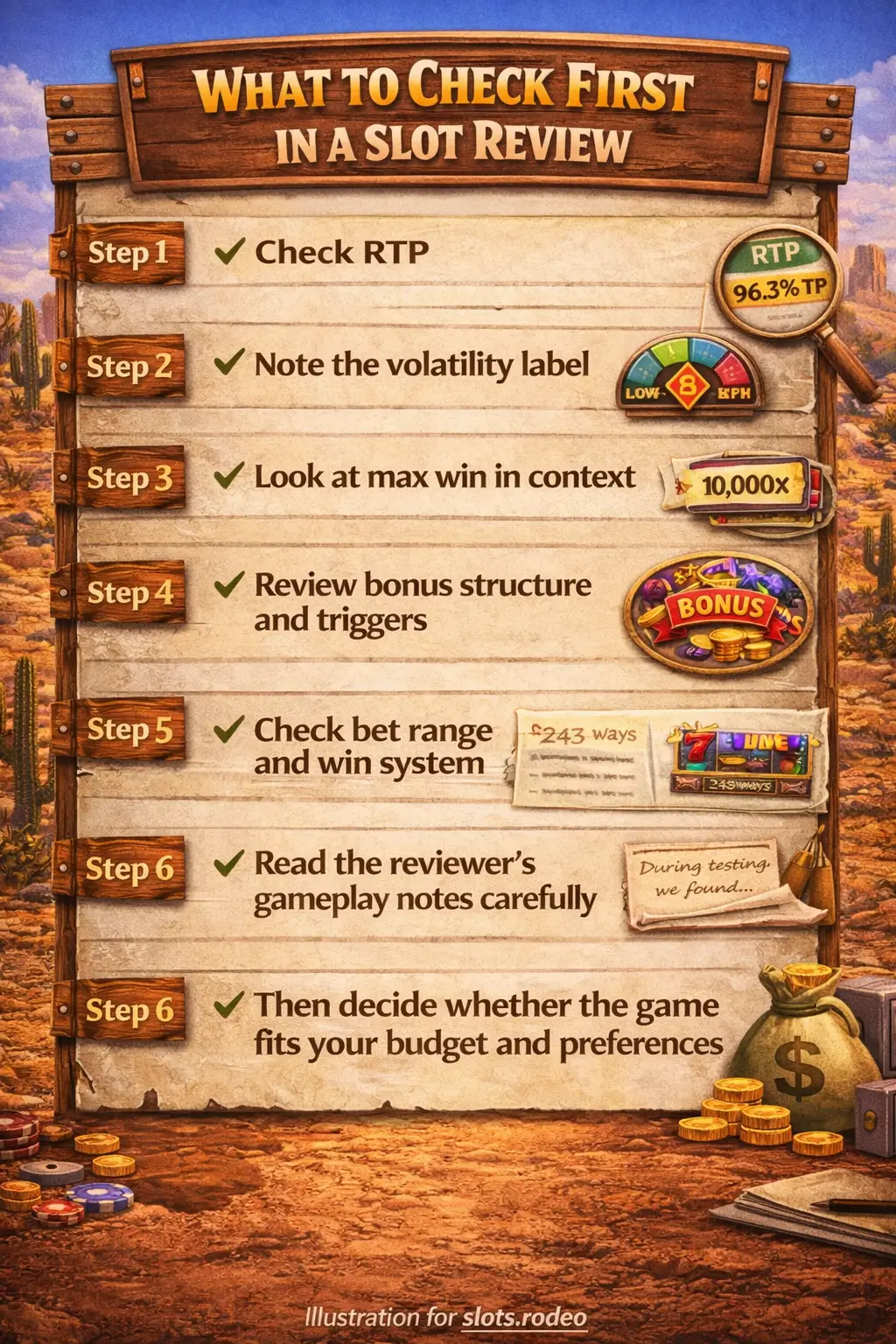
1. Check the data block
Look for RTP, volatility, max win, reels, rows, paylines or ways, and bet range.
2. Read the bonus section
See how the main features work and where the game's value seems to sit.
3. Check how wins are formed
Confirm whether it is a fixed-payline slot, ways-to-win slot, cluster game, or another format.
4. Review any note about RTP versions
This matters if the review acknowledges that casinos may run the same game under different return settings.
5. Treat theme and design as secondary
Useful for preference, but weaker for structural comparison.
What a trustworthy slot review usually gets right
A stronger review usually has these qualities:
- it separates facts from opinion
- it explains what the numbers mean
- it avoids pretending that short sessions can confirm RTP
- it describes bonus structure clearly
- it does not use vague praise as a substitute for analysis
- it helps the reader compare the game with other slot types
That does not mean the review has to be long. It means the important information is easy to find and easy to use.
Read a slot review like a comparison document
The most effective way to use a slot review is to read it like a structured comparison document.
You are not mainly looking for hype, theme summary, or broad recommendations. You are looking for answers to practical questions:
- How is the slot built?
- What numbers matter here?
- Where does the feature value sit?
- How might the session feel?
- Does this structure fit what I want?
Once you read reviews that way, it becomes much easier to ignore filler and focus on the parts that actually help you choose between games.

