

Comparing two slot games sounds simple, but many players do it the wrong way.
A common mistake is to compare only one number, such as RTP, max win, or hit frequency, and treat that as the full answer. That approach is incomplete. Two slots can share one similar metric and still behave very differently in practice.
A useful comparison should look at the game as a full structure: how wins are formed, where most value sits, how features work, and what the short-session experience is likely to feel like.
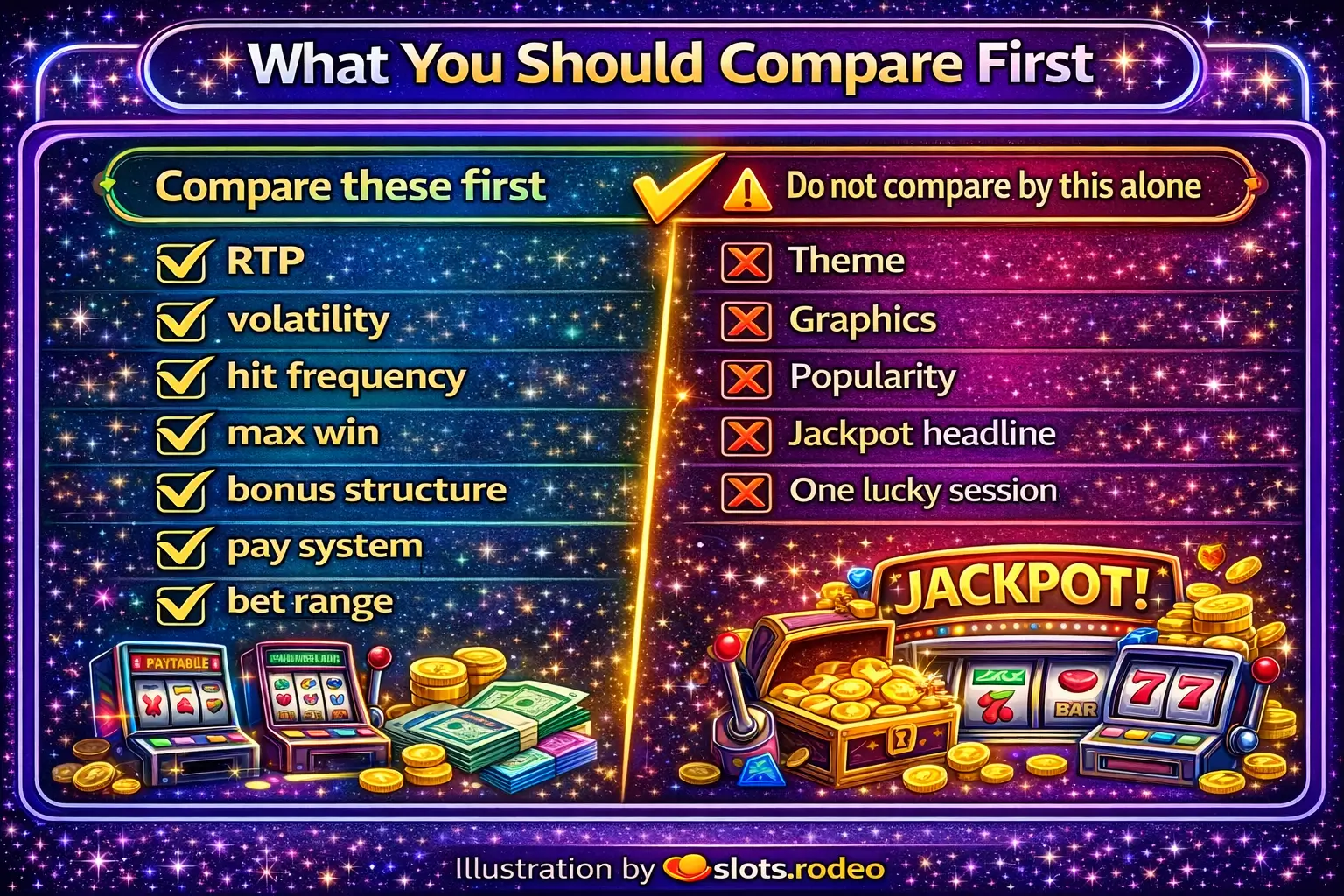
Why most slot comparisons go wrong
Many quick comparisons fail because they rely on one visible metric.
For example:
- Slot A has higher RTP, so it must be better
- Slot B has bigger max win, so it must be stronger
- Slot A hits more often, so it must be safer
- Slot B has more features, so it must pay better
These conclusions are too simple.
A slot is not defined by one headline figure. It is defined by how several parts work together:
- RTP
- volatility
- hit frequency
- max win
- win system
- bonus structure
- feature dependence
- symbol and payout balance
That is why two slots should be compared as systems, not as single numbers.
Start with the game structure, not the headline number
Before comparing any stats, check what kind of slots you are actually looking at.
Ask:
- do both games use paylines, ways to win, or cluster pays?
- are both fixed-structure slots or does one use Megaways?
- do both rely heavily on free spins?
- is one more base-game-driven while the other is bonus-driven?
- are both built around similar feature depth?
If the structure is very different, the same metric may not mean the same thing in practice.
For example, two slots may both list 96% RTP, but one may return more through small base-game wins while the other may hold more value inside a less frequent bonus round.
What you should compare first
The best starting point is the core design profile.
| Comparison point | Why it matters |
|---|---|
| Win system | Tells you how wins are formed |
| RTP | Shows long-term theoretical return |
| Volatility | Helps explain payout distribution |
| Feature structure | Shows where much of the game's value sits |
| Max win | Shows top payout ceiling |
| Hit frequency | Helps explain session rhythm |
| Bonus dependence | Shows whether the game relies heavily on feature access |
Win system
Why it matters
Tells you how wins are formed
RTP
Why it matters
Shows long-term theoretical return
Volatility
Why it matters
Helps explain payout distribution
Feature structure
Why it matters
Shows where much of the game's value sits
Max win
Why it matters
Shows top payout ceiling
Hit frequency
Why it matters
Helps explain session rhythm
Bonus dependence
Why it matters
Shows whether the game relies heavily on feature access
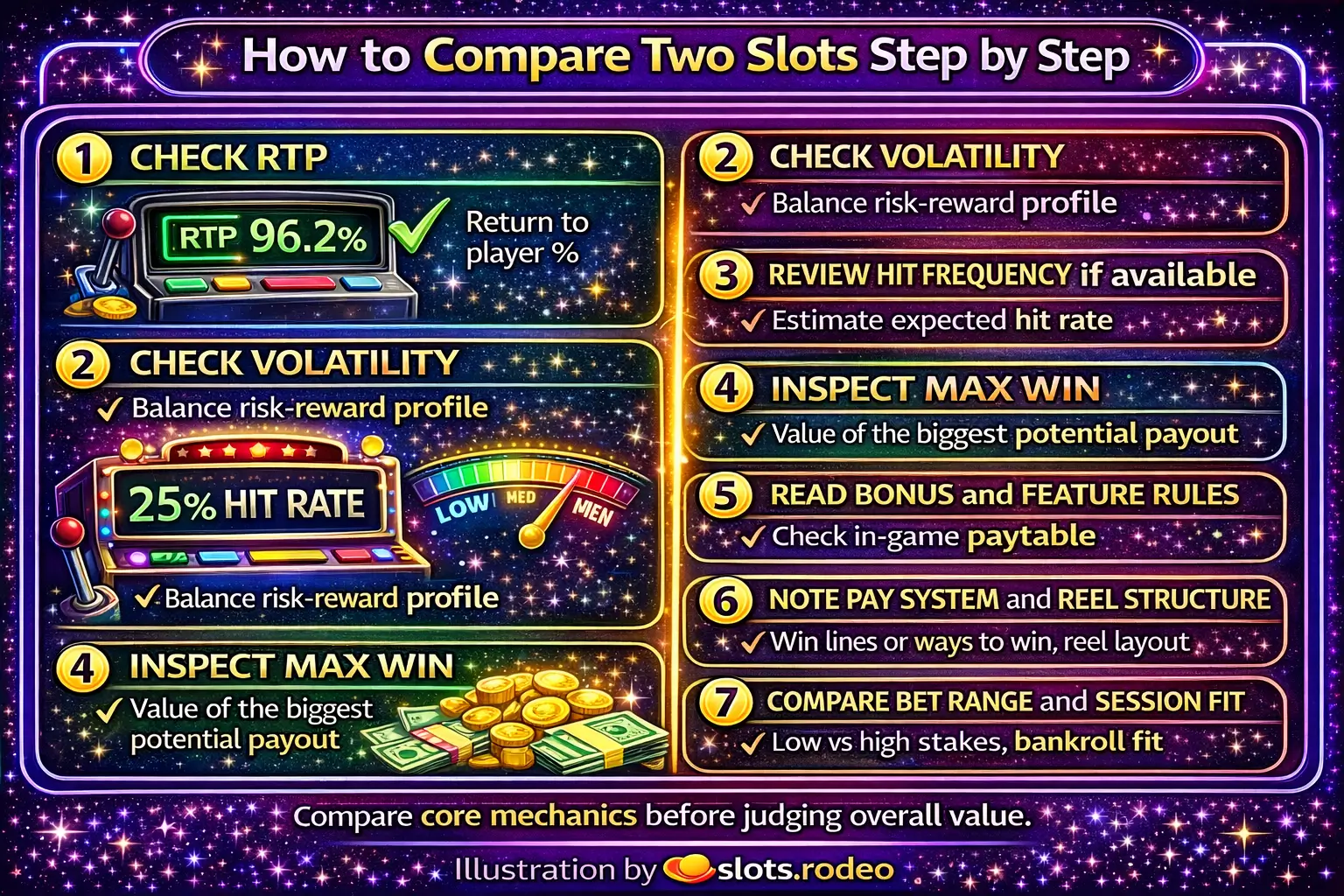
Step 1: Compare the win system
Before looking at payout figures, compare how each slot forms wins.
Possible systems include:
- fixed paylines
- ways to win
- Megaways
- cluster pays
This matters because the reel screen is interpreted differently in each system.
Questions to ask:
- does the slot use preset line patterns?
- does it count consecutive reels?
- does it use connected groups?
- does reel height change every spin?
If Slot A uses fixed paylines and Slot B uses Megaways, they may feel different even before you compare any other metric.
Step 2: Compare RTP, but read it correctly
RTP is useful, but only in its proper place.
When comparing RTP:
- check the exact RTP version, not a general reputation number
- remember RTP is long-term theoretical return
- do not treat a small RTP gap as the whole comparison
- do not use RTP as a short-session prediction
Example:
| Slot | RTP |
|---|---|
| Slot A | 96.1% |
| Slot B | 95.8% |
Slot A
RTP
96.1%
Slot B
RTP
95.8%
That difference matters, but it does not tell you everything. Slot A may still feel harsher in short play if its value sits deeper in bonus features or more uneven outcomes.
RTP should be part of the comparison, not the entire comparison.
Step 3: Compare volatility
Volatility helps explain how the slot distributes value.
Questions to ask:
- does the slot tend to spread value across smaller returns?
- does it put more value into fewer stronger outcomes?
- does it rely on occasional large bonus hits?
- does the base game stay active, or can it feel quiet?
Two slots can have similar RTP and very different volatility profiles. That difference often matters more to the player's short-session experience than RTP alone.
A simple comparison might look like this:
| Slot | RTP | Volatility profile |
|---|---|---|
| Slot A | 96.0% | Medium |
| Slot B | 96.0% | High |
Slot A
RTP
96.0%
Volatility profile
Medium
Slot B
RTP
96.0%
Volatility profile
High
Same RTP, different ride.
Step 4: Compare where the value sits
This is one of the most useful checks and one of the most ignored.
Ask where the slot seems to place most of its practical value:
- base game
- free spins
- bonus round
- multiplier feature
- jackpot layer
- cascading build-up
- symbol upgrade mechanics
If Slot A returns more through base-game hits and Slot B depends on feature triggers, the sessions may feel very different even when other metrics look similar.
This is often the real reason players describe two slots differently.
Step 5: Compare free spins and bonus structure
Many modern slots place a large share of their identity inside the feature.
Important questions:
- how are free spins triggered?
- how many spins are awarded?
- are retriggers possible?
- do multipliers apply in the feature?
- does the bonus change symbol behavior?
- is there one bonus mode or several variants?
A slot with simple free spins is different from a slot where free spins add sticky wilds, rising multipliers, or mode selection.
That difference should be part of the comparison.
Step 6: Compare max win, but do not overrate it
Max win matters because it shows the payout ceiling.
But it should be read carefully.
A slot with 50,000x max win is not automatically a better slot than one with 5,000x max win. It simply has a higher top-end ceiling.
Questions to ask:
- is the max win tied to rare feature conditions?
- does the slot need stacked multipliers to get there?
- is the game clearly top-heavy?
- is the max win realistic only under near-perfect conditions?
Max win is useful for understanding upside range, but it says very little about normal play on its own.
Step 7: Compare hit rhythm, not just hit count
If hit frequency information is available, use it to understand how the sessions may feel.
Ask:
- does the slot produce frequent small wins?
- are losing streaks likely to feel longer?
- does the game return many partial hits?
- do wins appear often but stay small?
This matters because a slot that "hits often" may still have weak average returns per winning spin.
So when comparing hit frequency, always keep it tied to payout size and feature structure.
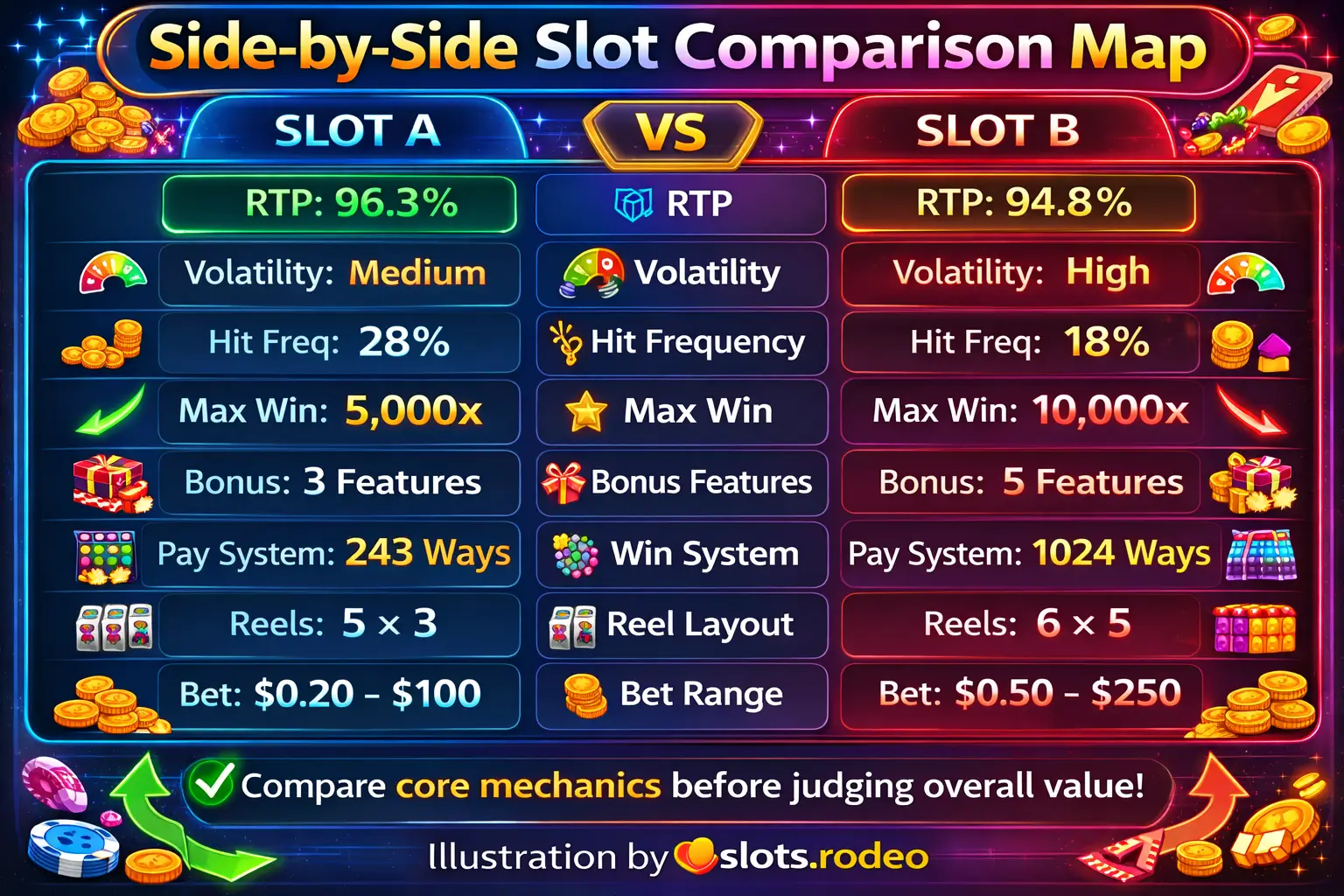
Side-by-side comparison map
A useful comparison often works best in a table.
| Comparison area | Slot A | Slot B | What to watch |
|---|---|---|---|
| Win system | Fixed paylines | Megaways | Structure changes how wins are formed |
| RTP | 96.1% | 95.8% | Small edge to Slot A, but not enough alone |
| Volatility | Medium | High | Slot B may feel harsher but more top-heavy |
| Feature focus | Balanced | Bonus-heavy | Slot B may depend more on feature access |
| Max win | 5,000x | 20,000x | Slot B has higher ceiling, not necessarily better average results |
| Session feel | More stable | More uneven | Depends on player preference |
Win system
Slot A
Fixed paylines
Slot B
Megaways
What to watch
Structure changes how wins are formed
RTP
Slot A
96.1%
Slot B
95.8%
What to watch
Small edge to Slot A, but not enough alone
Volatility
Slot A
Medium
Slot B
High
What to watch
Slot B may feel harsher but more top-heavy
Feature focus
Slot A
Balanced
Slot B
Bonus-heavy
What to watch
Slot B may depend more on feature access
Max win
Slot A
5,000x
Slot B
20,000x
What to watch
Slot B has higher ceiling, not necessarily better average results
Session feel
Slot A
More stable
Slot B
More uneven
What to watch
Depends on player preference
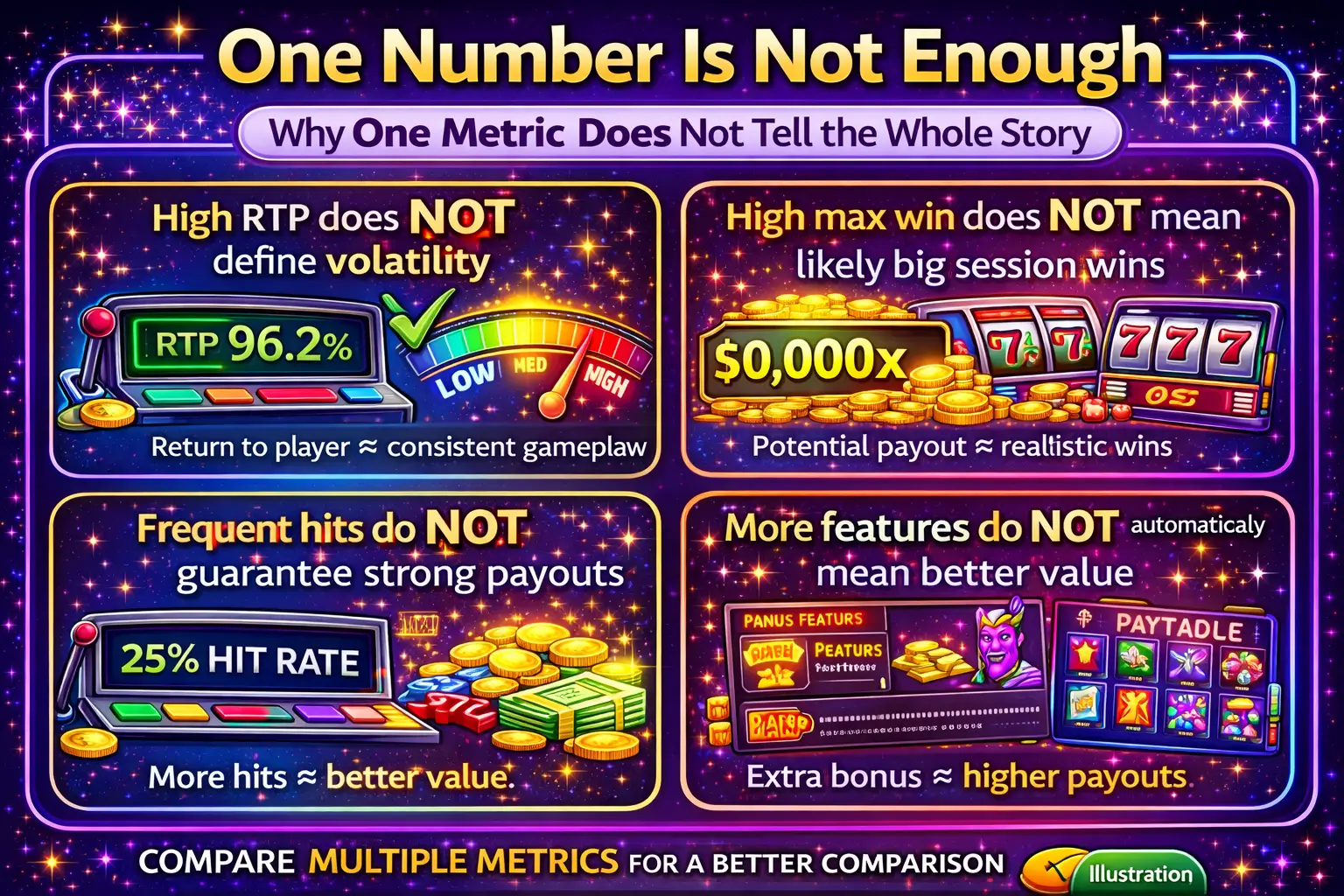
One number is not enough
This is the core rule.
No single number can fully compare two slots.
Here is why:
| Metric | Useful for | Not enough for |
|---|---|---|
| RTP | Long-term return comparison | Session feel, bonus timing, volatility |
| Volatility | Payout distribution style | Exact return value |
| Hit frequency | Win rhythm | Average payout quality |
| Max win | Ceiling comparison | Typical outcomes |
| Bonus feature depth | Feature profile | Full math model |
RTP
Useful for
Long-term return comparison
Not enough for
Session feel, bonus timing, volatility
Volatility
Useful for
Payout distribution style
Not enough for
Exact return value
Hit frequency
Useful for
Win rhythm
Not enough for
Average payout quality
Max win
Useful for
Ceiling comparison
Not enough for
Typical outcomes
Bonus feature depth
Useful for
Feature profile
Not enough for
Full math model
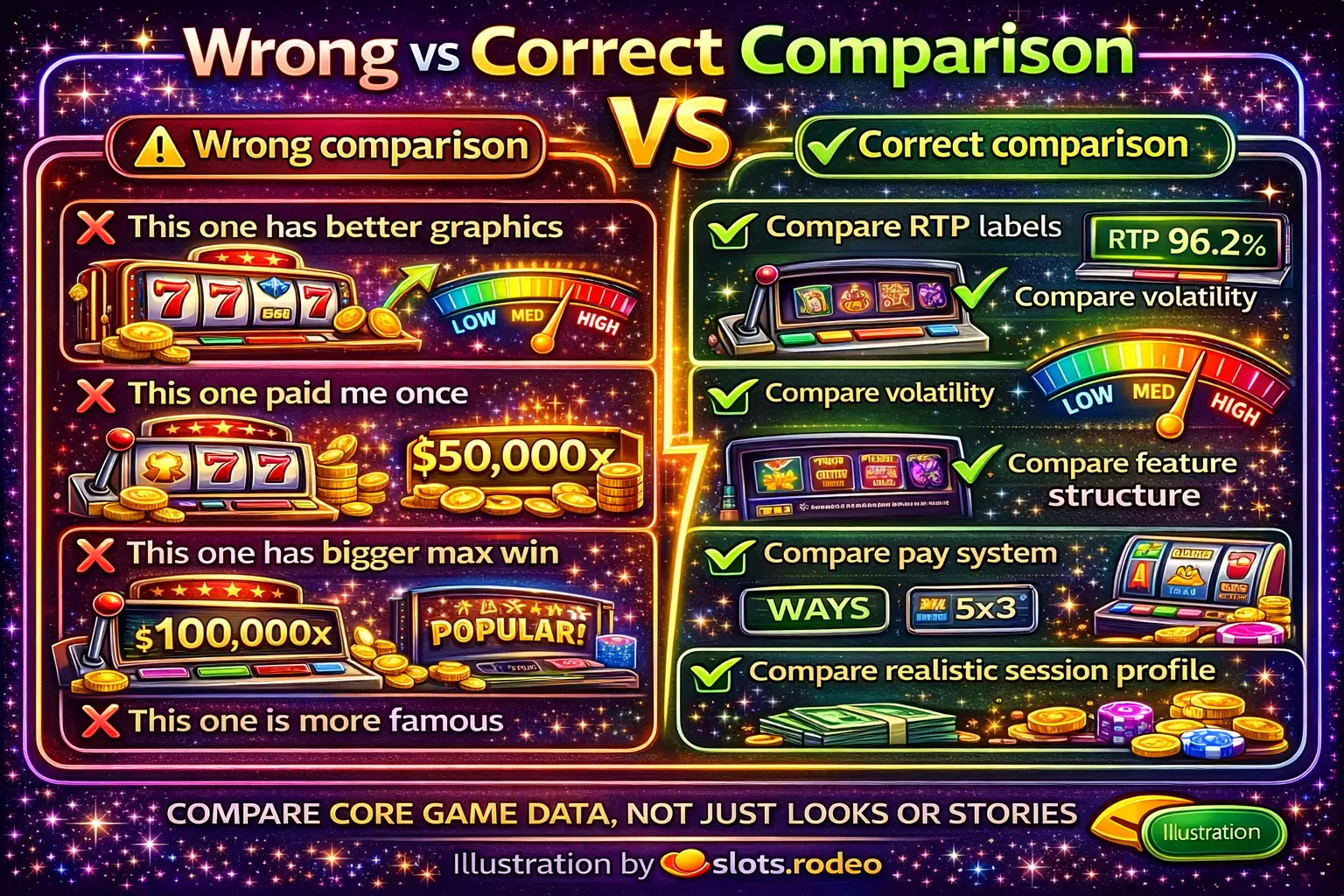
Wrong comparison vs correct comparison
A poor comparison sounds like this:
- Slot A has 96.2% RTP, so it is better than Slot B at 95.9%
- Slot B has 25,000x max win, so it is stronger than Slot A
- Slot A has more features, so it should pay more often
A better comparison sounds like this:
- Slot A has slightly higher RTP
- Slot B has a higher max win ceiling
- Slot A looks more base-game-active
- Slot B seems more bonus-dependent
- Slot A may feel steadier
- Slot B may feel more top-heavy
That is a real comparison, because it respects structure instead of collapsing everything into one metric.
Questions that help compare two slots properly
When comparing two games, ask these practical questions:
- Do both slots use the same win system?
- Is one more bonus-heavy than the other?
- Is the RTP gap meaningful or small?
- Does one slot clearly have higher volatility?
- Is one slot built around larger top-end potential?
- Does one feel more active in the base game?
- Does one rely more on free spins, multipliers, or jackpot logic?
These questions usually tell you more than one raw number ever will.
A simple comparison example
Imagine two slots:
Slot A
- 96.2% RTP
- medium volatility
- fixed paylines
- 5,000x max win
- active base game
- standard free spins
Slot B
- 96.0% RTP
- high volatility
- Megaways
- 20,000x max win
- quieter base game
- stronger feature multipliers
A weak reading would say Slot A is better because it has higher RTP.
A better reading would say:
- Slot A has a slight return edge
- Slot B has a higher ceiling
- Slot A may feel steadier
- Slot B may rely more on feature spikes
- they are built for different session profiles
That is the correct way to compare them.
Common mistakes when comparing two slots
Comparing only RTP
Useful, but incomplete.
Comparing only max win
Shows ceiling, not normal behavior.
Ignoring the win system
The structure of wins shapes the whole game.
Treating more features as automatically better
More mechanics do not guarantee stronger value.
Forgetting where the slot's value sits
Bonus-heavy and base-game-heavy slots can feel completely different.
Comparing different RTP versions by mistake
The same slot title can exist in different RTP configurations.
What a good slot comparison should achieve
A good comparison should help answer these questions:
- which slot has the higher theoretical return?
- which one feels more stable or more uneven?
- which one is more feature-driven?
- which one has the higher payout ceiling?
- which one is easier to read and understand?
- which one better matches the type of session you want to evaluate?
That is much more useful than simply naming one slot "better."
FAQ
Common questions about this topic.
There is no single most important metric. RTP, volatility, win system, feature structure, and max win should be read together.
No. RTP is useful, but it does not explain session feel, volatility, feature dependence, or payout ceiling.
No. Max win helps show the ceiling, but it says little about typical play by itself.
Because paylines, Megaways, ways to win, and cluster pays all form wins differently, which changes how the game behaves.
Yes. They can differ in volatility, bonus dependence, feature design, and win structure.


