

A slot can look good and still be the wrong fit for the way you want to play.
Some games are easier to read because the layout stays stable. Some feel more active because features appear more often. Others are chosen for higher payout potential, even though they may have longer quiet stretches between stronger outcomes.
So the useful question is not "which slot is best?" It is "which slot fits the kind of session I want?"
This guide is about matching slot structure to player preference. It does not predict outcomes. It helps you choose a game style that makes sense before you start.
Pick the thing that matters most to you first
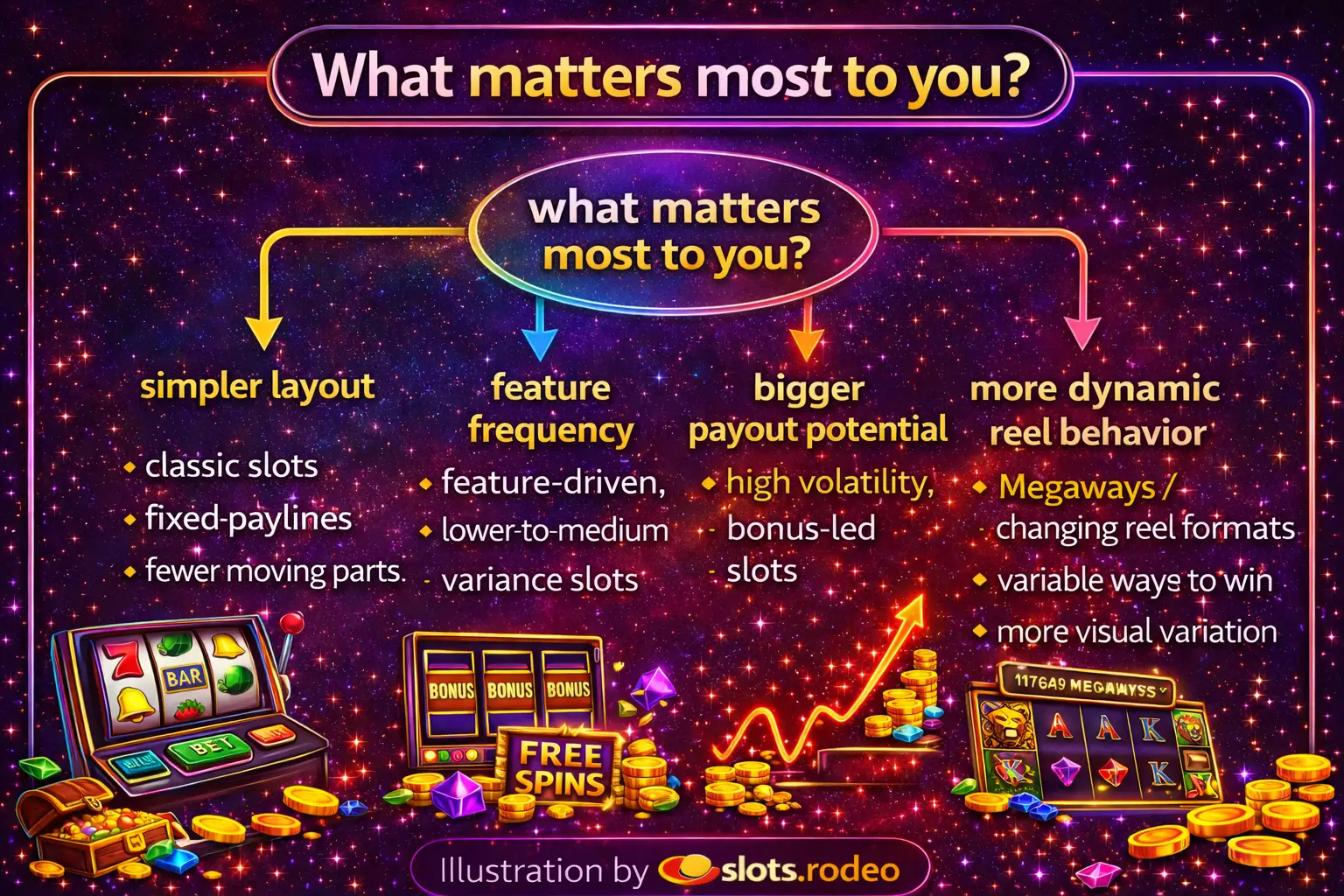
Before comparing titles, decide what you care about most during a session.
For many players, it is one of these:
- a layout that is simple and easy to follow
- features that show up more often
- higher payout potential
- a steadier session feel
- more movement and changing reel behavior
That one choice already removes a lot of bad matches.
What the main slot styles usually feel like
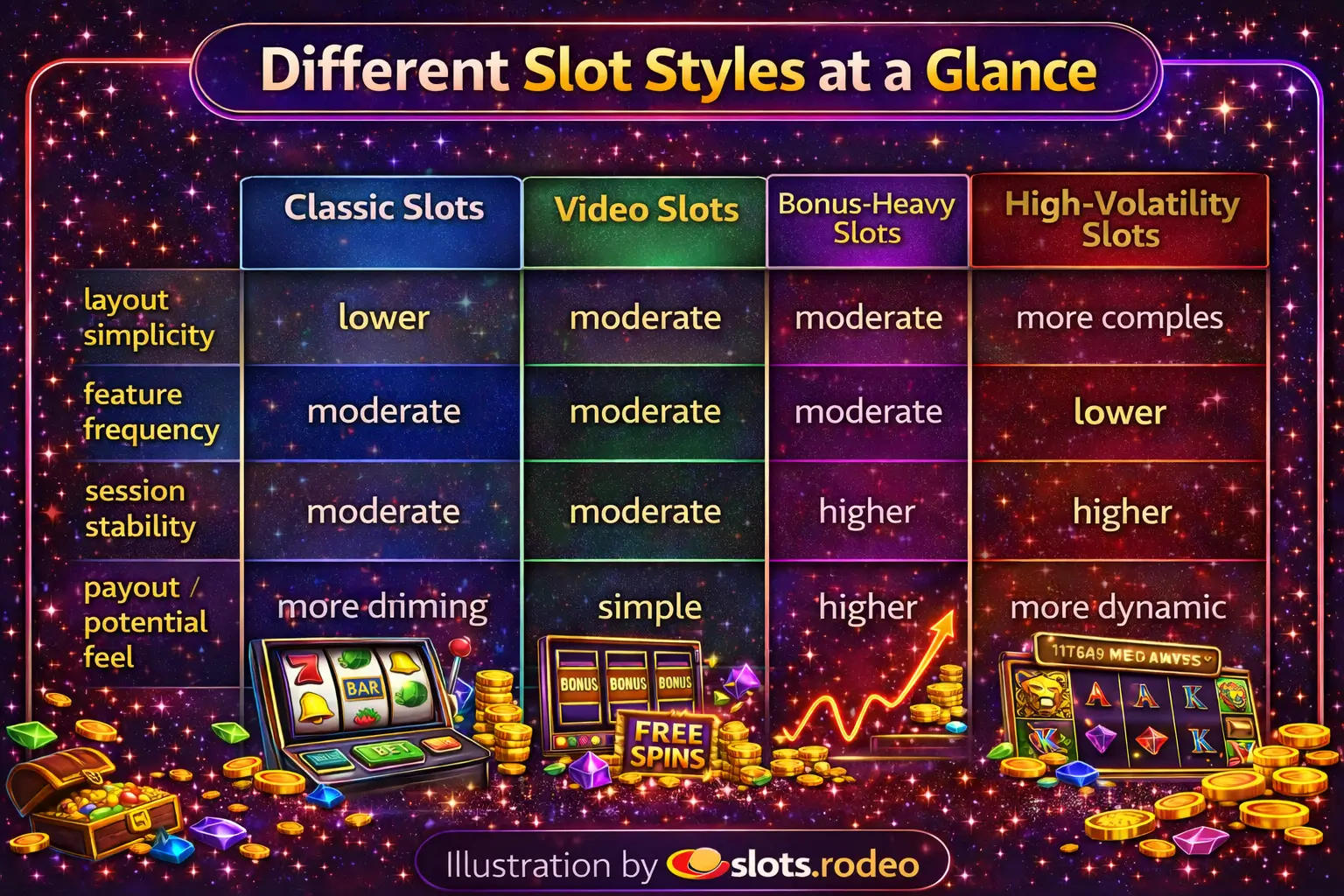
There is no single official system for grouping slots, but for practical use, these broad categories are enough to make better choices.
| Slot style | Usual feel | Why some players choose it | Main trade-off |
|---|---|---|---|
| Classic-style slots | Simple, stable, easy to read | Clear reel behavior and less visual noise | Usually less variety in features |
| Standard video slots | Familiar modern format with bonus features | Balanced mix of theme, structure, and features | Can differ a lot from one title to another |
| Low-to-medium volatility slots | Smoother session pacing | Smaller events may appear more often | Top-end upside is often lower |
| High-volatility slots | Swingier session pattern | Bigger payout potential | Longer dry stretches can happen |
| Megaways or variable-layout slots | Reel structure may change often | More dynamic spin-to-spin behavior | Harder for beginners to track |
| Cluster or cascade-focused slots | Chain reactions and board changes | More active session feel | Layout logic may be less intuitive |
Classic-style slots
Usual feel
Simple, stable, easy to read
Why some players choose it
Clear reel behavior and less visual noise
Main trade-off
Usually less variety in features
Standard video slots
Usual feel
Familiar modern format with bonus features
Why some players choose it
Balanced mix of theme, structure, and features
Main trade-off
Can differ a lot from one title to another
Low-to-medium volatility slots
Usual feel
Smoother session pacing
Why some players choose it
Smaller events may appear more often
Main trade-off
Top-end upside is often lower
High-volatility slots
Usual feel
Swingier session pattern
Why some players choose it
Bigger payout potential
Main trade-off
Longer dry stretches can happen
Megaways or variable-layout slots
Usual feel
Reel structure may change often
Why some players choose it
More dynamic spin-to-spin behavior
Main trade-off
Harder for beginners to track
Cluster or cascade-focused slots
Usual feel
Chain reactions and board changes
Why some players choose it
More active session feel
Main trade-off
Layout logic may be less intuitive
The category helps, but it is only a starting point. Two slots in the same broad group can still feel very different because of bonus weighting, symbol values, and feature design.
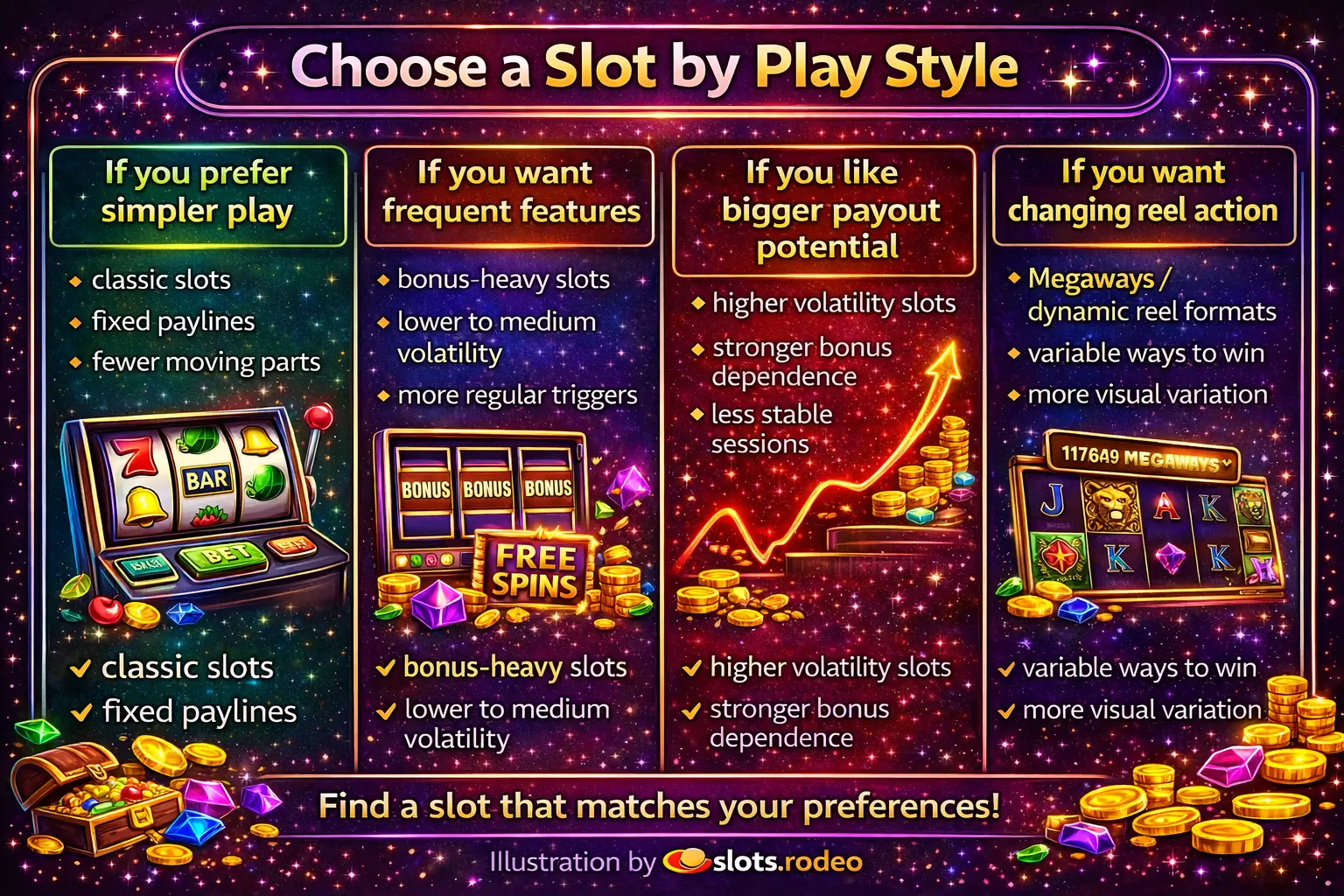
If you want something simple to follow
Some players do not want changing reel heights, multiple side meters, or several overlapping mechanics on one screen. They want to see a spin result and understand it immediately.
That usually makes these types more suitable:
- classic-style slots
- fixed-payline games
- standard video slots with clear bonus rules
- games with fewer modifiers on screen
These games are often better for newer players because the structure is easier to read. You spend less time decoding the interface and more time understanding whether the game actually suits you.
Simple does not mean outdated or weak. It just means the game places less emphasis on mechanical complexity.
If you care more about feature frequency
Some players mainly want the game to stay active. They want visible events, not just a long series of plain losing spins.
In practice, that can mean:
- cascades
- respins
- frequent modifier symbols
- side features outside the main bonus round
- lower-to-medium volatility profiles
But feature frequency needs to be read carefully. A game can trigger something often without that something being especially valuable. More activity does not automatically mean stronger results.
So if this is your priority, look for games where the features matter, not just games that make the screen busy.
If higher payout potential matters more
Some players accept a less stable session because they care more about upside.
These players often look at:
- high-volatility slots
- strong free spins rounds
- multiplier-heavy features
- large published max win figures
This style can make sense, but the trade-off is important. A slot with higher upside usually puts more of its value into rarer events. That can mean:
- longer periods without meaningful returns
- more bankroll pressure if bet size is too high
- a session that feels quiet until the right feature lands
So if you are choosing by payout potential, do not look at max win alone. Check whether the volatility and bonus structure match the kind of variance you are willing to sit through.
What to compare when you are choosing between two slots
Theme is usually the least useful comparison point. Structure matters more.
A quick practical check looks like this:
| What to compare | Why it matters |
|---|---|
| Layout type | A fixed layout is usually easier to follow than a changing one |
| Volatility label | Helps estimate whether the session may feel steadier or swingier |
| Bonus structure | Shows whether value is spread across small events or concentrated in rare features |
| Max win figure | Gives a rough idea of upside, but not how often strong outcomes happen |
| Feature mechanics | Helps you judge whether the game will feel calm, busy, simple, or layered |
| RTP version shown | Matters because the same slot can exist in more than one RTP configuration |
Layout type
Why it matters
A fixed layout is usually easier to follow than a changing one
Volatility label
Why it matters
Helps estimate whether the session may feel steadier or swingier
Bonus structure
Why it matters
Shows whether value is spread across small events or concentrated in rare features
Max win figure
Why it matters
Gives a rough idea of upside, but not how often strong outcomes happen
Feature mechanics
Why it matters
Helps you judge whether the game will feel calm, busy, simple, or layered
RTP version shown
Why it matters
Matters because the same slot can exist in more than one RTP configuration
This tells you much more than theme, branding, or whether the game "looks exciting."
Play-style matching examples
These examples are not rules, but they are useful shortcuts.
| Your preference | Slot styles that may fit better | Why |
|---|---|---|
| "I want something easy to read" | Classic slots, fixed-payline video slots | Stable layout and clearer win formation |
| "I want the game to do something more often" | Lower-to-medium volatility feature slots, cascade games | More visible events during the session |
| "I care more about bigger upside" | High-volatility bonus-led slots | More value may be concentrated in rarer events |
| "I do not like busy screens" | Simpler layouts with fewer modifiers | Lower visual and mental load |
| "I want more changing reel behavior" | Megaways and other variable-layout slots | Reel state can change from spin to spin |
"I want something easy to read"
Slot styles that may fit better
Classic slots, fixed-payline video slots
Why
Stable layout and clearer win formation
"I want the game to do something more often"
Slot styles that may fit better
Lower-to-medium volatility feature slots, cascade games
Why
More visible events during the session
"I care more about bigger upside"
Slot styles that may fit better
High-volatility bonus-led slots
Why
More value may be concentrated in rarer events
"I do not like busy screens"
Slot styles that may fit better
Simpler layouts with fewer modifiers
Why
Lower visual and mental load
"I want more changing reel behavior"
Slot styles that may fit better
Megaways and other variable-layout slots
Why
Reel state can change from spin to spin
Use these as a first filter, then check the rules screen and paytable before making the final choice.
What beginners often get wrong
One common mistake is choosing by theme alone. A slot can have a theme you like and still be a poor fit for your session preference.
Another mistake is assuming that more features always means a better game. In reality, extra mechanics can just make the slot noisier without improving the overall fit.
A third mistake is picking a high-upside game without adjusting expectations. Bigger payout potential often comes with less stable session flow. That is not a flaw. It is part of the design.
The better approach is simple:
- decide what kind of session you want
- check the slot structure
- compare the volatility label, features, and layout
- ignore claims based on streaks, luck patterns, or "due" outcomes
A better way to think about slot choice
Choosing a slot is mostly about choosing a session profile.
You are not selecting a machine that is ready to pay. You are selecting a game structure:
- simple or layered
- steady or swingy
- feature-active or bonus-dependent
- fixed or dynamic in layout
Once you look at it that way, the choice becomes much easier. The best slot for your play style is usually the one whose mechanics match what you actually want to see, follow, and tolerate during a session.

