

What You Can Control (and What You Can't)
Slots are games of chance. There is no strategy that can control or predict individual outcomes.
What you can't control:
- The outcome of the next spin (or any specific spin)
- "Hot" or "cold" streaks in a meaningful, predictable way
- When a jackpot will drop
- Whether a bonus triggers on a particular spin
What you can control:
- Which slot you play (type, features, volatility profile)
- Your total bet per spin
- Your session budget and time limits
- Whether you test a slot in demo mode first
- How much you rely on bonus-driven gameplay
A useful mindset: your "strategy" is not about beating the math - it's about choosing the right math for you and staying within limits you're comfortable with.
Choose a Slot That Matches Your Goal
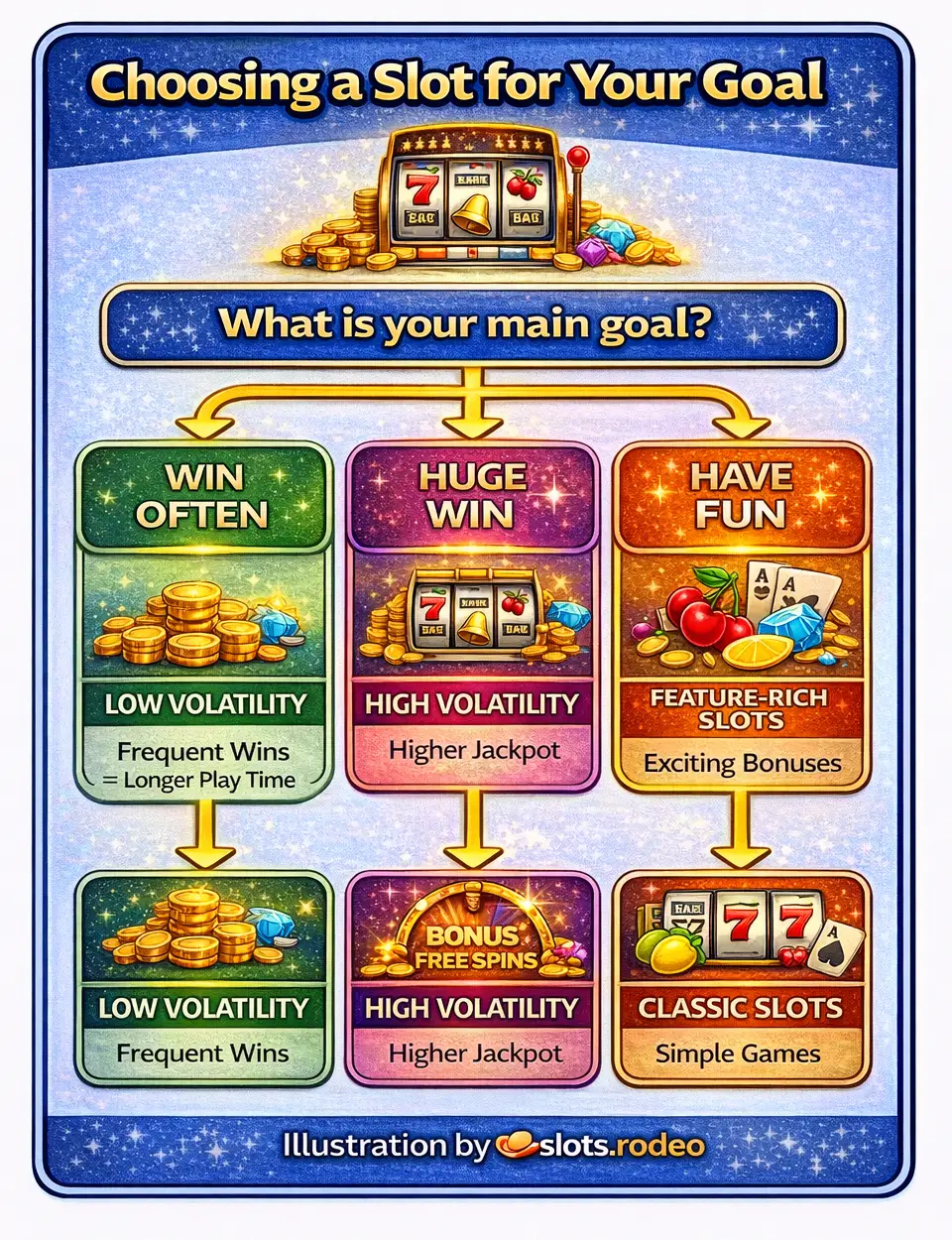
If your goal is "win more often"
Consider lower volatility slots, games with higher win frequency (hit rate) when shown, and less bonus dependency. This doesn't mean you will win overall - it usually means the session feels smoother with fewer long dry spells.
If your goal is "bigger upside"
Consider higher volatility slots, games known for large max-win ceilings, and feature-driven slots where the biggest outcomes happen inside bonuses. The trade-off: longer stretches without meaningful returns are normal.
If your goal is "feature-rich entertainment"
Consider slots with clear feature sets (Free Spins variants, respins, multipliers), Hold & Spin / bonus-focused formats, and games with straightforward feature rules you can verify in the paytable.
Use RTP and Volatility as Comparison Signals
RTP is best used as a long-run comparison tool: if two slots are similar in style, a higher displayed RTP can be a better long-run baseline. It does not predict your next session.
Volatility is best used as a session-feel filter: lower volatility tends to feel steadier; higher volatility tends to feel swingier.
When comparing two slots, ask:
- Is the RTP shown in the game (and are there multiple RTP versions)?
- Is volatility labeled (low/medium/high or similar)?
- Is the slot heavily bonus-driven?
- What's the max win (if shown), and does the game rely on rare big outcomes?
Read the Paytable Before You Commit Real Money
The paytable is where the slot tells you:
- how wins are counted (paylines/ways/cluster rules)
- what Wilds substitute for
- what triggers Free Spins or bonus rounds
- whether special rules apply in bonus mode (multipliers, sticky wilds, etc.)
- any key restrictions (reel limits, left-to-right only, etc.)
A one-minute paytable check prevents most common misunderstandings.
"Before You Spin" Checklist

- Read the paytable (win rules + feature triggers)
- Check RTP & volatility (if displayed)
- Set a session budget you're comfortable losing
- Test in demo mode if it's a new slot or unfamiliar rules
- Understand features (what triggers them and what changes inside them)
This doesn't improve odds. It improves decision quality.
Bankroll and Bet Sizing: Pacing Your Session
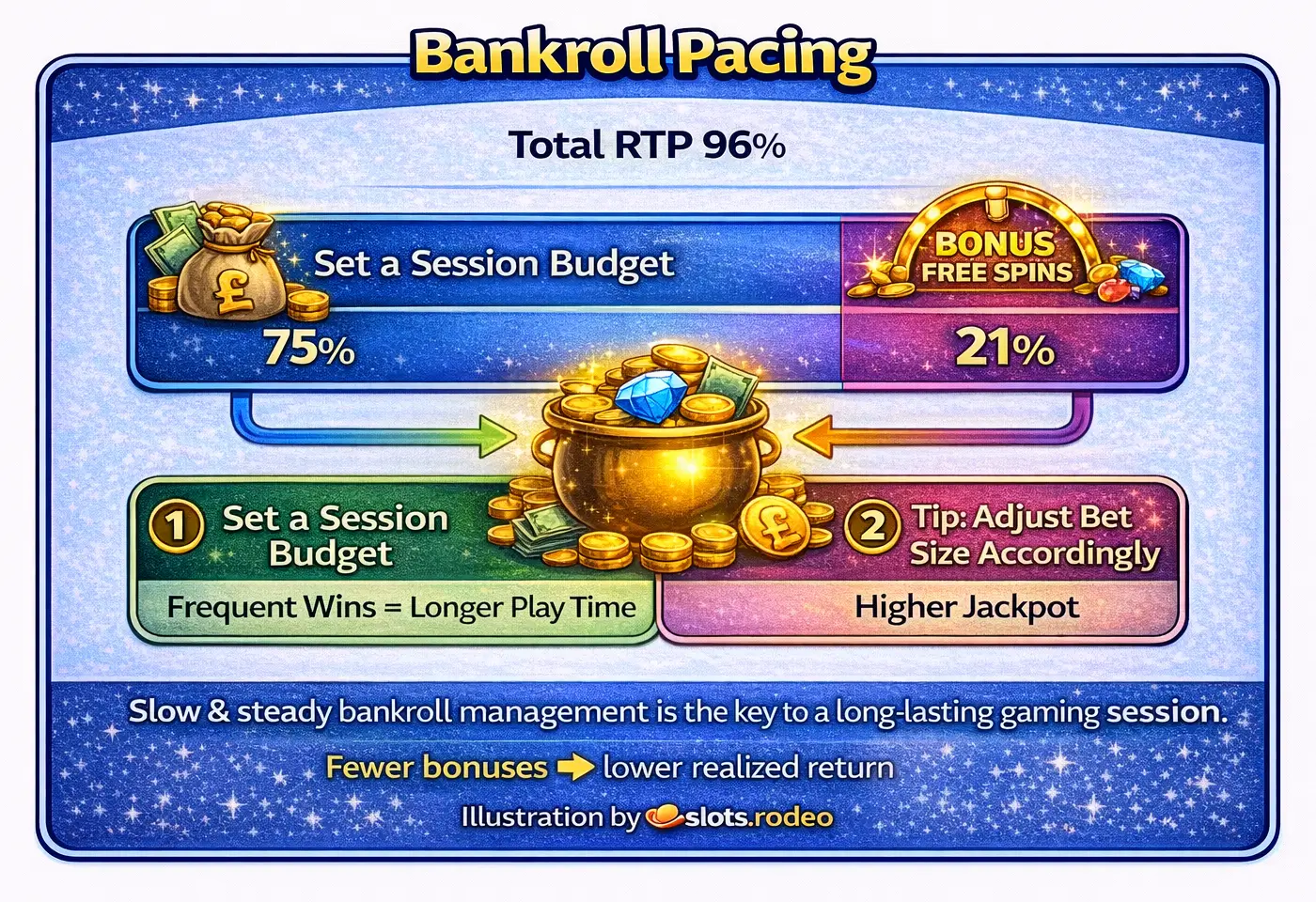
Set a session budget before you start
Define a number you're comfortable spending for entertainment. Then treat it as a hard boundary. Two boundaries that help: a loss limit (stop when reached) and a time limit (stop after a set duration).
Choose a bet size that fits your budget
- Smaller bet size = more spins for the same budget
- Larger bet size = fewer spins and larger swings
This is especially important in higher-volatility slots, where long dry spells are normal. Bet sizing is about controlling how quickly your budget can be consumed by variance - not about increasing win chances.
Avoid "chasing" with bet increases
Raising the bet to recover losses changes the size of swings - it doesn't create a predictable path back to even. If you adjust your bet at all, do it for pacing reasons, not because a slot is "due."
Bonus Features: Understand the Risk Shape
Many modern slots are "feature-first." The most exciting outcomes happen in Free Spins/bonus rounds, and a meaningful portion of returns can be concentrated in those features. This means:
- a session without bonuses can feel "worse" even if RTP is normal
- outcomes can become more variable if the bonus is a big part of the math
Treat bonus triggers as part of the experience, not as a goal you can force. Choose feature-heavy slots only if you're comfortable with the variance that comes with them.
Avoid Common Myths

- Myth: "The next spin is guaranteed to win."
Each spin is independent in RNG-based slots. You can't infer the next outcome from the previous one. - Myth: "Lucky time / hot streak."
There's no reliable timing pattern you can use to predict outcomes. Treat streaks as normal variance. - Myth: "Higher bet = higher chance."
In most slots, bet size primarily changes payout size and the cost per spin. It doesn't give a controllable probability edge. - Myth: "This slot is due to pay."
"Due" thinking leads to chasing. The only safe assumption is that variance is real and unpredictable in short sessions.
A Practical Strategy Framework
- Pick the right slot category - steadier sessions => lower volatility; high upside => higher volatility; feature entertainment => feature-rich games with clear rules.
- Confirm the rules in the paytable - pay system, symbol roles, feature triggers, restrictions, and bonus-mode changes.
- Use RTP and volatility for comparison - RTP for long-run baseline; volatility for expected session feel.
- Set limits and size your bet for pacing - budget and time limits first; bet size chosen to match session length and swing tolerance.
- Use demo mode as a learning tool - learn the win system, see how features trigger, check whether the slot's pace matches expectations. Not proof of future results.
Key Takeaway
Slots don't reward "systems." They reward clarity and discipline: pick games that match your volatility preference, verify rules in the paytable, use RTP as a long-run comparison signal, and manage your session with budget and bet sizing. That approach doesn't promise results - but it makes your play more informed, controlled, and consistent.
Slot Tips FAQ
Common questions answered honestly.
There is no strategy that can reliably control outcomes in RNG-based slots. Practical strategies focus on game selection, understanding rules, and managing budget and bet sizing.
A realistic approach: choose a slot that matches your volatility preference, read the paytable, check RTP/volatility if shown, set limits, and size your bet to pace the session.
Low volatility generally means smaller, more frequent wins and smoother sessions. High volatility generally means rarer bigger wins and larger swings. The better choice depends on your budget and preferences.
Smaller bets usually buy more spins for the same budget. Bigger bets increase the cost per spin and can increase swings. Bet sizing is best treated as pacing and risk control - not a way to influence outcomes.
Players can experience streaks, but in RNG-based games there's no reliable method to identify a slot that is "due" or predict that a streak will continue.
RTP is a long-run theoretical metric. Short sessions can deviate widely due to variance. RTP is still useful for comparing slots over time, but it doesn't predict a single session.
Yes - for learning rules and features. It doesn't predict future outcomes, but it helps you understand how a slot works before playing for real.


