

Two slots can sit very close on paper and still behave very differently in play.
A game with 96.10% RTP and another with 96.00% RTP may look almost identical from a return perspective, but that does not mean they will create the same session pattern. One may pay more often in smaller amounts. Another may stay quiet longer and rely more on bonus rounds or larger swings.
That difference comes from how the slot distributes value, not from RTP alone.
RTP tells you the long-run return, not the shape of the ride
RTP is a theoretical long-run figure. It describes how much a slot is expected to return over a very large number of spins.
What RTP does not tell you on its own:
- how often wins appear
- how large typical wins are
- how much of the return comes from base game vs bonus feature
- how long dry stretches may last
- how much balance pressure a session may create
That is why two slots with near-identical RTP can still feel completely different.
A close RTP number does not mean the same session pattern
A difference of 0.10% or 0.20% in RTP is small compared with the effect of volatility and payout structure.
For example:
| Slot | RTP | Typical pattern |
|---|---|---|
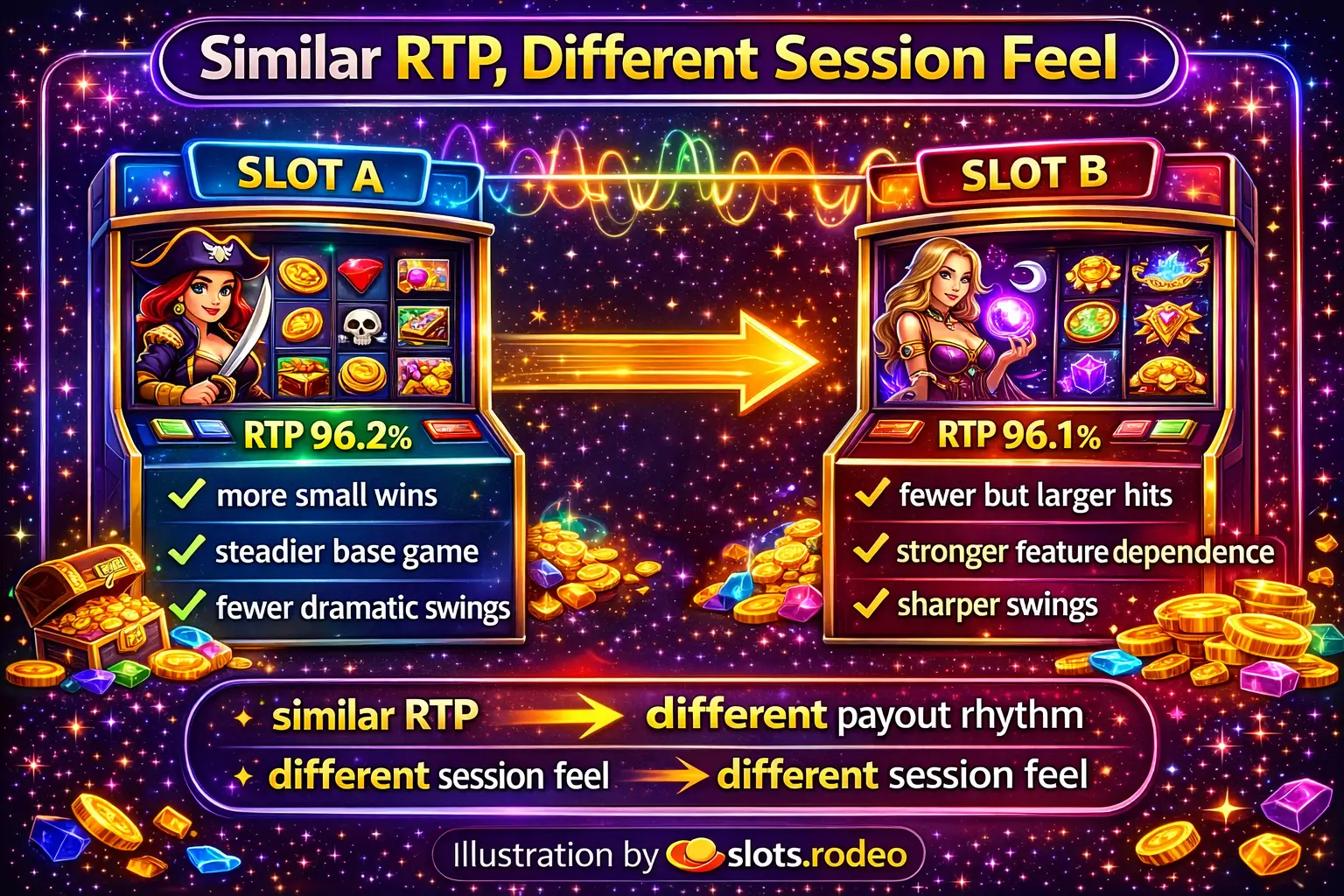
| Slot A | 96.1% | More frequent small wins, steadier balance movement |
| Slot B | 96.0% | Longer quiet stretches, more value tied to feature rounds |
Slot A
RTP
96.1%
Typical pattern
More frequent small wins, steadier balance movement
Slot B
RTP
96.0%
Typical pattern
Longer quiet stretches, more value tied to feature rounds
These are not predictions for one session. They show that return percentage and return distribution are separate things.
What shapes slot feel beyond RTP
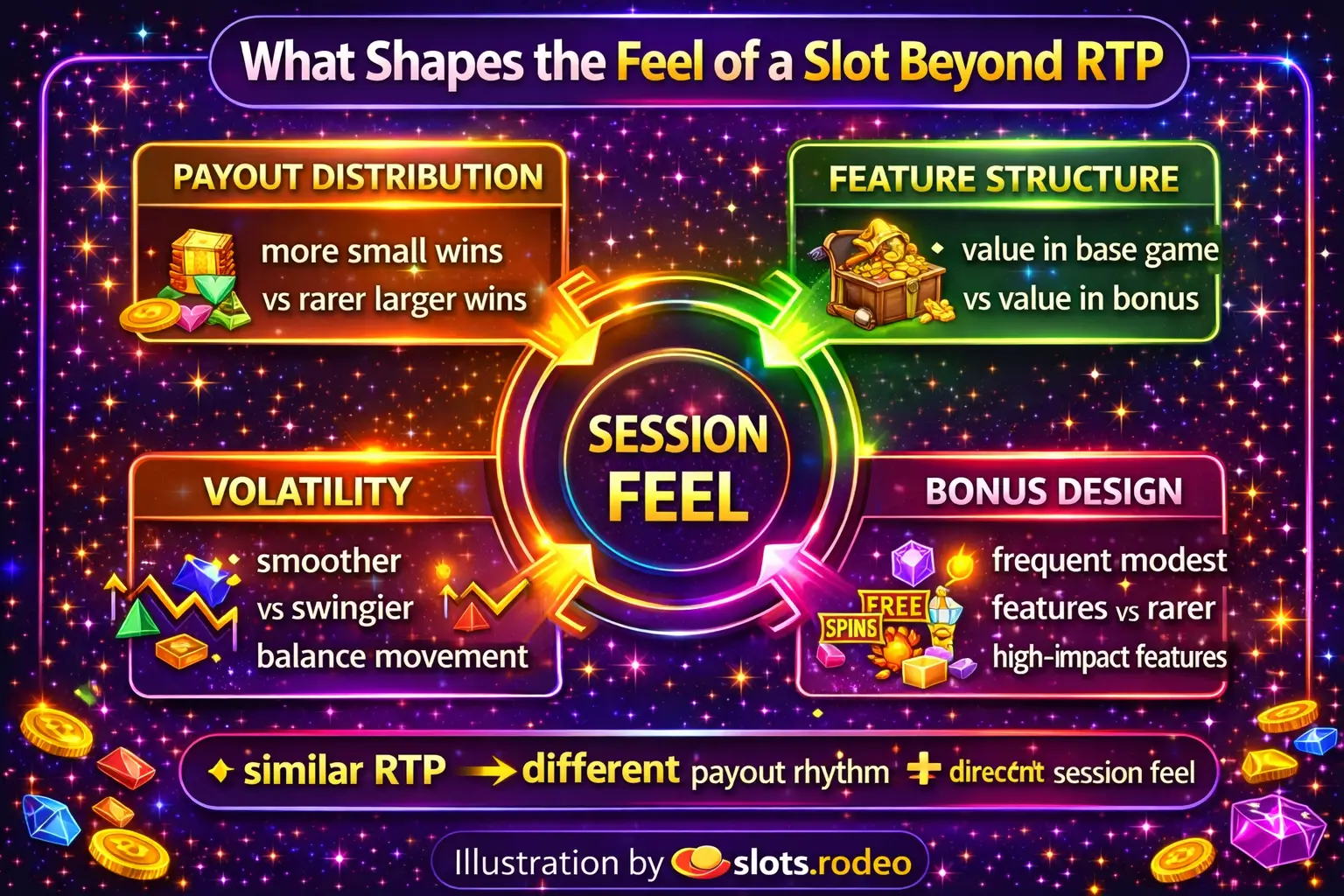
The way a slot behaves is usually driven by several connected design choices.
Volatility
Volatility affects how payout value is spread across time.
A lower-volatility slot often produces more regular hits and smaller swings. A higher-volatility slot may pay less often but leave more room for larger outcomes.
This is one of the biggest reasons similar-RTP games can feel so different.
Payout distribution
Some slots return a larger share of value through the base game. Others push more value into free spins, multipliers, respins, or top-end combinations.
If more value is concentrated in rarer events, the game may feel slower or more uneven between those events.
Feature structure
Bonus design changes rhythm.
A slot with frequent but modest feature triggers can feel active. A slot with rarer but more powerful features may feel flat for longer periods, even if both games sit near the same RTP.
Win frequency and hit profile
Two games can both land many "winning spins," but that still does not mean they feel alike. A slot with many low-value hits that return less than the stake may feel different from one with fewer but more meaningful hits.
Reel and symbol behavior
Megaways-style layouts, cluster pays, cascades, expanding symbols, sticky wilds, and progressive multipliers all affect how wins build. These mechanics influence session rhythm even when RTP is similar.
The same RTP can be split in very different ways
Think of RTP as the total amount of return the game is built to deliver over the long run. The important question is how that total is divided.
| Return component | Slot style 1 | Slot style 2 |
|---|---|---|
| Base-game contribution | Higher share | Lower share |
| Bonus-feature contribution | Lower share | Higher share |
| Small wins | More common | Less common |
| Large swings | Less pronounced | More pronounced |
| Session feel | Smoother | More uneven |
Base-game contribution
Slot style 1
Higher share
Slot style 2
Lower share
Bonus-feature contribution
Slot style 1
Lower share
Slot style 2
Higher share
Small wins
Slot style 1
More common
Slot style 2
Less common
Large swings
Slot style 1
Less pronounced
Slot style 2
More pronounced
Session feel
Slot style 1
Smoother
Slot style 2
More uneven
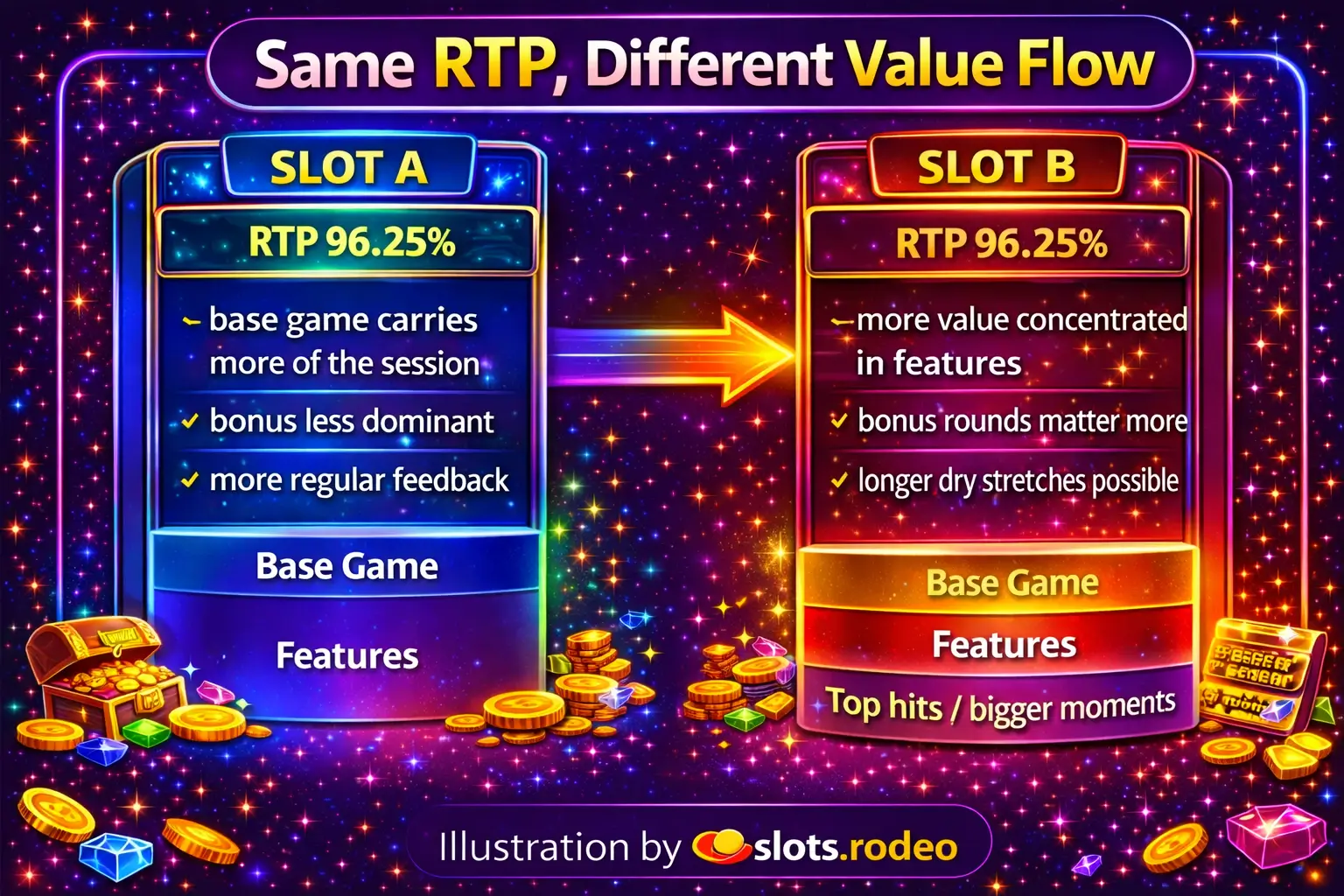
This is why "same RTP" is not the same as "same value flow."
A slot that feeds more return through regular base-game hits may feel stable. Another slot with the same RTP may hide more value inside bonus rounds, which makes the session feel more delayed and more dependent on feature access.
Why feature-heavy slots often feel different
Feature-heavy slots often concentrate a meaningful part of their return in one or more bonus modes. This can change the whole pacing of play.
A game built this way may show:
- longer stretches where the base game does not do much
- stronger focus on triggering free spins or another main feature
- bigger contrast between ordinary spins and premium moments
- more visible swings in balance
By contrast, a more base-game-driven slot can feel less dramatic, but more even.
Neither structure is automatically better. They simply create different play patterns.
Similar RTP, different pressure on the bankroll
Session feel is closely tied to bankroll pressure.
A slot that returns value in a steadier pattern may let the balance decline more slowly in some sessions. Another slot with similar RTP may consume balance faster between feature hits, even though its long-run theoretical return is close.
That difference matters because most players do not experience slots over millions of spins. They experience them in short real sessions.
Why beginners often overread RTP
Many new players treat RTP as the single number that explains everything. It is important, but it is incomplete on its own.
RTP can help answer this question:
What is the game's theoretical long-run return?
It does not fully answer these questions:
- Will the slot feel calm or swingy?
- Is most value in the base game or the bonus?
- Are hits frequent but small?
- Are bonus rounds rare but important?
- How much variance might show up in a short session?
Those questions are often more relevant to actual session feel.
A practical comparison example
Imagine two slots:
Slot A
- RTP: 96.1%
- medium volatility
- more base-game activity
- smaller but more regular returns
- bonus rounds matter, but do not dominate the whole model
Slot B
- RTP: 96.0%
- high volatility
- quieter base game
- more value concentrated in bonus rounds
- larger gaps between stronger moments
On paper, the RTP gap is tiny. In practice, the two sessions may feel nothing alike.
What to check when RTP is close
If you are comparing two slots with similar RTP, use more than one metric.
| What to check | Why it matters |
|---|---|
| Volatility label | Gives context on payout spread and session swings |
| Bonus structure | Shows whether value is concentrated in features |
| Base-game activity | Helps explain how often the slot feels "alive" |
| Max win framing | Signals whether the model leaves room for bigger top-end outcomes |
| Mechanics | Cascades, multipliers, wild features, and reel changes affect rhythm |
| In-game rules | Best place to verify what the game actually says about its setup |
Volatility label
Why it matters
Gives context on payout spread and session swings
Bonus structure
Why it matters
Shows whether value is concentrated in features
Base-game activity
Why it matters
Helps explain how often the slot feels "alive"
Max win framing
Why it matters
Signals whether the model leaves room for bigger top-end outcomes
Mechanics
Why it matters
Cascades, multipliers, wild features, and reel changes affect rhythm
In-game rules
Why it matters
Best place to verify what the game actually says about its setup
This gives a more useful picture than RTP alone.
When similar RTP does matter
RTP still matters. Over the long run, a higher RTP is generally more favorable than a lower one, all else equal.
But when the RTP difference is small, the way the slot behaves may matter more to the player's actual experience than the tiny gap in theoretical return.
That is why a useful slot comparison should not stop at the RTP number.
FAQ
Common questions about this topic.
No. Similar RTP only means their long-run theoretical return is close. The path of wins, bonus timing, and volatility can still differ a lot.
No. Volatility and RTP are separate concepts. A slot can have high volatility and high RTP, or low volatility and similar RTP.
Because activity depends on payout distribution, hit pattern, feature frequency, and base-game structure, not just on RTP.
Yes. It may simply return more of its value through less frequent but larger events.
For short-session feel, volatility and value distribution often have a bigger visible impact. RTP remains important, but it does not describe the full session pattern.

