

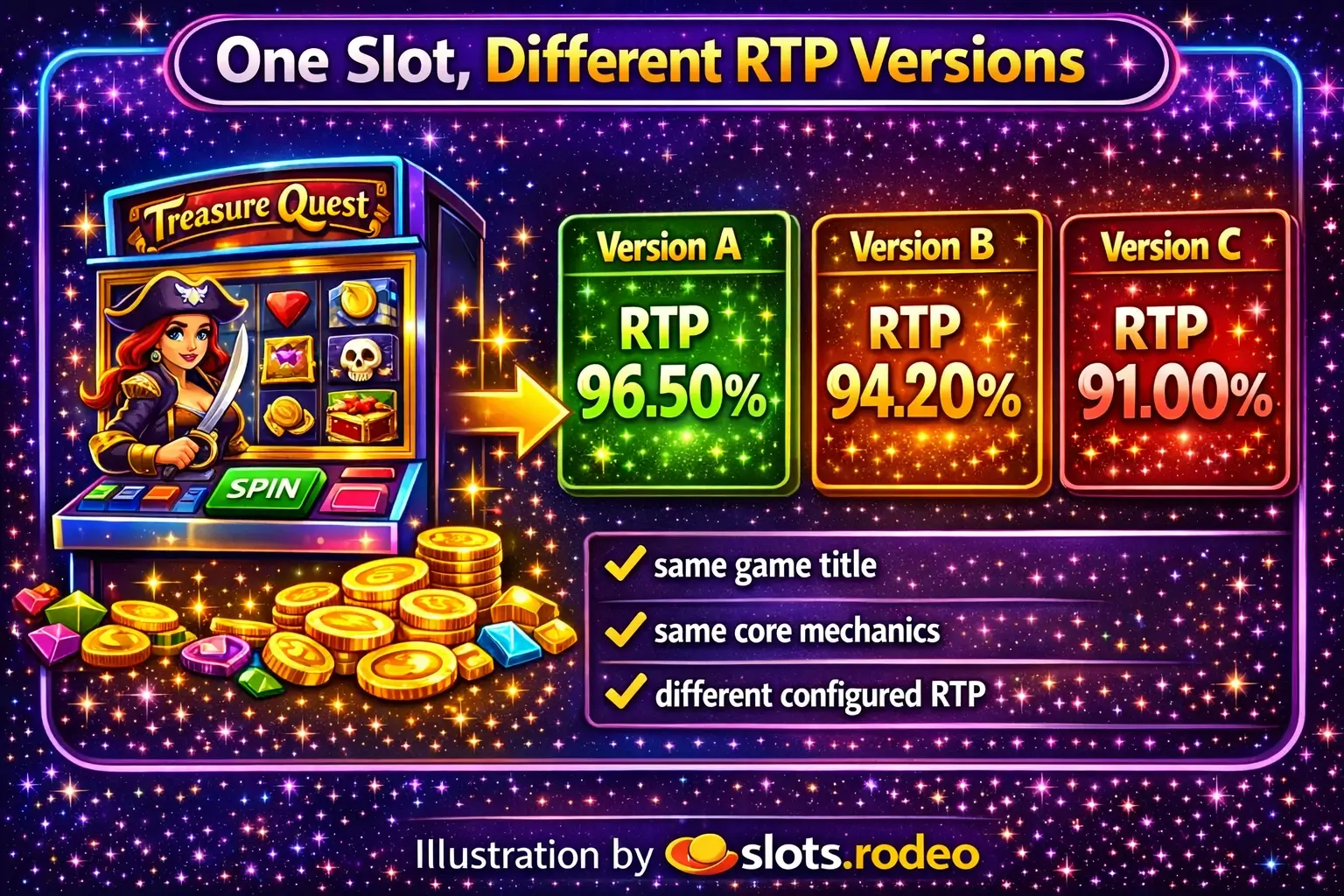
A slot title is not always tied to one fixed RTP. In many cases, the same game is released in more than one RTP version. The design, reels, symbols, bonus features, and max win can stay the same, while the theoretical return changes.
This matters because two casinos can both offer the same slot, but the long-term mathematical return may be different. If a player compares only the game name, the comparison may be incomplete.
Why one slot can have more than one RTP version
RTP stands for Return to Player. It is the theoretical percentage of wagered money that a game is expected to return over a very large number of spins.
A provider may build several RTP configurations for the same slot. For example, one version might be set at 96.20%, another at 94.10%, and another at 91.00%. The player still sees the same brand, same artwork, and usually the same feature set. What changes is the underlying payout model.
This is done so the same game can be distributed to different operators, markets, or commercial setups.
What usually stays the same, and what changes
Multiple RTP versions do not usually mean that the whole slot is rebuilt from scratch. In most cases, the visible product remains almost identical.
| Part of the slot | Usually stays the same | Can change between RTP versions |
|---|---|---|
| Game title | Yes | No |
| Theme and graphics | Yes | Rarely |
| Reel layout | Yes | Usually no |
| Bonus features | Yes | Usually no |
| Paytable values | Sometimes | Sometimes |
| Underlying return model | No | Yes |
| Long-run expected return | No | Yes |
Game title
Usually stays the same
Yes
Can change between RTP versions
No
Theme and graphics
Usually stays the same
Yes
Can change between RTP versions
Rarely
Reel layout
Usually stays the same
Yes
Can change between RTP versions
Usually no
Bonus features
Usually stays the same
Yes
Can change between RTP versions
Usually no
Paytable values
Usually stays the same
Sometimes
Can change between RTP versions
Sometimes
Underlying return model
Usually stays the same
No
Can change between RTP versions
Yes
Long-run expected return
Usually stays the same
No
Can change between RTP versions
Yes
In practice, the player may open what looks like the same slot in two casinos and get the same basic gameplay experience, but the theoretical return behind it may differ.
How providers and casinos are involved
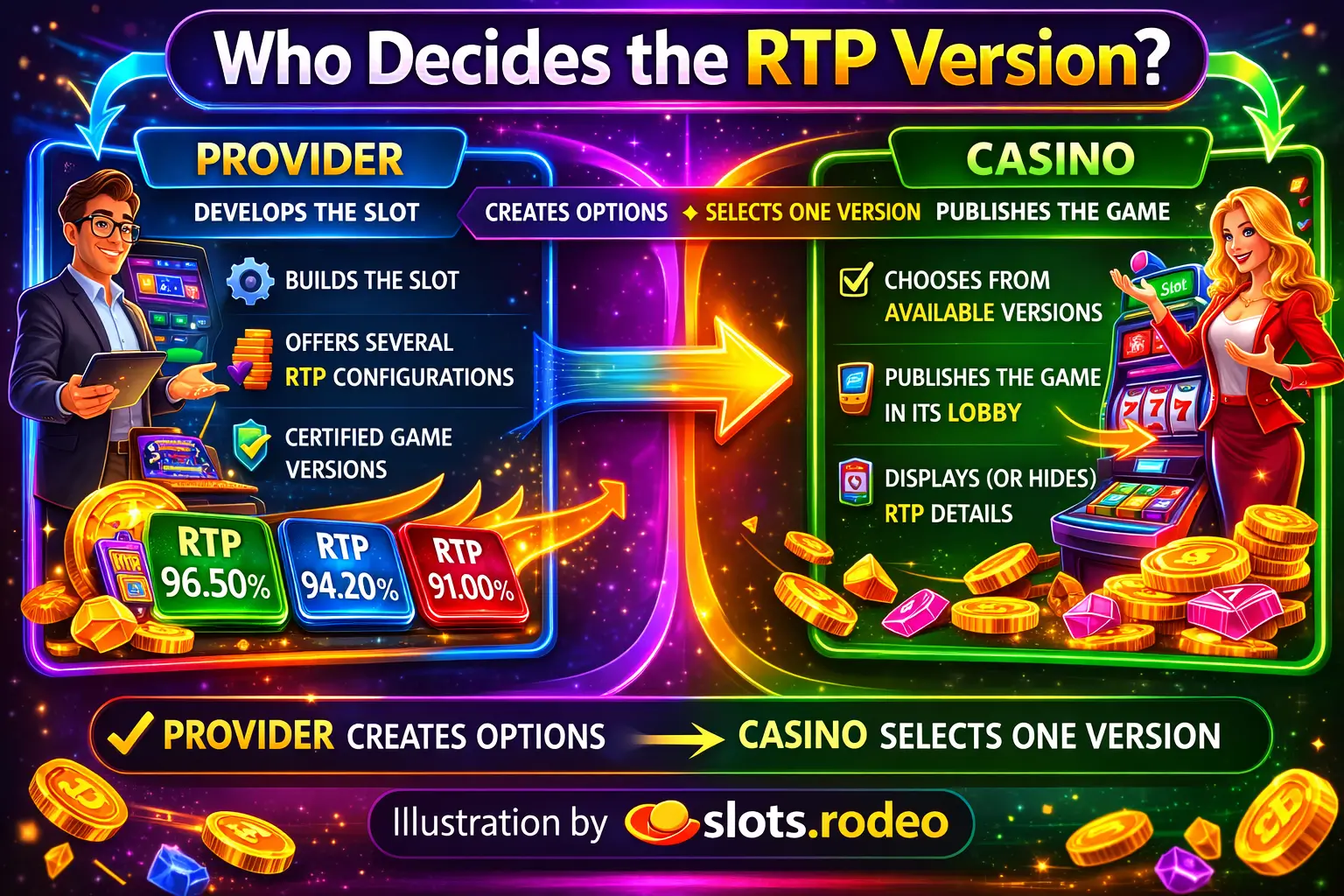
The slot developer usually creates the game and makes one or more RTP versions available. The casino operator then may choose from the versions that are available for that title in its platform, licensing setup, or market arrangement.
This does not mean that a casino can freely invent any RTP it wants for any slot. The choice is normally limited to the versions prepared and supported by the provider or platform setup.
Why this matters when comparing casinos
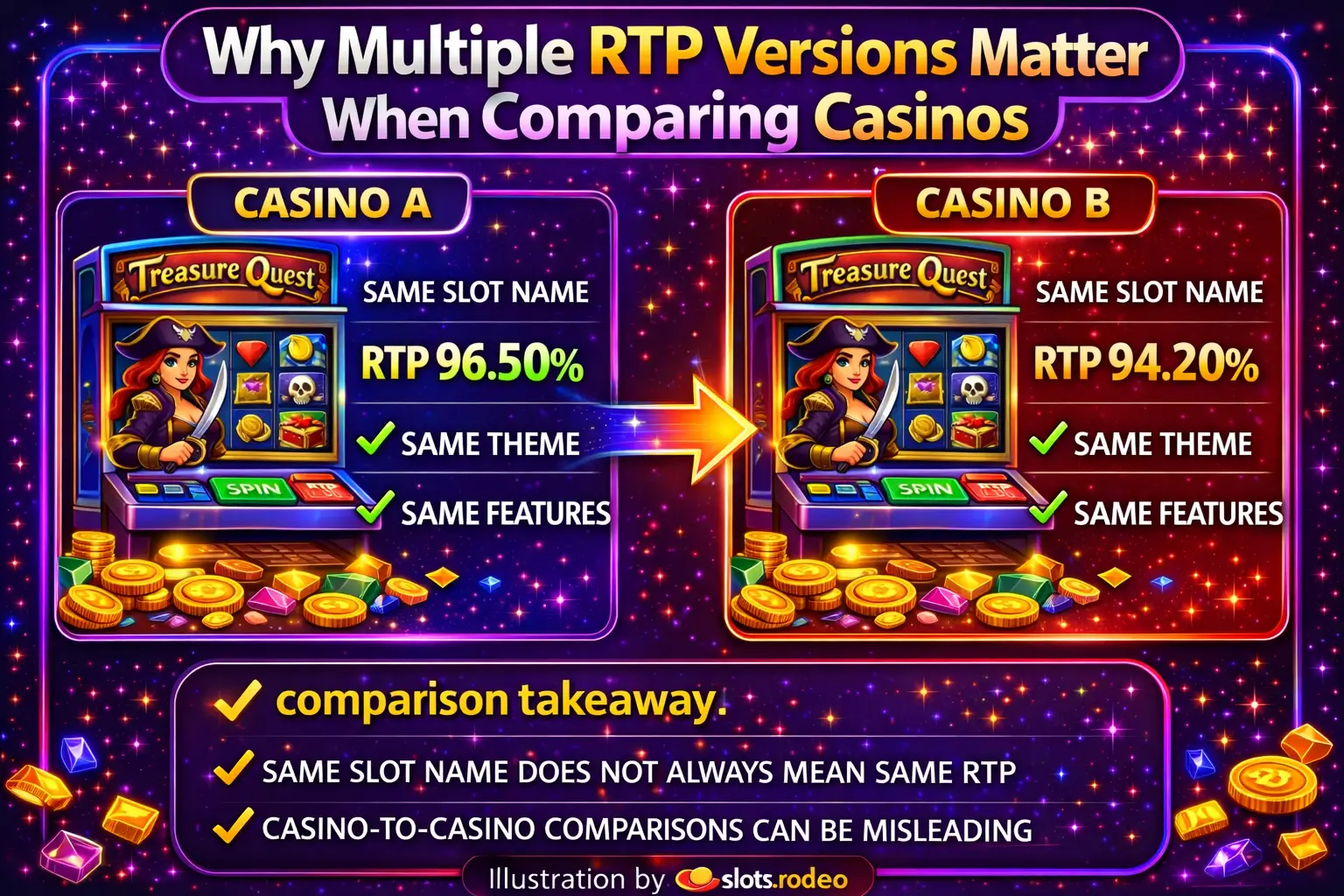
If Casino A and Casino B both list the same slot, that does not automatically mean the player is getting the same RTP.
This affects comparisons in three main ways:
1. The same slot name may not mean the same return
A player may assume that a known game always has one standard RTP. That assumption is not always correct. Two versions of the same slot can carry different theoretical returns.
2. Review pages can become inaccurate if they ignore version differences
A site may publish one RTP figure for a slot without checking whether that figure applies across all casinos. That creates confusion, especially when players compare operators side by side.
3. A lower RTP changes the long-run math
The difference may look small on paper, but it changes the theoretical expected return over time.
| RTP version | Theoretical return per 100 wagered | Theoretical house edge |
|---|---|---|
| 96% | 96 | 4% |
| 94% | 94 | 6% |
| 92% | 92 | 8% |
96%
Theoretical return per 100 wagered
96
Theoretical house edge
4%
94%
Theoretical return per 100 wagered
94
Theoretical house edge
6%
92%
Theoretical return per 100 wagered
92
Theoretical house edge
8%
This table does not predict what will happen in one session. It simply shows that lower RTP means lower theoretical long-run return.
Does a lower RTP mean the slot will feel different immediately?
Not necessarily.
RTP is a long-run theoretical measure. In a short session, a player may not notice any visible difference at all. A lower-RTP version does not guarantee a bad session, and a higher-RTP version does not guarantee a good one.
The main point is not short-term prediction. The point is that when two casinos offer different RTP versions of the same game, they are not offering the exact same long-run value.
Where players can find the RTP version
The easiest place to check is usually the in-game help, paytable, or information menu. Some slots show the RTP clearly in the rules screen. Others make it less visible.
When comparing the same slot across casinos, check:
- the RTP shown inside the game
- the paytable or help file
- whether the casino publishes slot details accurately
- whether a review page names the exact RTP version rather than assuming one universal figure
If no RTP is shown in the game interface, comparison becomes weaker because the player cannot confirm whether both casinos are offering the same version.
A simple example of how confusion happens
A player sees Slot X reviewed online as "96.1% RTP."
Then the same player opens Slot X in a casino and finds "94.0% RTP" in the rules.
This does not automatically mean one of the numbers is fake. It may simply mean:
- the review used a different RTP version
- the game exists in multiple configurations
- the review did not specify which version it referred to
That is why slot comparisons should focus on the version actually shown in the game, not only on the slot title.
What this means for slot reviews and database pages
A strong slot page should avoid presenting RTP as a single universal number unless the version has been verified. A more accurate approach is:
- show the RTP found in the reviewed game instance
- mention that other RTP versions may exist
- avoid implying that the same figure applies everywhere
- separate game-level facts from operator-level conditions
This improves trust and reduces misleading comparisons.
FAQ
Common questions about this topic.
Yes. A provider may release more than one RTP version of the same slot. The game can look the same while the theoretical return differs.
Usually no. In most cases, the provider supplies the available RTP configurations, and the casino offers one of those supported versions.
Not in the way players usually mean it. It is generally the same game title and same core product, but with a different theoretical long-run return setting.
Usually not. The most reliable place to check is inside the game's help, info, or paytable section.
No. RTP is a long-run theoretical measure, not a prediction for a short session.

