

Max win in slots is the highest theoretical payout a game can produce from a single completed outcome or feature sequence under its rules.
It is usually shown as a multiple of your stake, such as:
- 5,000x bet
- 10,000x bet
- 50,000x bet
If a slot lists a max win of 10,000x, that means the largest theoretical result is 10,000 times the triggering bet.
This sounds simple, but max win is one of the most misunderstood slot terms. Many players read it as a sign of what the game "normally can pay." That is not what it means.

What max win means in simple terms
A max win is the upper payout limit built into the game's math and rules.
If your bet is $1 and the max win is 5,000x, the highest theoretical payout is:
$1 x 5,000 = $5,000
If your bet is $0.20 and the max win is 5,000x, the highest theoretical payout is:
$0.20 x 5,000 = $1,000
The x-bet value stays the same. The money value changes with the stake.
Max win is theoretical, not typical
This is the most important point.
Max win does not mean:
- a normal strong session should reach that level
- the slot often pays near that amount
- most bonus rounds are built around that outcome
- the game is likely to hit that ceiling in ordinary play
Max win is the outer limit of the game's payout structure, not a description of average or common outcomes.
A slot with a 20,000x max win can still produce many sessions with only small wins or no feature success at all.
How max win is usually expressed
Most providers show max win as a multiplier of total bet.
Examples:
| Listed max win | Meaning at $0.20 bet | Meaning at $1 bet |
|---|---|---|
| 1,000x | $200 | $1,000 |
| 5,000x | $1,000 | $5,000 |
| 10,000x | $2,000 | $10,000 |
| 50,000x | $10,000 | $50,000 |
1,000x
Meaning at $0.20 bet
$200
Meaning at $1 bet
$1,000
5,000x
Meaning at $0.20 bet
$1,000
Meaning at $1 bet
$5,000
10,000x
Meaning at $0.20 bet
$2,000
Meaning at $1 bet
$10,000
50,000x
Meaning at $0.20 bet
$10,000
Meaning at $1 bet
$50,000
This x-bet format makes it easier to compare slots without tying the number to one fixed currency amount.
Where max win usually comes from
In many slots, the max win does not come from a simple base-game line hit.
It often depends on a specific chain of favorable events, such as:
- premium symbol combinations
- full bonus feature alignment
- stacked multipliers
- retriggers
- maximum-value wild setups
- expanding symbols
- bonus-round progression
- top-end reel or cluster configurations
In other words, the published max win usually represents a best-case scenario, not a normal result.
Max win is often tied to the bonus feature
Many modern slots place their biggest possible outcomes inside free spins or bonus modes.
That means the highest listed win may depend on:
- entering the feature
- triggering the strongest feature variant
- landing multiple high-value modifiers
- reaching top symbol alignment
- stacking multipliers or wild effects in the same result
This is why max win is often more connected to feature design than to ordinary base-game behavior.

Max win is not the same as RTP
A slot can have:
- moderate RTP and very high max win
- high RTP and lower max win
- similar RTP to another slot but a very different max win ceiling
That is because RTP and max win measure different things.
RTP
Long-term theoretical return across a very large number of spins.
Max win
The highest theoretical single outcome or capped result.
A high max win does not mean the slot returns more overall. It means the game has room for a larger top-end payout.
Max win is not the same as volatility
Max win and volatility are related, but not identical.
A very high max win often appears in slots that feel more top-heavy, because a lot of value may be concentrated in rare, stronger outcomes. But max win alone does not define the full volatility profile.
For example:
- one slot may have 5,000x max win with moderate behavior
- another may have 50,000x max win but still distribute some value more broadly
- a third may have lower max win but still feel harsh because of bonus dependence
So max win helps describe the top ceiling, while volatility helps explain how uneven the path to returns may feel.
A high max win does not mean "better" for every player
Some players assume a bigger max win automatically makes a slot better.
That is too simple.
A higher max win may mean:
- more top-end theoretical upside
- more emphasis on rare peak outcomes
- more value concentrated in unusual feature results
But it may also mean:
- typical outcomes remain much lower
- many sessions never get close to the ceiling
- the bonus round carries most of the game's big-hit logic
So max win is useful, but it should be read as a structural metric, not as a direct quality score.
Why max win can sound more important than it is
Max win is easy to market because it is a large number and easy to compare.
But on its own, it leaves out a lot of practical context, such as:
- how difficult that outcome is to reach
- whether it depends on several rare events happening together
- how much of the slot's value sits far below the ceiling
- how the game behaves in short sessions
This is why max win can be informative but also misleading when taken alone.
Max win often depends on perfect conditions
In many slots, reaching max win requires a near-ideal sequence.
That may include:
- the right feature trigger
- the right symbol on the right reels
- full multiplier stacking
- repeated retriggers
- maximum-value symbol transformation
- full screen or full cluster conditions
So the max win is not just "the biggest symbol payout." It is often the product of multiple systems aligning at once.
Some slots have explicit win caps
Many slots include a published win cap that acts as the maximum possible payout.
This means that even if several mechanics combine, the game will stop at the stated cap, such as:
- max payout capped at 5,000x
- maximum win of 10,000x total bet
- total feature payout cannot exceed 50,000x
This cap matters because it defines the top boundary of the slot.
A simple example of how max win works
Imagine a slot with:
- max win = 10,000x
- total bet = $0.50
Then the maximum theoretical payout is:
10,000 x $0.50 = $5,000
That does not mean:
- the next bonus can pay that much
- a strong feature is likely to reach it
- most players will ever see it
It only tells you the upper edge of the payout model.
Max win vs what players usually experience
This is the practical difference that matters most.
| Metric | What it describes |
|---|---|
| Max win | Theoretical top payout ceiling |
| Typical session | Normal short-term play result |
| Bonus result | One feature outcome, often far below the ceiling |
| RTP | Long-term return design |
| Volatility | How uneven returns may feel |
Max win
What it describes
Theoretical top payout ceiling
Typical session
What it describes
Normal short-term play result
Bonus result
What it describes
One feature outcome, often far below the ceiling
RTP
What it describes
Long-term return design
Volatility
What it describes
How uneven returns may feel
A player may have many sessions in a slot without coming anywhere near the listed max win. That is normal.
What max win is useful for
Max win is still useful when read correctly.
It helps you:
- understand the slot's payout ceiling
- compare how much top-end range different games allow
- identify whether a slot is designed with a low, medium, or very high upside cap
- place the game in context with other slots
For example, a 500x max win slot and a 50,000x max win slot are clearly built with different upper limits, even if both can still produce ordinary short-term results.
Common mistakes players make about max win
Treating max win as a realistic session target
It is a theoretical upper boundary, not a normal benchmark.
Confusing max win with RTP
One measures the payout ceiling. The other measures long-term return.
Confusing max win with average win size
A slot can have huge max win and still give mostly small returns.
Assuming bigger max win means better value
A larger ceiling does not automatically mean stronger overall gameplay value.
Ignoring the bonus dependence
Many top-end outcomes exist mainly inside special feature conditions.
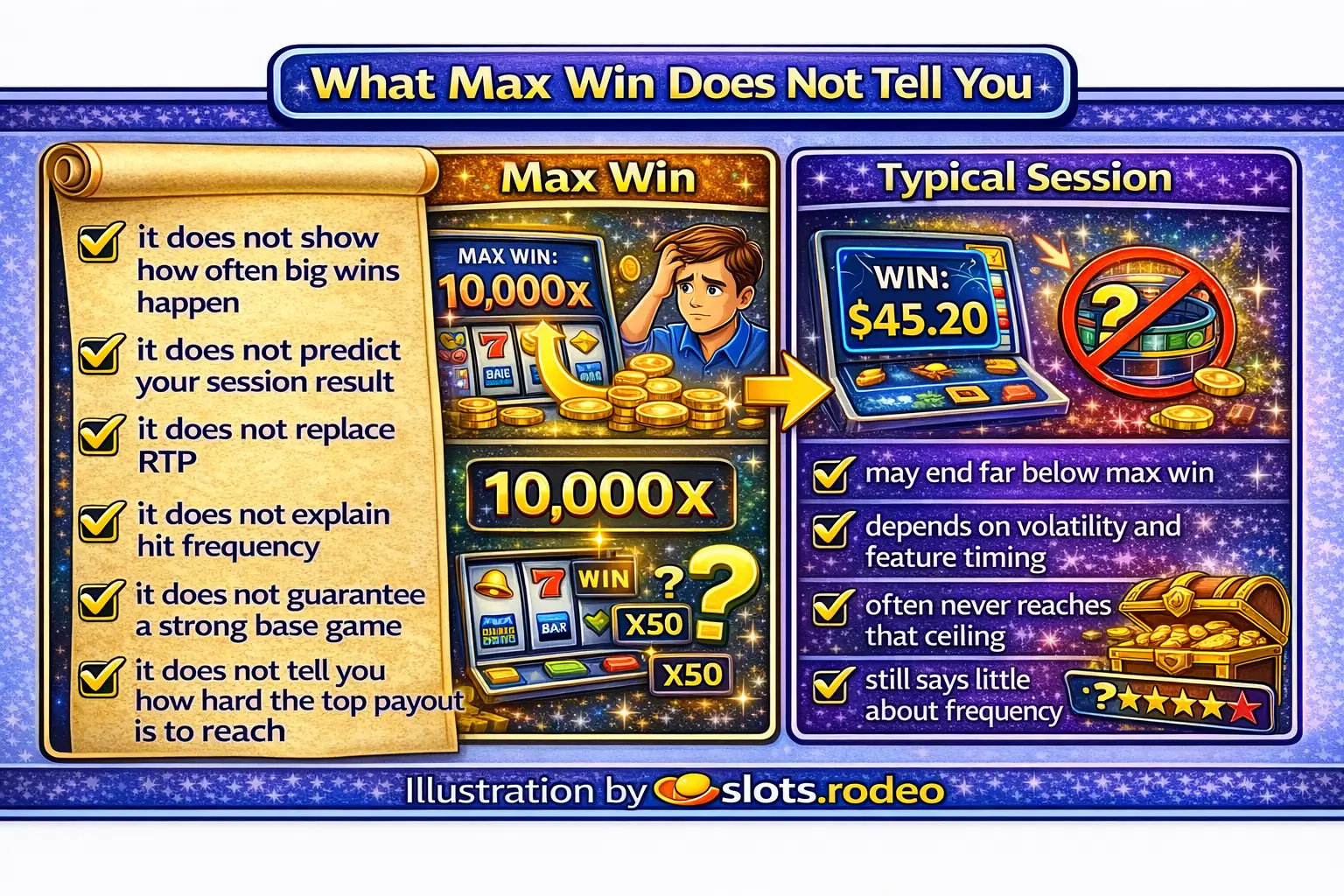
What max win does not tell you
Max win is useful, but limited.
It does not tell you:
- how often strong wins happen
- how often the bonus triggers
- what a normal session looks like
- how much the average bonus pays
- whether the base game is active or quiet
- how much of RTP sits in the feature
- how volatile the slot feels in practice
How to read max win correctly
The best way to use max win is to treat it as a ceiling metric.
It helps answer:
- how high can this slot theoretically go?
- is this a low-cap or high-cap design?
- does the game offer modest or very large top-end range?
It does not answer:
- how often will I win?
- how often will I hit the feature?
- what should I expect in a short session?
- is this slot smoother than another one?
For those questions, you need other metrics and rule details.
Quick comparison: what max win can and cannot do
| Useful for | Not enough for |
|---|---|
| Understanding payout ceiling | Predicting normal results |
| Comparing top-end slot range | Estimating bonus frequency |
| Identifying capped upside | Judging RTP |
| Seeing whether a game is low-cap or high-cap | Explaining average session value |
Understanding payout ceiling
Not enough for
Predicting normal results
Comparing top-end slot range
Not enough for
Estimating bonus frequency
Identifying capped upside
Not enough for
Judging RTP
Seeing whether a game is low-cap or high-cap
Not enough for
Explaining average session value
FAQ
Common questions about this topic.
It means the highest theoretical payout the slot can produce under its rules.
No. It is a ceiling, not a normal or likely result.
Not automatically. It only means the slot allows a larger top-end outcome.
No. RTP is long-term theoretical return. Max win is the highest possible payout cap.
Often no. In many slots, the maximum result depends on bonus features, multipliers, or other special conditions.


