

Variance is one of the main reasons two slots can create very different bankroll pressure even when their RTP looks similar.
A session does not depend only on the long-run return number. It also depends on how unevenly that return is delivered. Some slots spread value in a steadier way. Others concentrate more of it in rarer events, which creates larger swings and more pressure on the balance between meaningful hits.
That is why variance matters for session risk.
What variance means in simple terms
In slot play, variance describes how widely results can swing around the average.
A lower-variance slot usually spreads more of its value through smaller and more regular returns. A higher-variance slot usually puts more value into less frequent but potentially larger outcomes.
This does not mean low variance is "safe" or high variance is "bad." It means the balance can behave very differently from one slot type to another.
Why variance matters more in real sessions than in theory
Most players do not experience a slot over the kind of huge sample behind the RTP figure. They experience it in one evening, one balance, one session length, and one bonus cycle.
In that real setting, variance often has a bigger visible effect than the abstract long-run average.
A lower-variance slot may still lose money, but the path of loss can be less abrupt. A higher-variance slot may keep the balance under more pressure because long quiet stretches are more likely before a stronger event lands.
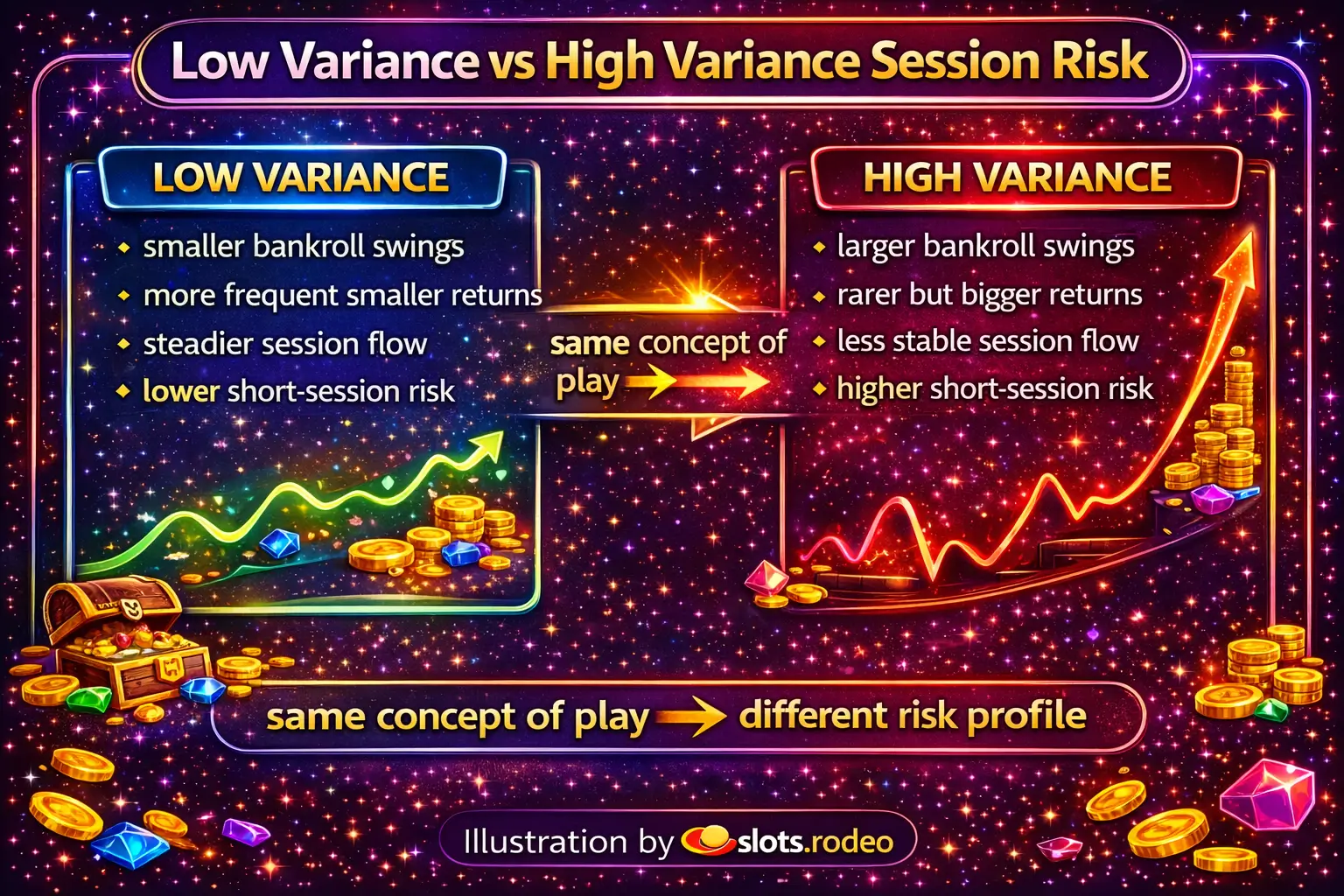
Low variance and high variance do not manage balance the same way
The simplest way to see session risk is to compare how the balance tends to move.
| Slot type | Typical bankroll movement | Common session feel | Risk profile |
|---|---|---|---|
| Low variance | Smaller fluctuations | More stable, more regular activity | Lower short-term swing risk |
| Medium variance | Mixed movement | Alternates between quiet and active phases | Moderate swing risk |
| High variance | Larger drops and sharper jumps | Longer waiting periods, stronger turns | Higher short-term swing risk |
Low variance
Typical bankroll movement
Smaller fluctuations
Common session feel
More stable, more regular activity
Risk profile
Lower short-term swing risk
Medium variance
Typical bankroll movement
Mixed movement
Common session feel
Alternates between quiet and active phases
Risk profile
Moderate swing risk
High variance
Typical bankroll movement
Larger drops and sharper jumps
Common session feel
Longer waiting periods, stronger turns
Risk profile
Higher short-term swing risk
This table describes the general pattern, not a guarantee for any single session.
How variance affects bankroll during a session
Variance changes how much pressure the bankroll may face before the slot returns meaningful value.
A lower-variance game may support the balance with more frequent small returns. These wins do not necessarily create profit, but they can slow down the drop and make the session feel less severe.
A higher-variance game often behaves differently:
- more spins may return nothing
- many wins may be too small to offset the spend
- stronger outcomes may be less frequent
- one bonus round may carry a large share of the session's value
As a result, the balance can fall faster between better events.

Why high variance usually means more bonus dependency
High-variance slots often push a bigger share of their return into bonus rounds, special features, multipliers, or premium combinations.
That creates bonus dependency. In simple terms, the session relies more heavily on reaching a feature that can carry a large part of the value.
This does not mean every high-variance slot works in the exact same way, but the pattern is common:
- base game may feel quiet for long stretches
- smaller base-game hits may not sustain the balance well
- the bonus becomes a central event rather than a side feature
- missing the bonus can make the session feel weak very quickly
That is why high variance often feels harsher in short play.
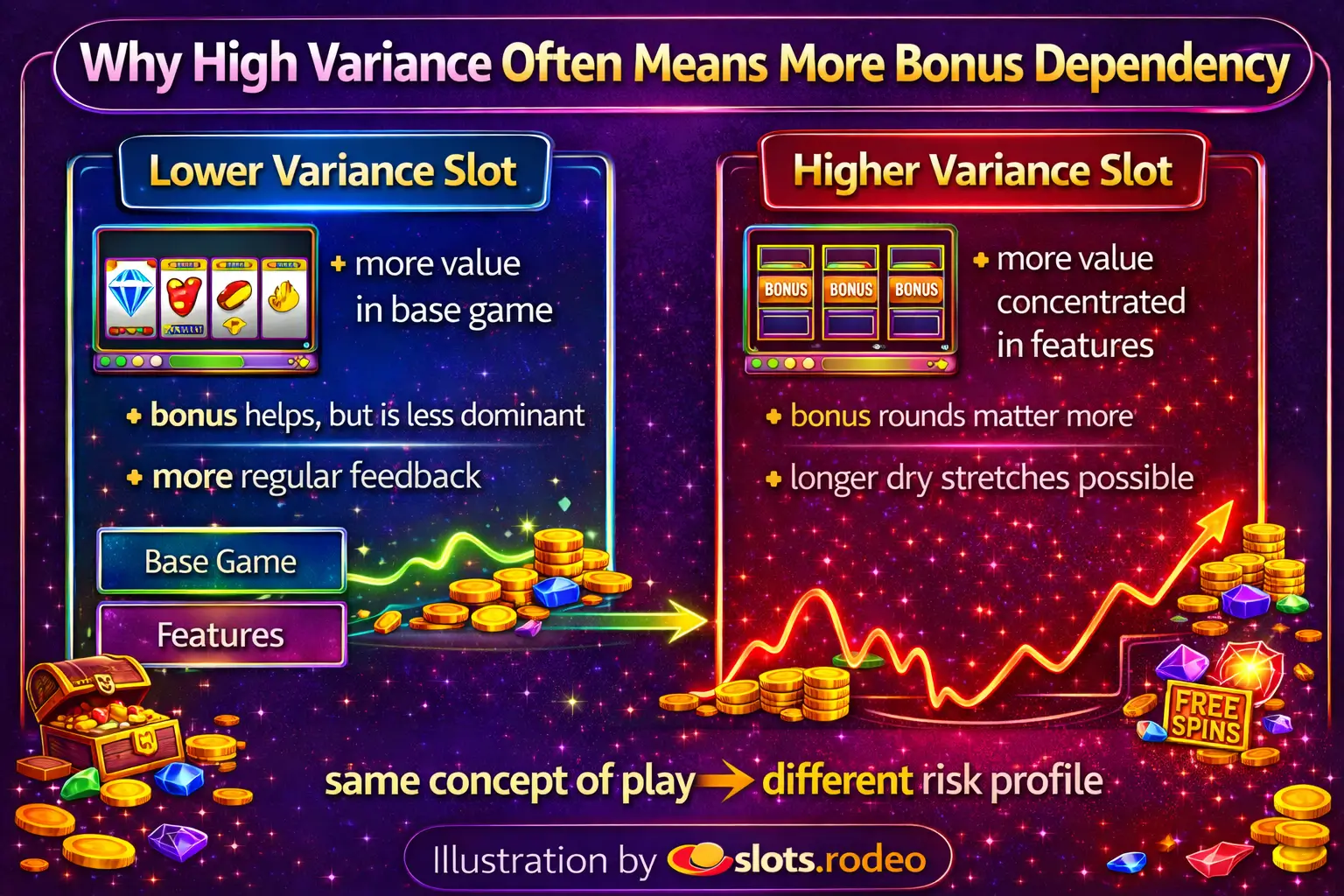
Session stability depends on more than RTP
A player may see two slots with similar RTP and assume they carry similar session risk. That assumption is often wrong.
Variance changes the shape of the session.
| Factor | Lower-variance slot | Higher-variance slot |
|---|---|---|
| Frequency of supportive returns | More common | Less common |
| Reliance on bonus rounds | Lower | Higher |
| Dry-stretch pressure | Usually lower | Usually higher |
| Short-term result spread | Narrower | Wider |
| Session stability | More stable | Less stable |
Frequency of supportive returns
Lower-variance slot
More common
Higher-variance slot
Less common
Reliance on bonus rounds
Lower-variance slot
Lower
Higher-variance slot
Higher
Dry-stretch pressure
Lower-variance slot
Usually lower
Higher-variance slot
Usually higher
Short-term result spread
Lower-variance slot
Narrower
Higher-variance slot
Wider
Session stability
Lower-variance slot
More stable
Higher-variance slot
Less stable
This is why session stability should not be judged from RTP alone.
The same RTP can still mean very different session risk
Imagine two slots:
| Slot | RTP | Variance | Likely session pattern |
|---|---|---|---|
| Slot A | 96.1% | Low-medium | More regular returns, softer swings |
| Slot B | 96.0% | High | Longer dead stretches, stronger dependency on bonus timing |
Slot A
RTP
96.1%
Variance
Low-medium
Likely session pattern
More regular returns, softer swings
Slot B
RTP
96.0%
Variance
High
Likely session pattern
Longer dead stretches, stronger dependency on bonus timing
The RTP difference is tiny. The session risk difference may be much more noticeable.
That is because variance affects how the return is distributed across the session, not just how much the game is built to return in the long run.
Why high variance feels more punishing in short sessions
Short sessions amplify the effect of high variance.
A player has limited spins, limited balance, and limited time to "wait" for the events that carry the slot's value. If those events do not arrive soon enough, the session may end well before the long-run model has any chance to show itself.
This creates three practical problems:
1. Faster bankroll pressure
The balance may drop quickly before a meaningful hit appears.
2. Larger dependence on timing
A strong feature can rescue the session, but only if it arrives within the actual play window.
3. Wider emotional and financial swing
Results may feel more extreme from one session to another.
Low variance does not mean low loss
It is important not to overread the label.
A lower-variance slot can still produce a losing session. It simply tends to distribute outcomes in a less extreme way. In other words, the path may be smoother, but the result can still be negative.
Variance is about how the session moves, not whether the player wins overall.
What to check if you care about session risk
If session stability matters to you, look beyond the RTP number.
| What to check | Why it matters for risk |
|---|---|
| Volatility / variance label | Gives the clearest clue about swing intensity |
| Bonus structure | Shows how much value may depend on feature access |
| Base-game activity | Helps indicate whether the game supports the balance between bonuses |
| Max win framing | Very large top-end potential often comes with wider payout spread |
| In-game rules and paytable | Best place to verify how the slot is presented by the game itself |
Volatility / variance label
Why it matters for risk
Gives the clearest clue about swing intensity
Bonus structure
Why it matters for risk
Shows how much value may depend on feature access
Base-game activity
Why it matters for risk
Helps indicate whether the game supports the balance between bonuses
Max win framing
Why it matters for risk
Very large top-end potential often comes with wider payout spread
In-game rules and paytable
Why it matters for risk
Best place to verify how the slot is presented by the game itself
These checks do not predict one exact outcome, but they give a better picture of real session risk.
A simple practical example
Think of variance like this:
- Lower variance: the game may hand back value in smaller pieces more often
- Higher variance: the game may hold back value longer and return more of it in bigger but rarer moments
Both slots can have a solid RTP on paper. The difference is how much stress the balance may take before that value appears.
When high variance may suit a player - and when it may not
A high-variance slot may suit a player who accepts larger short-term swings and understands that much of the value may sit in rarer events.
It may be less suitable for a player who wants:
- steadier balance movement
- less bonus dependency
- fewer sharp drawdowns during short sessions
- a less swing-heavy session pattern
That is not about "good" or "bad" slots. It is about matching the slot structure to the player's tolerance for session risk.
FAQ
Common questions about this topic.
No. RTP is the theoretical long-run return. Variance describes how unevenly that return may appear during actual play.
Because they often rely more on rarer events and put more pressure on the bankroll between those events.
No. Any slot can produce a bad session. Lower variance usually means narrower swings, not guaranteed protection.
Because a larger share of total return is often concentrated in bonus rounds or other less frequent premium events.
Variance usually has a more visible effect on short-session risk, while RTP remains a long-run theoretical measure.

