

RTP stands for Return to Player. It is one of the most cited slot metrics, and also one of the most misunderstood.
Many players see a number like 96% RTP and assume it means they will get back 96% of their money in a normal session. That is not how RTP works.
RTP is a long-term theoretical return built into the game math. It describes how the slot is designed to return value across a very large number of spins. It does not describe what will happen in one session, one hour, or even several sessions in a row.
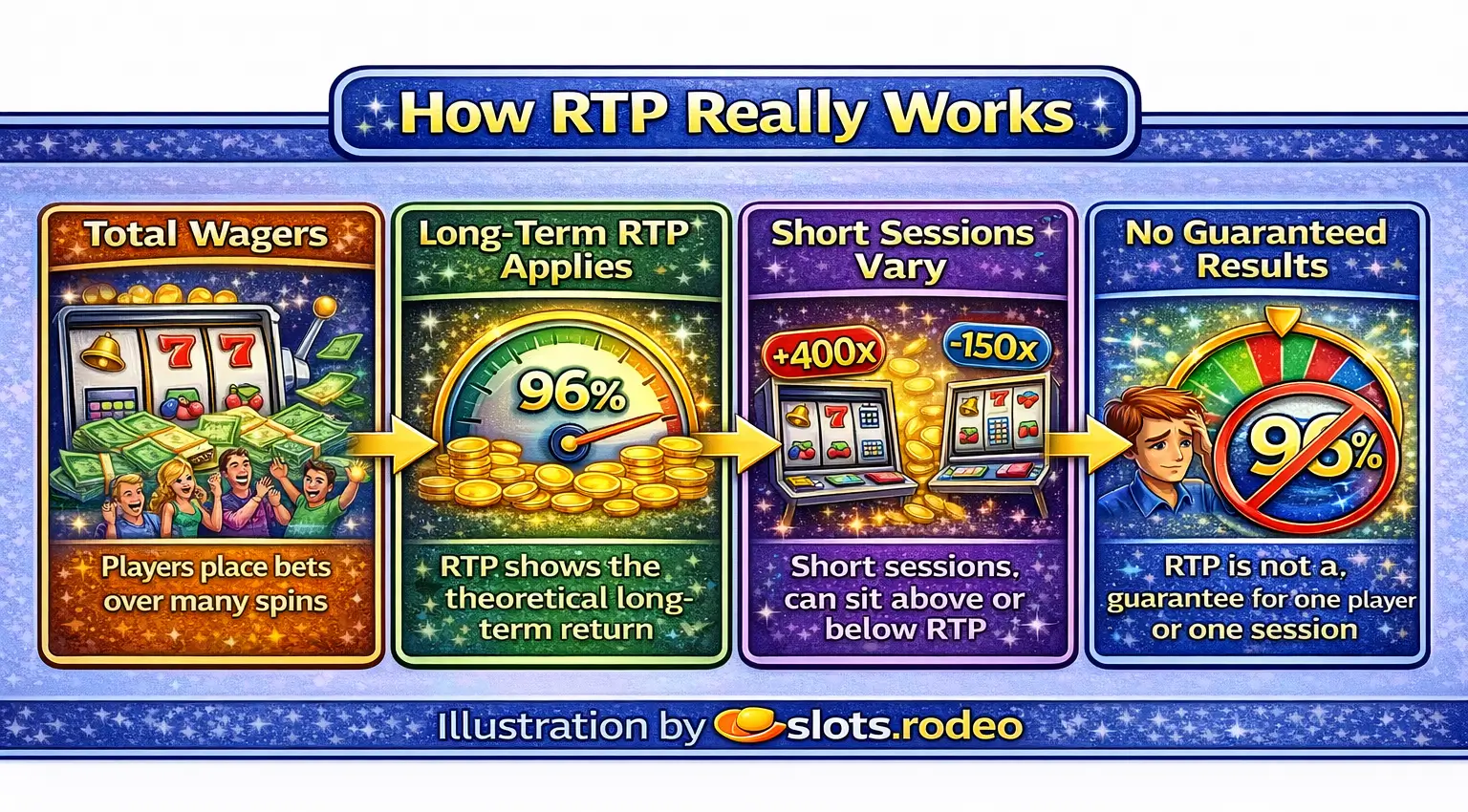
What RTP means in simple terms
If a slot has 96% RTP, the theoretical meaning is:
- over a very large sample of play
- the game is designed to return about 96 units
- for every 100 units wagered in total
The remaining 4 units represent the built-in house edge.
That does not mean:
- every player gets 96 back from every 100 spent
- a 100-spin session should return close to 96
- the slot gradually "owes" you the missing 4
- the game becomes more likely to pay because you are below the RTP number
RTP is a design statistic, not a session guarantee.
RTP is about the game, not your individual outcome
This is the main point that clears up most confusion.
RTP belongs to the mathematical model of the slot. It is not a promise tied to your balance or your personal session.
A player can:
- finish far above RTP in a short session
- finish far below RTP in a short session
- hit a bonus early and leave ahead
- get very little back over a limited number of spins
All of those outcomes can happen in a slot with the same listed RTP.
Why short sessions can look nothing like RTP
Slots do not return money in a smooth, even way.
They return money through:
- many losing spins
- small wins
- medium wins
- occasional feature triggers
- rare larger hits
Because of that, short-term play can swing far away from the long-term return figure.
Here is a simple illustration:
| Session size | Possible relationship to RTP |
|---|---|
| 20 spins | Can be far above or far below RTP |
| 100 spins | Still highly unstable |
| 500 spins | More data, but still noisy |
| Very large number of spins | More likely to move closer to theoretical RTP |
20 spins
Possible relationship to RTP
Can be far above or far below RTP
100 spins
Possible relationship to RTP
Still highly unstable
500 spins
Possible relationship to RTP
More data, but still noisy
Very large number of spins
Possible relationship to RTP
More likely to move closer to theoretical RTP
The key idea is that sample size matters. RTP becomes more meaningful as the number of spins becomes very large.
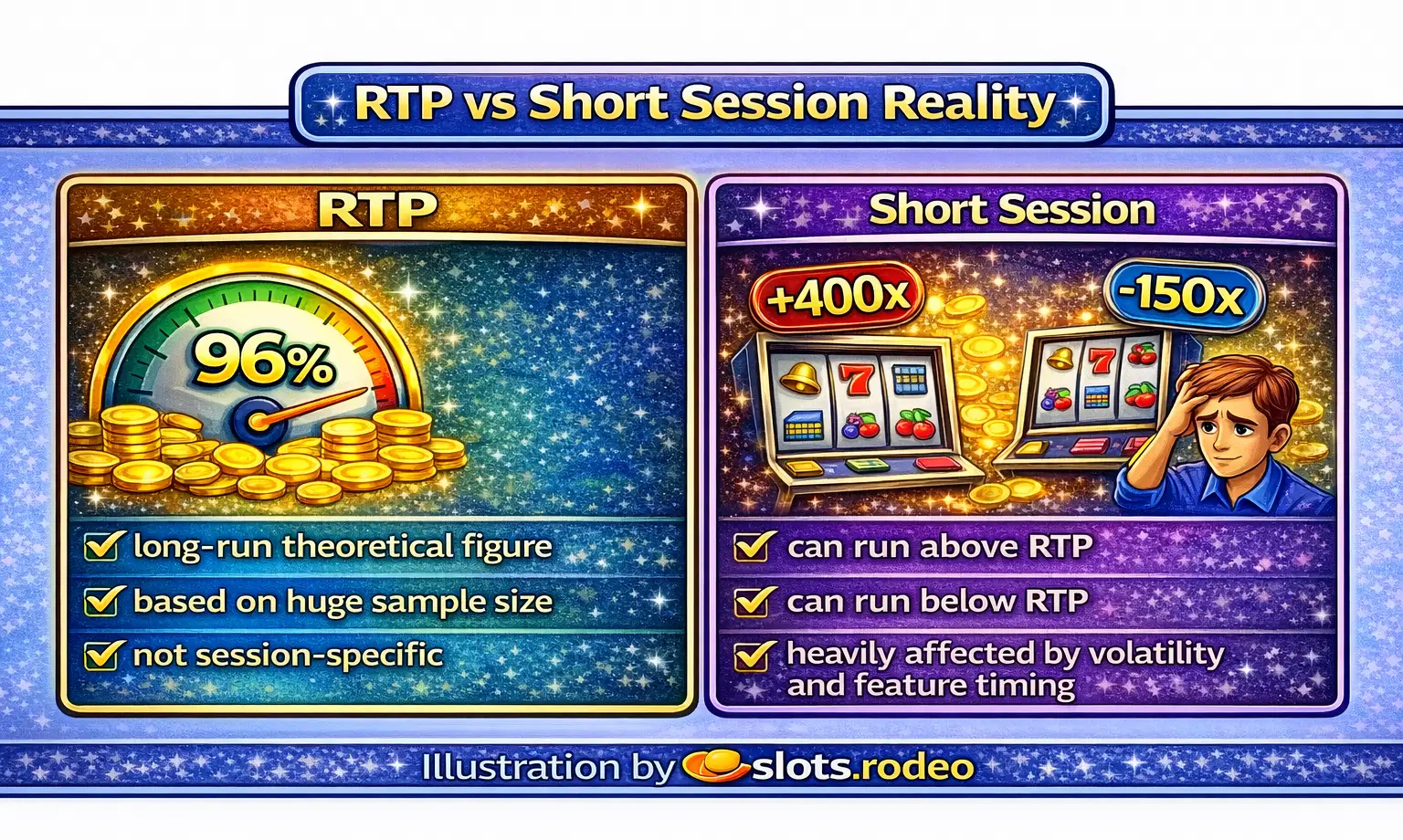
RTP is theoretical, not a live session meter
A slot does not constantly calculate your session and try to move you toward its RTP number.
It does not work like this:
- you are below 96%, so the game should pay more now
- you are above 96%, so the game should pay less now
That is not how standard slot math works.
The slot simply runs its built-in rules on each spin. Over time, the total results across a huge amount of play are expected to align with the theoretical return profile. But the game does not "correct" your session in real time.
How RTP is usually distributed inside a slot
The listed RTP is often not coming from one single part of the game.
It may be split across different areas such as:
| Slot component | Possible RTP contribution |
|---|---|
| Base game line wins | Part of total RTP |
| Scatter payouts | Part of total RTP |
| Free spins feature | Often a major part |
| Bonus rounds | Sometimes meaningful share |
| Multipliers or modifiers | Embedded in total game return |
Base game line wins
Possible RTP contribution
Part of total RTP
Scatter payouts
Possible RTP contribution
Part of total RTP
Free spins feature
Possible RTP contribution
Often a major part
Bonus rounds
Possible RTP contribution
Sometimes meaningful share
Multipliers or modifiers
Possible RTP contribution
Embedded in total game return
This matters because two slots with the same RTP can feel very different if one puts more of its value into bonus features while another returns more through base-game hits.
A 96% slot is not always "equal" to another 96% slot in the way it behaves over short play.
RTP is not the same as hit frequency
RTP tells you the long-term return percentage. It does not tell you how often the slot pays.
A slot can have:
- relatively frequent small wins and 96% RTP
- less frequent but larger wins and 96% RTP
Both are possible because RTP measures total return, not payout rhythm.
That is why RTP must not be confused with:
- hit frequency
- volatility
- bonus frequency
- max win potential
These are different parts of slot behavior.
RTP is not the same as volatility
This is another common mistake.
A high-volatility slot and a lower-volatility slot can both show the same RTP, but the path to that RTP can be completely different.
For example:
| Slot type | Possible profile |
|---|---|
| Lower-volatility slot | More regular small and medium returns |
| Higher-volatility slot | Longer dry periods with more value concentrated in bigger outcomes |
Lower-volatility slot
Possible profile
More regular small and medium returns
Higher-volatility slot
Possible profile
Longer dry periods with more value concentrated in bigger outcomes
Both could still list 96% RTP.
So RTP tells you how much the game is designed to return over time, while volatility helps explain how that return may be distributed.
RTP does not tell you when a bonus will land
A listed RTP number cannot tell you:
- when free spins will trigger
- when a multiplier will connect
- whether the next session will be better
- whether the game is currently "due"
- how long a dry spell may last
This is important because many players use RTP as if it predicts timing. It does not.
A slot with 96.5% RTP can still produce long stretches without a meaningful hit. A slot with slightly lower RTP can still deliver a strong short session.
Why the same slot can have different RTP versions
Some slots are released in more than one RTP configuration.
That means the same game title may exist at, for example:
- 96.5%
- 95%
- 94%
- or another configured value
The rules, graphics, and core mechanics may look almost identical, but the theoretical return can differ depending on the version used.
This is why checking the actual RTP shown in the game help screen matters more than assuming a default number from the slot's general reputation.
A simple example of how RTP should be read
Imagine a slot with 96% RTP.
If total wagers across a huge amount of play equal $1,000,000, the theoretical model suggests about $960,000 is returned to players over time, while about $40,000 remains as the house edge.
That does not mean:
- each $100 session returns $96
- each player loses exactly $4 per $100
- every 100 spins should look close to 96%
Some sessions may return:
- $0
- $40
- $85
- $140
- much more than the starting balance
All of those can exist within the same RTP framework.
What RTP is useful for
RTP is still useful when it is read correctly.
It helps you:
- compare theoretical return between slot versions
- understand the game's long-term return design
- avoid confusing one short session with the full game profile
- spot when one version of a slot has a meaningfully lower theoretical return than another
Used this way, RTP is a helpful benchmark.
Used as a short-session prediction tool, it becomes misleading.
Common mistakes players make about RTP
Treating RTP as a session promise
It is not a guarantee for a short playing session.
Thinking the slot will "balance out" quickly
Theoretical return needs a very large sample. Short-term results can stay far away from it.
Confusing RTP with volatility
RTP measures long-term return. Volatility describes payout distribution and swing.
Assuming all versions of the same slot have the same RTP
Some titles are offered in more than one RTP setting.
Using RTP to predict the next spin
RTP does not forecast upcoming outcomes.
What RTP does not tell you
RTP is useful, but limited.
It does not tell you:
- how often the slot pays
- how large most wins are
- how volatile the game feels
- how much RTP sits in the bonus round
- how hard it is to trigger free spins
- whether short sessions are likely to feel smooth or harsh
- whether the current session is "good" or "bad" relative to what comes next
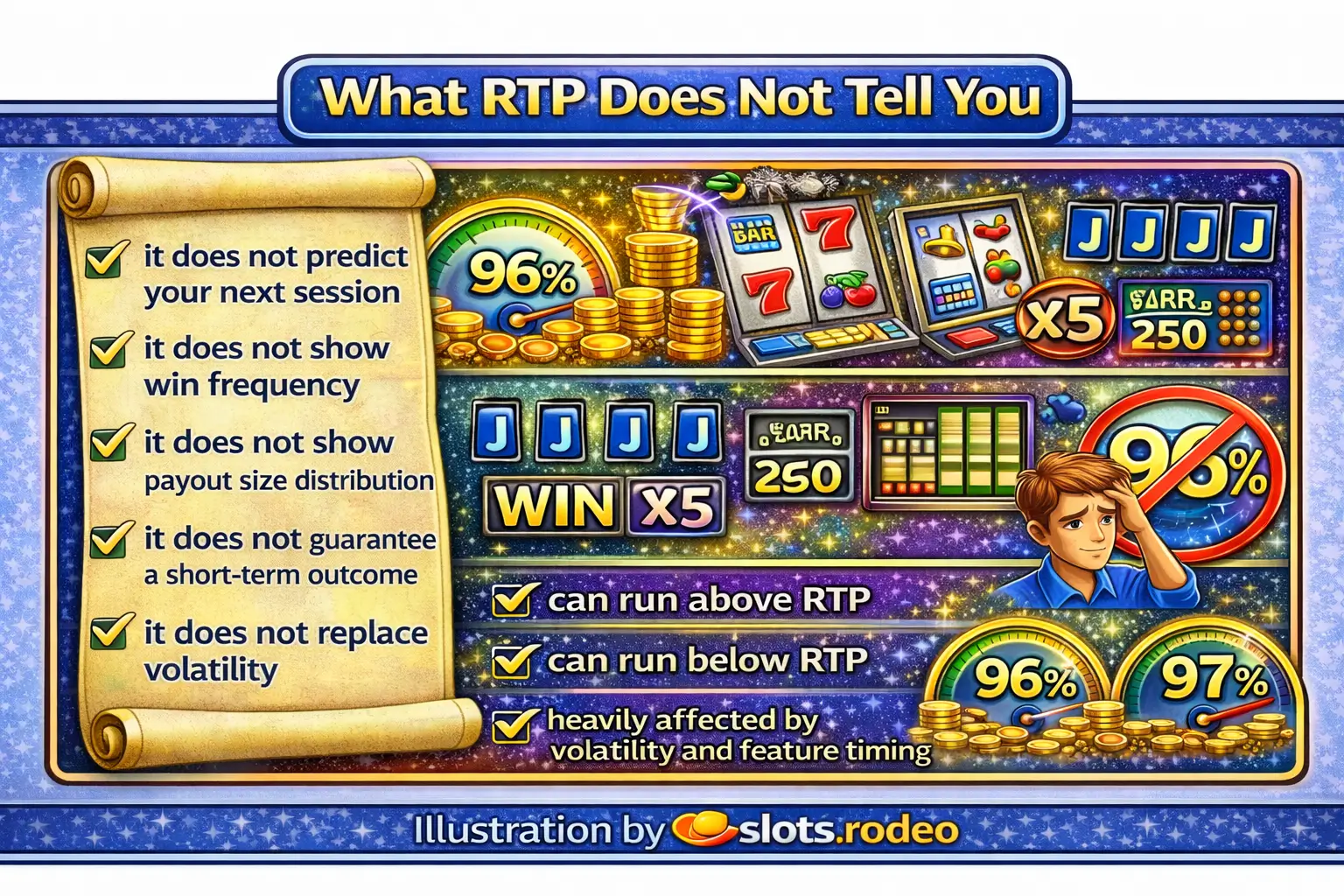
RTP and real session outcomes
A practical way to think about RTP is this:
- RTP is the blueprint
- your session is one small sample taken from that blueprint
The smaller the sample, the less closely it may resemble the full design.
This is normal. It does not mean the RTP is false. It means short-term variance is part of how slots work.
How to use RTP correctly when comparing slots
If you want RTP to be useful, apply it in a narrow and realistic way.
Check:
| What to compare | Why it matters |
|---|---|
| Exact RTP version shown in the game | The same title may exist in different RTP settings |
| RTP together with volatility | Return and payout pattern are different metrics |
| RTP together with feature structure | Bonus-heavy slots may feel different from base-game-heavy slots |
| RTP as a long-term indicator only | Prevents bad session-level assumptions |
Exact RTP version shown in the game
Why it matters
The same title may exist in different RTP settings
RTP together with volatility
Why it matters
Return and payout pattern are different metrics
RTP together with feature structure
Why it matters
Bonus-heavy slots may feel different from base-game-heavy slots
RTP as a long-term indicator only
Why it matters
Prevents bad session-level assumptions
This gives you a much clearer picture than looking at RTP alone.
FAQ
Common questions about this topic.
No. It means the slot is theoretically designed to return 96% over a very large amount of total play, not in each personal session.
Yes. Short sessions can sit far below or far above the listed RTP.
No. RTP is long-term return. Hit frequency is about how often wins occur.
No. RTP does not predict timing, feature frequency, or the next result.
Yes. Some slots are offered in multiple RTP configurations, so checking the in-game value matters.


