

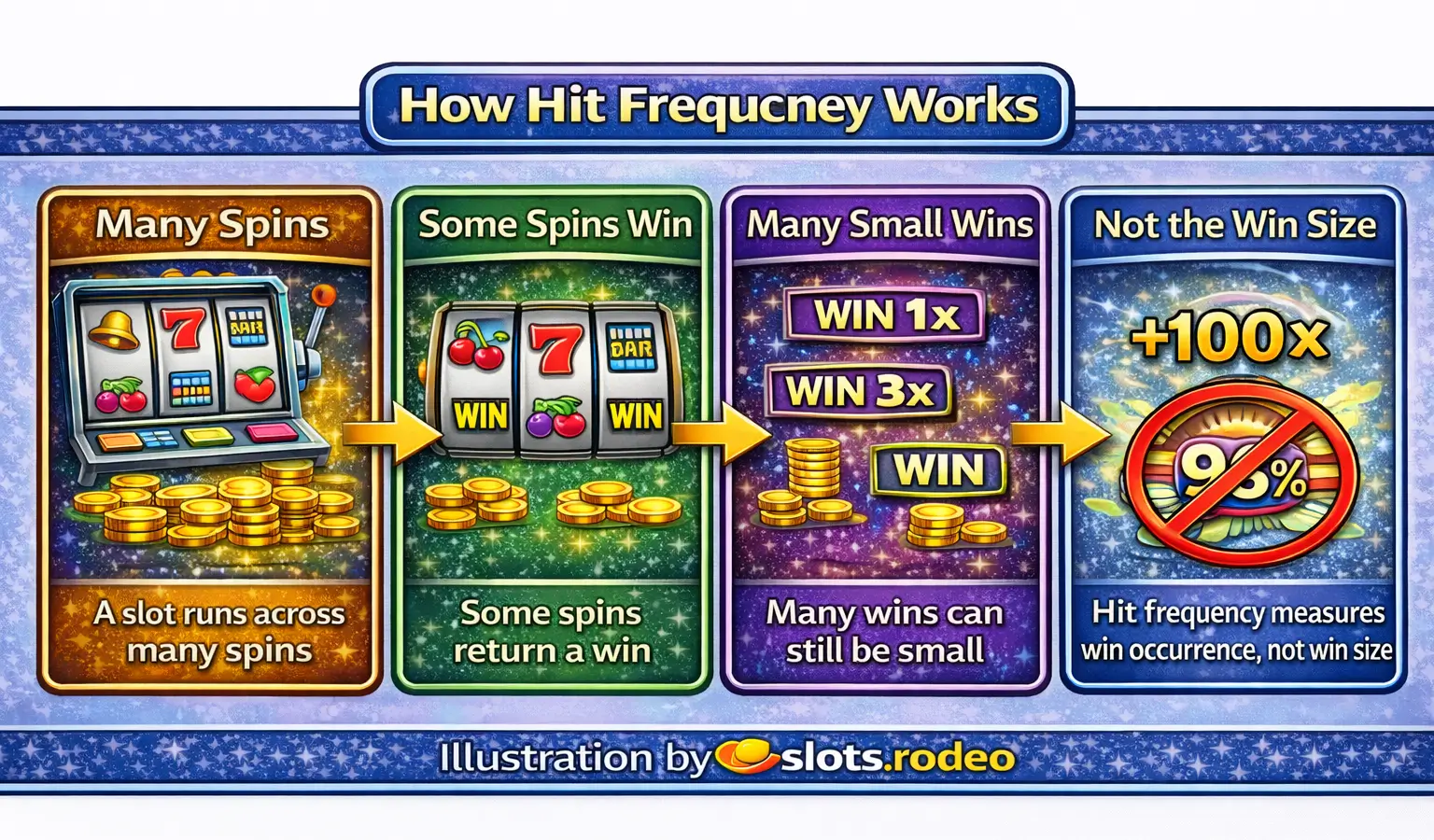
Hit frequency in slots is the rate at which a game produces a winning result.
In simple terms, it answers this question:
How often does the slot give any kind of win?
If a slot has a higher hit frequency, it usually produces winning spins more often. If it has a lower hit frequency, wins tend to appear less often.
That sounds simple, but many players misunderstand what hit frequency actually tells them. A slot that pays often does not automatically pay well. A slot that pays less often is not automatically worse. Hit frequency describes how often wins happen, not how large or useful those wins are.
What hit frequency means in practical terms
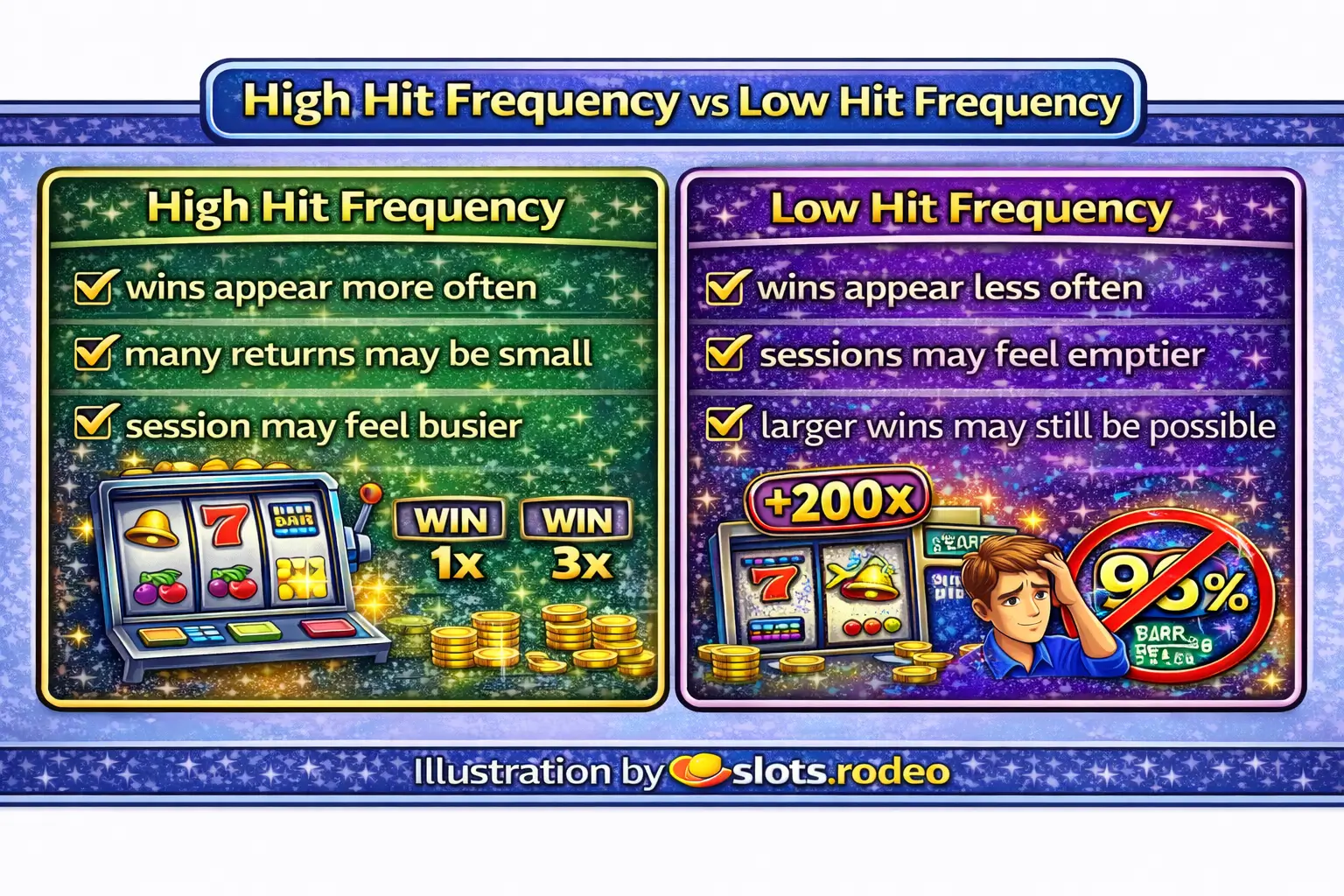
If a slot has a relatively high hit frequency, you may see:
- more frequent small returns
- fewer long dry stretches
- a more active session feel
- more spins that return something, even if the amount is small
If a slot has a relatively low hit frequency, you may see:
- more losing spins in a row
- less frequent winning events
- a quieter or harsher session feel
- more value concentrated in fewer results
The key phrase here is session feel. Hit frequency often changes how a slot feels during play, even when it does not fully explain the long-term math.
Hit frequency is about win occurrence, not win size
This is the most important distinction.
A slot can have:
- high hit frequency + many small wins
- low hit frequency + fewer but larger wins
- moderate hit frequency + mixed payout pattern
So when players say "this slot hits a lot," they usually mean it gives some kind of return more often. That does not mean those wins are large enough to offset losses.
For example:
| Slot profile | What it may look like |
|---|---|
| High hit frequency | Many small wins, frequent activity |
| Low hit frequency | Fewer wins, more empty spins |
| Similar RTP, different hit frequency | Same long-term return, very different session feel |
High hit frequency
What it may look like
Many small wins, frequent activity
Low hit frequency
What it may look like
Fewer wins, more empty spins
Similar RTP, different hit frequency
What it may look like
Same long-term return, very different session feel
This is why hit frequency should never be treated as the same thing as profitability.
How hit frequency usually works
A slot consists of many possible spin outcomes.
Some of those outcomes are:
- non-winning spins
- small wins
- medium wins
- feature triggers
- larger wins
Hit frequency focuses on one basic question:
What share of total spins returns any win at all?
If the slot generates a lot of small line hits, mini cluster wins, or frequent low-value returns, its hit frequency may be relatively high. If it gives fewer winning events overall, hit frequency may be lower.
That is the broad concept, even though providers may calculate or present it differently.
A "hit" does not always mean a profitable spin
This is where beginners often get confused.
A winning spin is not always a good spin in balance terms.
Example:
- total bet = $1.00
- winning spin returns $0.20
That is technically a hit, because it produced a win. But it is still a net loss on that spin.
So a slot can have frequent hits while still draining balance steadily over time.
This is one of the most important practical points about hit frequency.
High hit frequency vs low hit frequency
The easiest way to understand hit frequency is by contrast.
| Feature | High hit frequency | Low hit frequency |
|---|---|---|
| Winning spins | More common | Less common |
| Losing streaks | Usually shorter | Usually longer |
| Small returns | More frequent | Less frequent |
| Session feel | More active | More uneven or dry |
| Value concentration | Often spread more widely | Often more concentrated |
Winning spins
High hit frequency
More common
Low hit frequency
Less common
Losing streaks
High hit frequency
Usually shorter
Low hit frequency
Usually longer
Small returns
High hit frequency
More frequent
Low hit frequency
Less frequent
Session feel
High hit frequency
More active
Low hit frequency
More uneven or dry
Value concentration
High hit frequency
Often spread more widely
Low hit frequency
Often more concentrated
Hit frequency is not the same as RTP
A slot can have high hit frequency and average RTP. It can also have low hit frequency and the same RTP.
That is because RTP and hit frequency describe different things.
RTP
RTP is a long-term theoretical return percentage.
Hit frequency
Hit frequency is about how often winning outcomes occur.
A slot that pays often in small amounts may still return the same theoretical percentage as a slot that pays less often but with larger results.
So when comparing slots, RTP and hit frequency should not be treated as interchangeable.
Hit frequency is not the same as volatility
These two are related in how a slot feels, but they are not identical.
A lower hit frequency often appears in slots that feel more volatile, because there may be more losing spins between important events.
A higher hit frequency often appears in slots that feel smoother, because small returns happen more often.
But this is not a strict rule.
A slot can:
- pay often, but still hold most of its value for occasional bigger features
- pay infrequently, but still not be extreme in overall volatility
- combine moderate hit frequency with sharp bonus-driven swings
So hit frequency can influence session feel, but it does not define the full volatility profile by itself.
Why hit frequency matters to players
Hit frequency matters because it changes how a slot feels in short play.
It can affect:
- how often you see wins on screen
- how long dry periods feel
- how much action the base game seems to have
- whether the slot feels "alive" or "cold"
- how quickly the session can feel frustrating
For many players, this is more noticeable than RTP during actual play. You can feel hit rhythm much faster than you can measure long-term return.
High hit frequency does not mean low risk
This is another common mistake.
A slot with frequent small wins can still be risky because:
- many hits may be below the total bet
- feature value may still be hard to access
- balance can still decline steadily
- larger outcomes may remain rare
A slot that "hits often" may simply be giving back small fragments of the stake more regularly.
That may feel smoother, but it does not automatically make the game safer in any strong mathematical sense.
Low hit frequency does not mean the slot is bad
A lower hit frequency slot may simply distribute value differently.
Possible reasons include:
- more emphasis on bonus features
- larger average win size when hits do occur
- longer build-up between meaningful events
- more concentration of return in premium combinations
So a lower hit frequency slot is not automatically worse. It often just means the slot is less generous with how often it shows visible wins.
Hit frequency can include very different kinds of wins
Not every hit is equally meaningful.
Depending on the slot, a winning spin may be:
- a very small line hit
- a near-break-even return
- a scatter payout
- a cluster win
- a feature trigger
- a larger multiplier result
All of these may count as hits, but they do not carry the same weight for the player.
That is why hit frequency alone gives only part of the picture.
Simple example of hit frequency in practice
Imagine two slots:
Slot A
- wins happen often
- many wins are 0.2x to 0.8x bet
- bonus triggers are less central to the session feel
Slot B
- wins happen less often
- losing streaks are longer
- some wins are stronger when they land
- more value may sit inside the feature
Both slots may be valid designs. They simply distribute action differently.
This is the practical meaning of hit frequency.
Why providers do not always highlight hit frequency clearly
Unlike RTP, hit frequency is not always displayed in a standard, universal way across slots.
Some reasons:
- not every game help screen shows it
- different sources may describe it differently
- players often confuse it with volatility or payout rate
- the number alone can be misleading without context
That is why hit frequency is often discussed more as a gameplay characteristic than as a main published metric.
Common mistakes players make about hit frequency
Treating every hit as a good result
A hit can still be smaller than the total bet.
Confusing hit frequency with RTP
One measures win occurrence. The other measures long-term theoretical return.
Confusing hit frequency with volatility
They can be related, but they are not the same thing.
Assuming high hit frequency means better value
Frequent wins do not automatically mean stronger returns.
Assuming low hit frequency means a bad slot
Some slots simply concentrate value into fewer events.
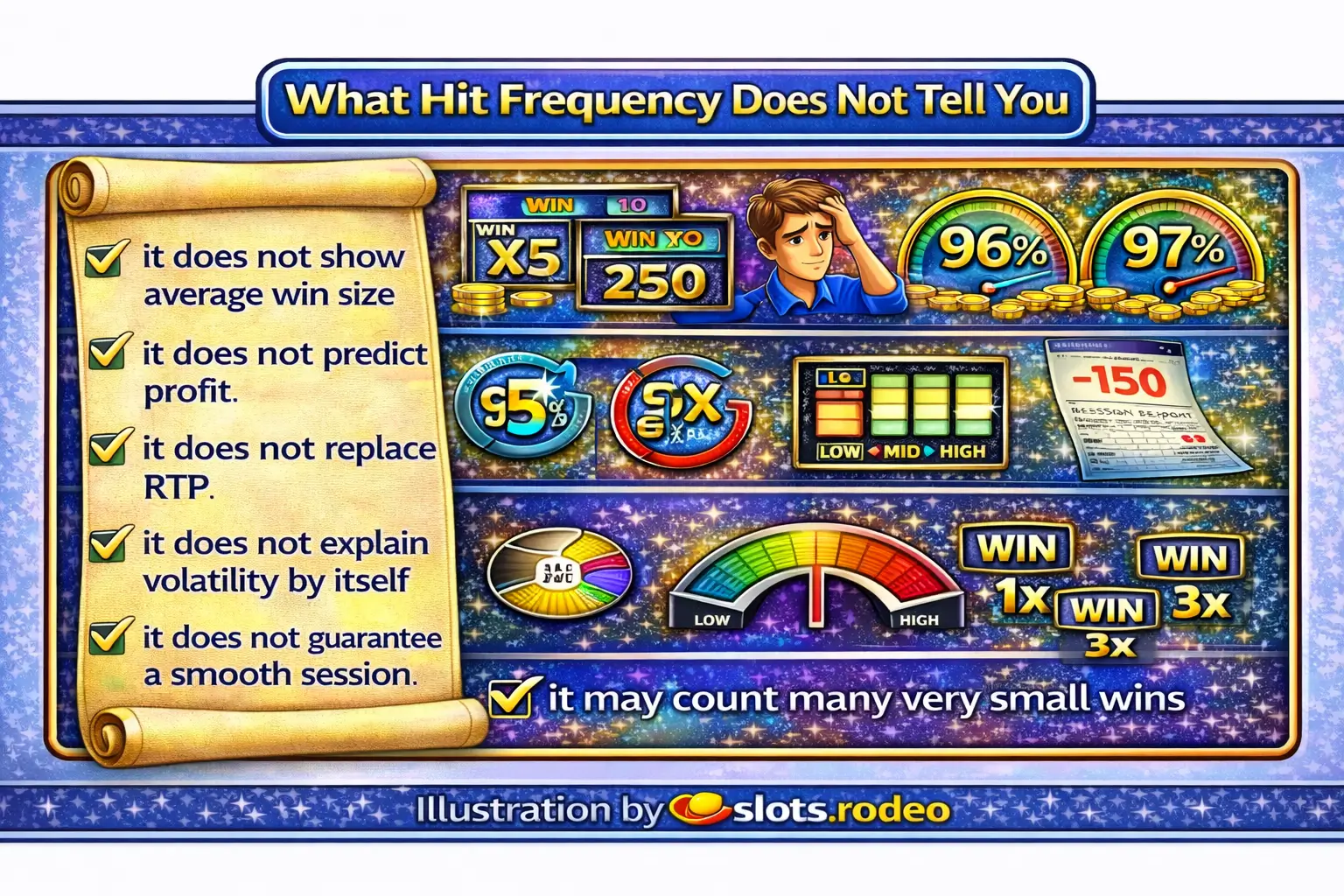
What hit frequency does not tell you
Hit frequency is useful, but limited.
It does not tell you:
- how large the average win is
- whether most wins are below or above stake
- how much of the slot's RTP is in the bonus round
- how often free spins trigger
- how volatile the game is overall
- what the max win is
- whether the slot is profitable in a short session
How to use hit frequency correctly
The best way to read hit frequency is as a session rhythm indicator.
It can help you understand:
- whether the slot tends to produce frequent visible action
- whether dry spells may feel longer
- whether the game returns small amounts regularly
- whether the gameplay feels smoother or harsher
Used this way, hit frequency is helpful.
Used as a shortcut for "good slot" or "bad slot," it becomes misleading.
Quick comparison: what hit frequency can and cannot do
| Useful for | Not enough for |
|---|---|
| Understanding how often wins appear | Predicting long-term return |
| Comparing session feel | Measuring volatility alone |
| Explaining why one slot feels more active | Estimating average win size |
| Identifying frequent small-hit designs | Judging full game value by itself |
Understanding how often wins appear
Not enough for
Predicting long-term return
Comparing session feel
Not enough for
Measuring volatility alone
Explaining why one slot feels more active
Not enough for
Estimating average win size
Identifying frequent small-hit designs
Not enough for
Judging full game value by itself
FAQ
Common questions about this topic.
It means how often the slot produces a winning result.
No. It usually means wins happen more often, not that they pay more.
Yes. Many frequent wins may still be smaller than the total bet.
No. RTP is long-term theoretical return. Hit frequency is win occurrence rate.
No. It often just means the slot gives fewer wins and may concentrate value into fewer results.


