

A high RTP looks attractive on paper, but it does not tell you what will happen in the next 20, 50, or 200 spins.
That is one of the most common misunderstandings around slots. A player sees 96.5% RTP and expects a "better" short session than on a game with 95.5% RTP. In reality, both sessions can end in completely different ways, and the higher-RTP game can still produce a poor short-term result.
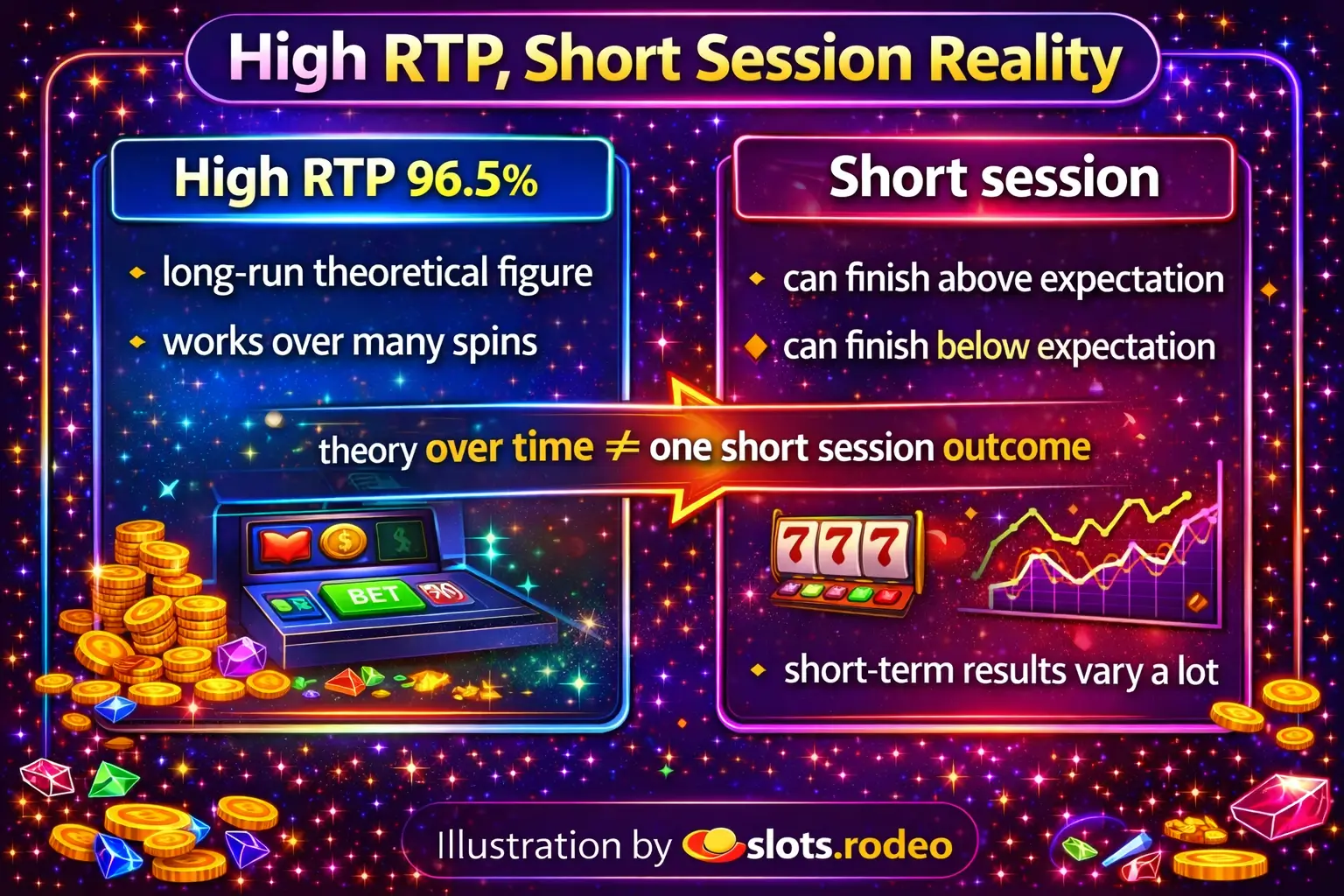
The reason is simple: RTP is a long-run theoretical average, not a short-session promise.
What RTP actually measures
RTP stands for Return to Player. It is the theoretical share of total wagered money that a slot is expected to return over a very large number of spins.
If a game has 96% RTP, that does not mean:
- you get back 96 from every 100 you stake
- each session will stay close to 96%
- losses will be limited to 4% in normal play
- a short session will reflect the stated percentage
It means that across an extremely large sample, the game's payout model is built around that theoretical return.
Why short sessions can look nothing like the RTP figure
Short sessions are small samples. Small samples are noisy.
Slots do not return value in a flat, even line. Wins come in clusters, dry spells, bonus triggers, and occasional larger hits. Because of that, a session of 30 or 100 spins can land far above or far below the long-run number.
That is normal slot behavior, not a contradiction of RTP.
The main reason: variance inside a small sample
A slot's long-run average only becomes more meaningful as the number of spins grows. In short play windows, the result is heavily affected by timing.
For example, in one 80-spin session:
- the player may not reach any meaningful feature
- several wins may return less than the stake
- the balance may decline steadily
In another 80-spin session on the same game:
- an early bonus may trigger
- one stronger hit may change the whole outcome
- the final result may look much better than the RTP would suggest
Neither session "proves" the RTP right or wrong. They are just short-term samples inside a wider distribution.
A higher RTP does not remove volatility
This is where many players mix up two separate ideas.
- RTP = long-run theoretical return
- Volatility = how unevenly that return may show up
A slot can have high RTP and still feel harsh in short sessions if a lot of its value is concentrated in rarer events. Another slot with slightly lower RTP may feel steadier because more return is spread through smaller, more regular hits.
| Slot | RTP | Volatility | Possible short-session feel |
|---|---|---|---|
| Slot A | 96.4% | High | Longer dry stretches, stronger swings |
| Slot B | 95.8% | Medium | More regular activity, smoother balance path |
Slot A
RTP
96.4%
Volatility
High
Possible short-session feel
Longer dry stretches, stronger swings
Slot B
RTP
95.8%
Volatility
Medium
Possible short-session feel
More regular activity, smoother balance path
This does not mean Slot B is better in the long run. It means the short-session experience can feel more stable even with a slightly lower RTP.
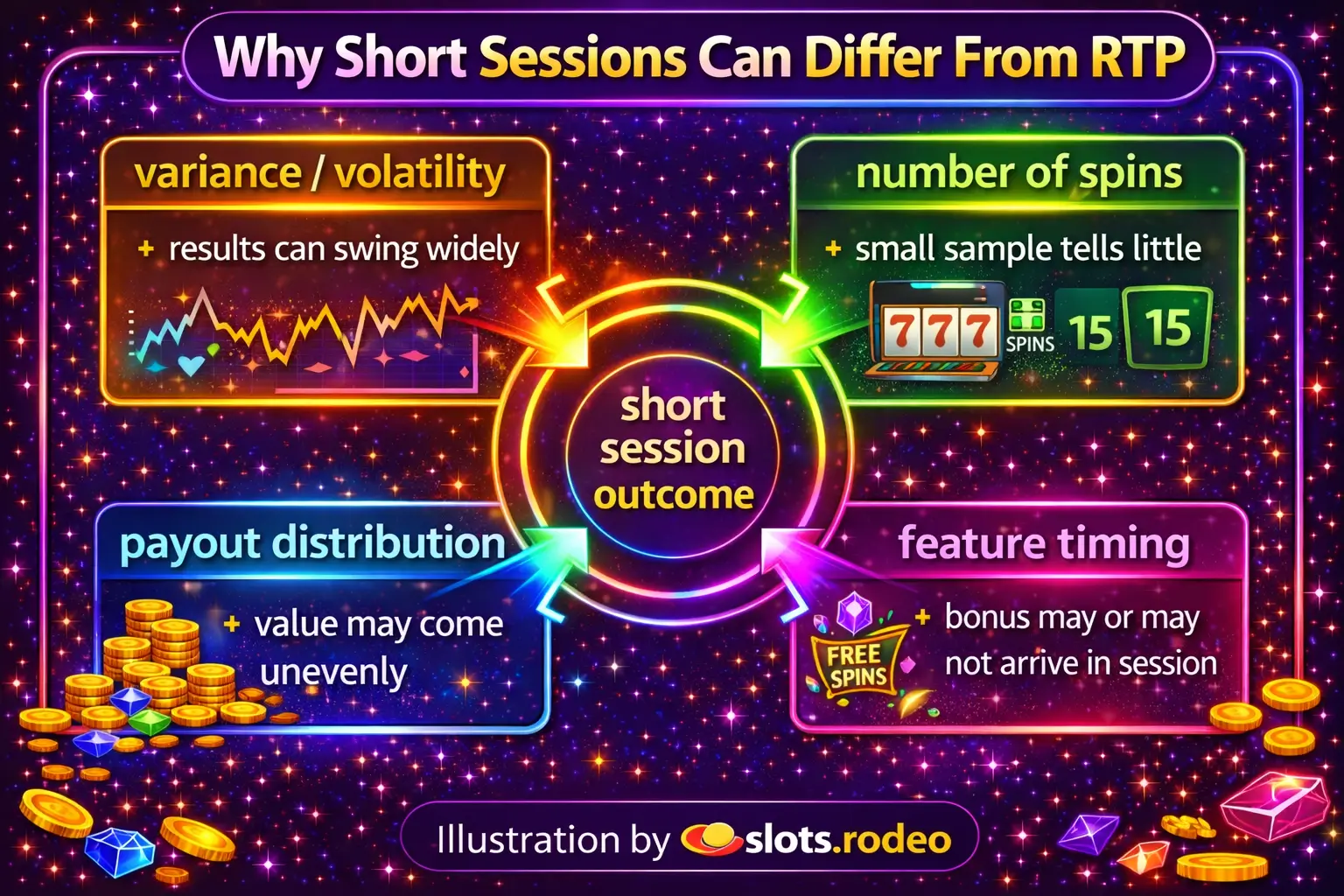
Why short sessions can differ so much from theory
Several factors shape the gap between theory and actual short play.
Bonus timing
If a slot puts a large share of its return into free spins, respins, or feature rounds, a short session may depend heavily on whether that feature appears at all.
No feature in the session? The result may look much weaker than the stated RTP.
Payout distribution
Some games return value through many smaller wins. Others keep more value tied to less frequent, larger events.
The second type often creates wider short-term deviation.
Win size, not just win count
A slot may produce many "winning" spins that still return less than the total bet. That can make a session feel bad even when the hit rate looks active.
Session length
The shorter the session, the less meaningful RTP becomes as a practical guide to that exact outcome.
Two players can get opposite results on the same slot
This is one of the easiest ways to understand the issue.
Imagine the same slot with 96.2% RTP:
| Player | Session length | What happens | Short-term result |
|---|---|---|---|
| Player A | 60 spins | No bonus, several small losses | Weak session |
| Player B | 60 spins | Early bonus and one larger hit | Strong session |
Player A
Session length
60 spins
What happens
No bonus, several small losses
Short-term result
Weak session
Player B
Session length
60 spins
What happens
Early bonus and one larger hit
Short-term result
Strong session
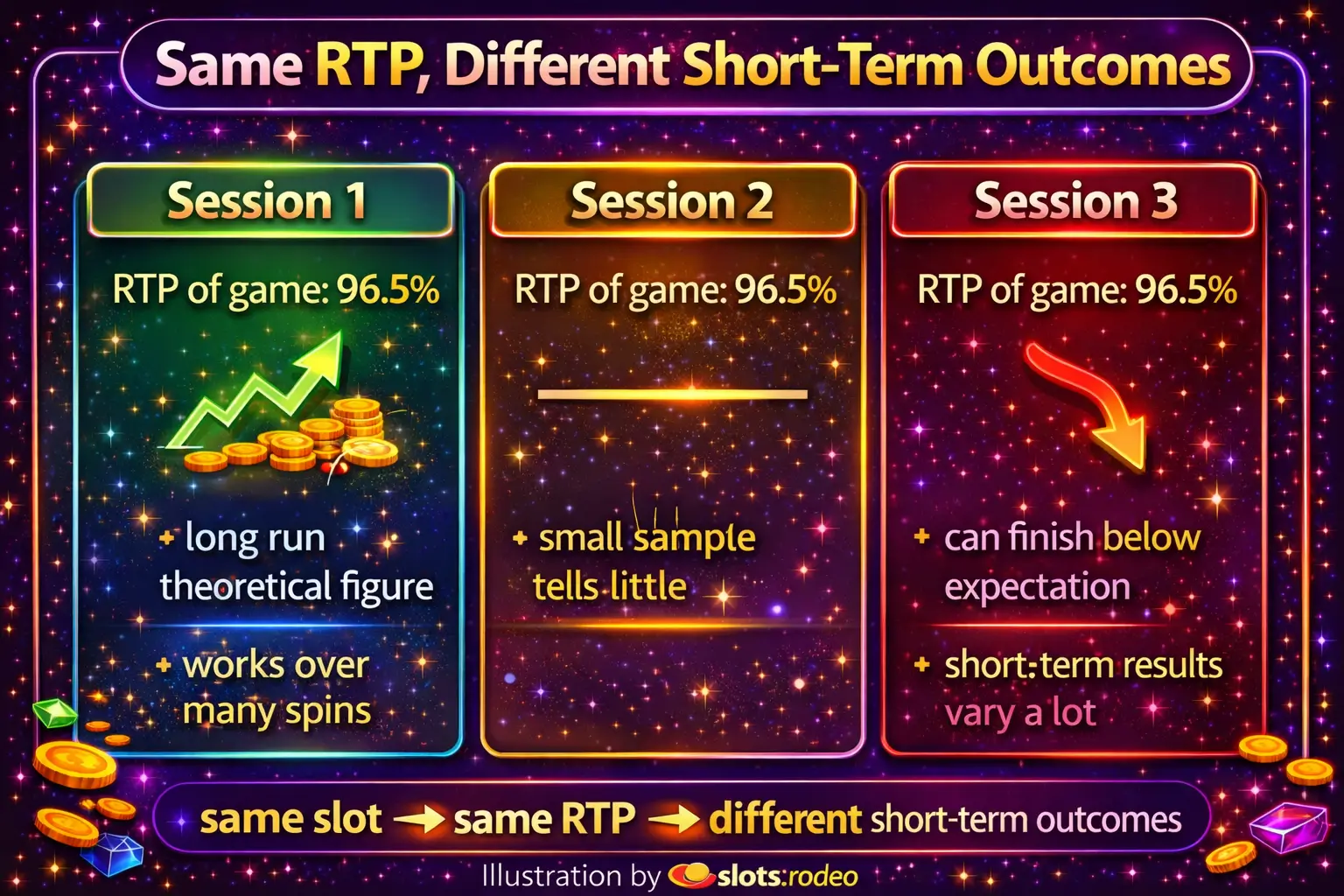
Same game. Same RTP. Same theoretical model. Very different short-term result.
That is why RTP should not be treated as a session forecast.
Why a 1% RTP difference may matter less in a short session than players think
Over the long run, RTP differences matter. A 96.5% slot is theoretically more favorable than a 95.5% slot, all else equal.
But in one short session, that gap can be drowned out by normal volatility.
A player can lose quickly on the higher-RTP game and do better on the lower-RTP game in the same evening. That does not mean RTP is useless. It means short-term variance is stronger than many people expect.
What high RTP is useful for - and what it is not
A high RTP is useful when you want to compare the long-run theoretical return of different games or different RTP versions of the same game.
It is not reliable as a promise of:
- a safer short session
- steadier balance movement
- quicker bonuses
- fewer losing stretches
- immediate "better value" over a small number of spins
That is why RTP should be read together with other factors.
What to check besides RTP
If you want a better idea of how a slot may feel in short play, RTP alone is not enough.
| What to check | Why it matters |
|---|---|
| Volatility | Helps explain how wide short-term swings may be |
| Bonus structure | Shows whether much of the return depends on features |
| Base-game activity | Indicates whether the session may feel active between bonuses |
| Max win profile | Suggests whether the slot leaves room for more top-heavy outcomes |
| In-game rules | Best source for the game's own stated setup |
Volatility
Why it matters
Helps explain how wide short-term swings may be
Bonus structure
Why it matters
Shows whether much of the return depends on features
Base-game activity
Why it matters
Indicates whether the session may feel active between bonuses
Max win profile
Why it matters
Suggests whether the slot leaves room for more top-heavy outcomes
In-game rules
Why it matters
Best source for the game's own stated setup
This gives a more realistic picture of the session pattern than RTP by itself.
A simple way to think about it
RTP answers this question:
Over a very large sample, what is the game theoretically built to return?
Short sessions raise a different question:
How will this particular slice of play land before the long-run average has any chance to show itself?
Those are not the same question.
When RTP still matters
RTP still matters because it remains one of the clearest indicators of long-run theoretical value.
If two versions of the same slot are identical except one has higher RTP, the higher-RTP version is generally the better mathematical option over time.
But that long-run edge does not protect a short session from normal variance.
FAQ
Common questions about this topic.
No. A high RTP improves long-run theoretical return, but a short session can still go badly.
Yes. In short play, variance can easily outweigh a small RTP difference.
Because RTP is not a guarantee for the next session. Short samples can sit far below the long-run average.
No. It is useful for long-run comparison and for checking game value, but it should not be read as a session prediction.
Volatility, payout distribution, feature timing, and bonus dependence often shape short-session feel more directly than RTP alone.

