

Not all slot wins are formed the same way.
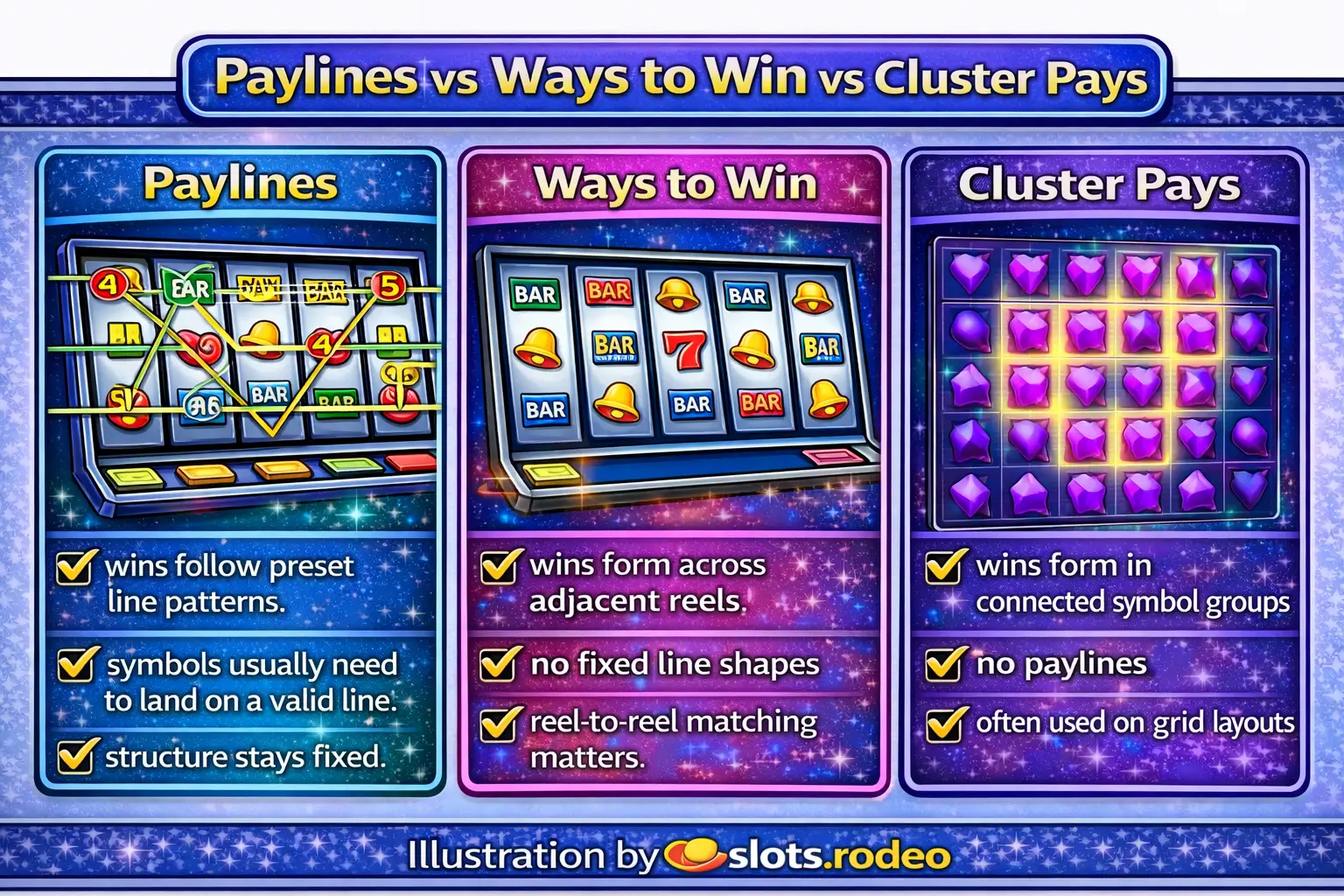
Some slots use paylines, where symbols must land on fixed line patterns. Some use ways to win, where matching symbols count across reels without needing a set line. Others use cluster pays, where wins come from groups of touching symbols.
This matters because the same reel screen can be a win in one slot and a non-win in another. If you do not understand the win system, you can misread both payouts and game behavior.
Why the win system matters
The win system tells the slot how to recognize a valid win.
Before the game can calculate any payout, it has to answer questions like:
- do the symbols need to sit on a preset line?
- do they only need to appear on consecutive reels?
- do they need to touch each other in a group?
- does position matter more than count?
- does adjacency matter more than reel order?
That is why the win system sits at the center of slot math. It defines the basic structure of every winning result.
What paylines are
A payline is a preset path across the reels.
In a payline slot, symbols usually have to land on one of those specific line patterns to create a winning combination. The line may run straight across, or it may zigzag depending on the game design.
For example, a 5-reel slot might use:
- 10 paylines
- 20 paylines
- 25 paylines
- 40 fixed paylines
A simple classic line is the middle horizontal row. More complex paylines can move up and down across the reels.
Core idea of paylines
The symbols must appear on the right pattern, not just anywhere on screen.
How paylines usually work
In most payline slots:
- wins are counted from left to right
- matching symbols must appear on an active line
- one symbol per reel usually matters for the line result
- the paytable shows how many matching symbols are needed
Example:
If a slot has 20 paylines and premium symbols land on reels 1, 2, and 3 in the exact shape of one active payline, that combination can pay.
If the same symbols land outside the payline pattern, they may not count at all.
What ways to win means
A ways to win system removes fixed line patterns.
Instead of following paylines, the slot usually pays when matching symbols land on consecutive reels, often from left to right. Row position is usually less important than reel presence.
A common example is a 5-reel slot where any matching symbol on reel 1 can connect with matching symbols on reel 2, reel 3, and so on.
This is why a ways slot may show values like:
- 243 ways
- 1,024 ways
- 4,096 ways
- 46,656 ways
The number represents how many possible reel-to-reel winning paths exist under the game's structure.
Core idea of ways to win
The symbols usually need to appear on adjacent reels, not on a preset line.
How ways to win usually work
In many ways slots:
- symbols usually pay from left to right
- matching symbols must appear on consecutive reels
- exact row position usually does not matter
- multiple matching symbols on the same reel can create more combinations
For example:
- 1 matching symbol on reel 1
- 2 matching symbols on reel 2
- 3 matching symbols on reel 3
This can create several winning ways from the same symbol type, because the game counts all valid reel-to-reel paths.
That is one reason ways slots often feel more flexible than line-based slots.
What cluster pays means
A cluster pays system does not rely on paylines or standard reel-to-reel chains.
Instead, wins come from groups of matching symbols that touch each other. The exact rule depends on the slot, but touching usually means horizontal and vertical connection, and sometimes diagonal connection as well if the game states that.
Cluster slots often use grid layouts rather than standard payline logic.
A cluster game may require:
- 4 matching symbols connected
- 5 matching symbols connected
- 6 or more connected symbols
Core idea of cluster pays
The symbols need to form a connected group, not a line or reel sequence.
How cluster pays usually work
In many cluster slots:
- wins are based on adjacent matching symbols
- connection matters more than reel order
- larger groups usually pay more
- winning symbols may disappear and trigger cascades or symbol drops
For example, if 6 matching symbols touch each other in a block or chain, that may create a valid cluster win even though there is no payline and no left-to-right sequence.
This gives cluster slots a different visual logic from traditional reel slots.
The same screen can mean different things
This is one of the biggest reasons players should understand these systems.
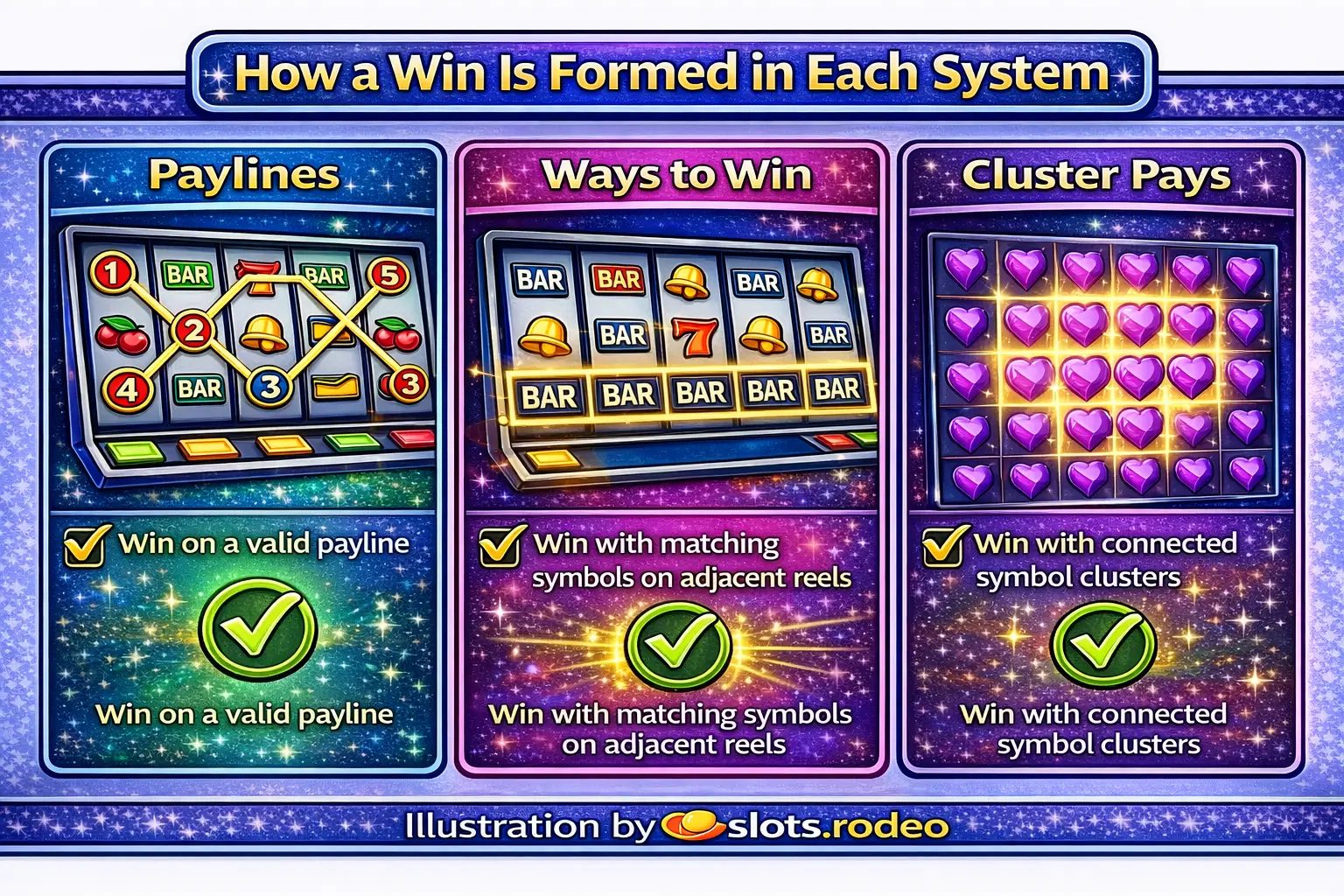
Imagine the same set of matching symbols on screen:
- in a payline slot, they may fail because they do not sit on one active line
- in a ways slot, they may pay because they appear on consecutive reels
- in a cluster slot, they may fail because they do not touch each other
Or the reverse can happen.
That means symbol appearance alone is not enough. The win system decides what counts.
Main differences at a glance
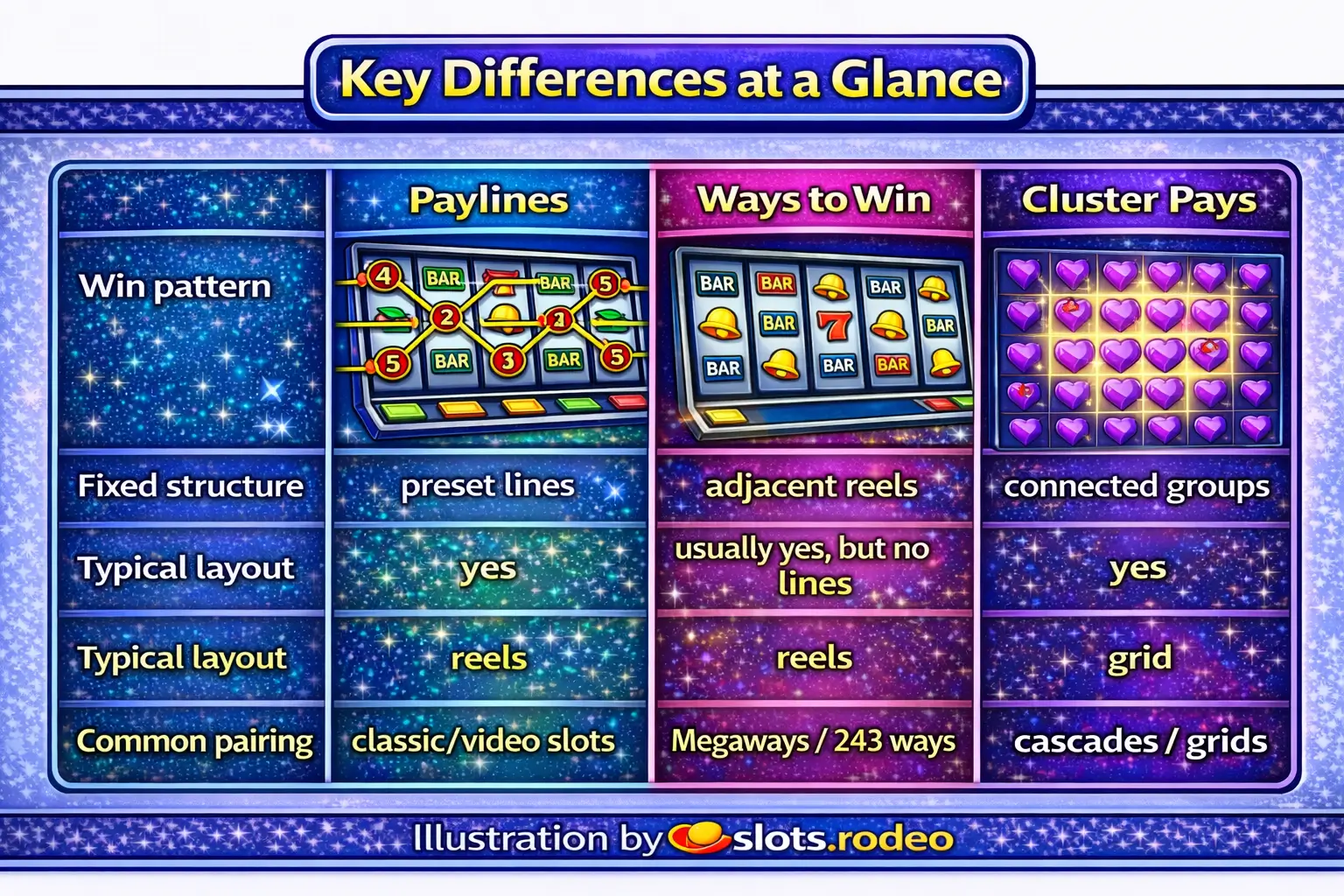
| Feature | Paylines | Ways to Win | Cluster Pays |
|---|---|---|---|
| Core structure | Fixed line patterns | Consecutive reels | Connected symbol groups |
| Position requirement | Must match a payline | Reel order matters more than row | Symbols must touch |
| Left-to-right logic | Usually yes | Usually yes | Usually no standard reel direction |
| Grid flexibility | Lower | Medium to high | High |
| Common display | 10, 20, 25, 40 lines | 243, 1024, 4096, 46656 ways | Cluster size requirement |
| Typical feel | More structured | More open reel matching | More grid-based and group-driven |
Core structure
Paylines
Fixed line patterns
Ways to Win
Consecutive reels
Cluster Pays
Connected symbol groups
Position requirement
Paylines
Must match a payline
Ways to Win
Reel order matters more than row
Cluster Pays
Symbols must touch
Left-to-right logic
Paylines
Usually yes
Ways to Win
Usually yes
Cluster Pays
Usually no standard reel direction
Grid flexibility
Paylines
Lower
Ways to Win
Medium to high
Cluster Pays
High
Common display
Paylines
10, 20, 25, 40 lines
Ways to Win
243, 1024, 4096, 46656 ways
Cluster Pays
Cluster size requirement
Typical feel
Paylines
More structured
Ways to Win
More open reel matching
Cluster Pays
More grid-based and group-driven
Paylines: strengths and limits
What paylines make clear
Paylines are easy to explain once you see the line map. They give the slot a fixed structure.
What can confuse beginners
Players often see matching symbols and assume they should pay, even when they are not on the same active line.
Typical use
Paylines are common in classic slots, older video slots, and many modern games that still use a structured reel format.
Ways to win: strengths and limits
What ways make easier
Ways systems usually reduce the need to follow specific row patterns. Matching symbols just need to continue across reels.
What can confuse beginners
Players may assume "any matching symbols anywhere" count, which is usually not true. Consecutive reel order still matters in most ways slots.
Typical use
Ways to win is common in modern video slots, especially games built around more open reel layouts.
Cluster pays: strengths and limits
What cluster pays changes
Cluster pays shifts attention from reels and lines to symbol groups. It often feels more like a grid puzzle than a traditional line slot.
What can confuse beginners
Players may not know whether diagonal connection counts, or how large the cluster must be, unless they read the rules.
Typical use
Cluster pays often appears in grid-based slots with cascades, symbol drops, chain reactions, or color/group mechanics.
Win counting works differently in each system
Another important difference is how multiple wins can be counted.
In paylines
The slot may count wins across several different active lines.
In ways to win
The slot may count many reel-to-reel combinations from one symbol type if multiple matching symbols appear on adjacent reels.
In cluster pays
The slot may count one or more connected groups, depending on the game's rules and how the clusters are formed.
This affects both the look and feel of the payout process.
These systems also shape game feel
The win system does more than decide valid combinations. It also changes how the slot feels during play.
| System | Typical feel |
|---|---|
| Paylines | More fixed and pattern-based |
| Ways to Win | More open and combination-heavy |
| Cluster Pays | More group-driven and grid-oriented |
Paylines
Typical feel
More fixed and pattern-based
Ways to Win
Typical feel
More open and combination-heavy
Cluster Pays
Typical feel
More group-driven and grid-oriented
This does not mean one system is better. It means each one gives the slot a different structure.
Common beginner mistakes
Thinking all matching symbols should pay
That depends entirely on the win system.
Confusing ways to win with cluster pays
Ways still usually depends on consecutive reels. Cluster pays depends on connected symbol groups.
Ignoring line count in payline slots
In line-based slots, the active line structure is the first thing to check.
Assuming row position never matters in ways slots
Row position usually matters less than in paylines, but the exact rules still depend on the game.
Not checking cluster size requirements
In cluster pays, the minimum group size is essential.
What to check in the paytable
Before you judge any slot's win logic, check these points:
| What to check | Why it matters |
|---|---|
| Win system type | Tells you whether the game uses lines, ways, or clusters |
| Reading direction | Shows whether wins count left to right, both ways, or by group adjacency |
| Minimum match requirement | Explains how many symbols are needed |
| Special symbol interaction | Wilds and scatters may behave differently under each system |
| Multiple win counting rules | Important for understanding combined payouts |
| Cascade or drop rules | Especially relevant in cluster games |
Win system type
Why it matters
Tells you whether the game uses lines, ways, or clusters
Reading direction
Why it matters
Shows whether wins count left to right, both ways, or by group adjacency
Minimum match requirement
Why it matters
Explains how many symbols are needed
Special symbol interaction
Why it matters
Wilds and scatters may behave differently under each system
Multiple win counting rules
Why it matters
Important for understanding combined payouts
Cascade or drop rules
Why it matters
Especially relevant in cluster games
Which system is easiest for beginners?
For many beginners:
- paylines are easiest once the line map is visible
- ways to win are easier once you understand that reel sequence matters
- cluster pays are easiest if you think in symbol groups instead of lines
There is no universal best system. The important thing is to know which one the slot uses before you interpret the reels.
FAQ
Common questions about this topic.
Paylines use fixed line patterns. Ways to win usually counts matching symbols on consecutive reels without needing a preset line.
No. Cluster pays uses touching groups of matching symbols, while ways to win usually uses adjacent reels.
Yes. The same symbol layout can be valid in one system and invalid in another.
All three are still used, but ways to win and cluster pays are especially common in many modern video slots.
Yes. The paytable or help screen is the best place to confirm how the game forms wins.


