

Some slot games do not use paylines or ways to win. Instead, they pay when matching symbols form a cluster.
This changes how the screen is read. In a payline slot, you check line paths. In a ways-to-win slot, you check adjacent reels. In a cluster pays slot, you usually check whether enough matching symbols are touching each other on the grid.
That is the main idea: a cluster pays game rewards groups of connected matching symbols rather than reel-to-reel line patterns.
What "cluster pays" means
In a cluster pays slot, a win usually happens when a required number of identical symbols connect horizontally and/or vertically. In some games, diagonal contact may count, but in many it does not. The exact rule is always defined in the paytable or help screen.
Instead of asking:
- are the symbols on a payline?
- do they appear on adjacent reels?
the game asks:
- are enough matching symbols connected together to form a valid group?
That is why cluster pays games are often built on grid-based layouts rather than on a classic 5-reel structure.
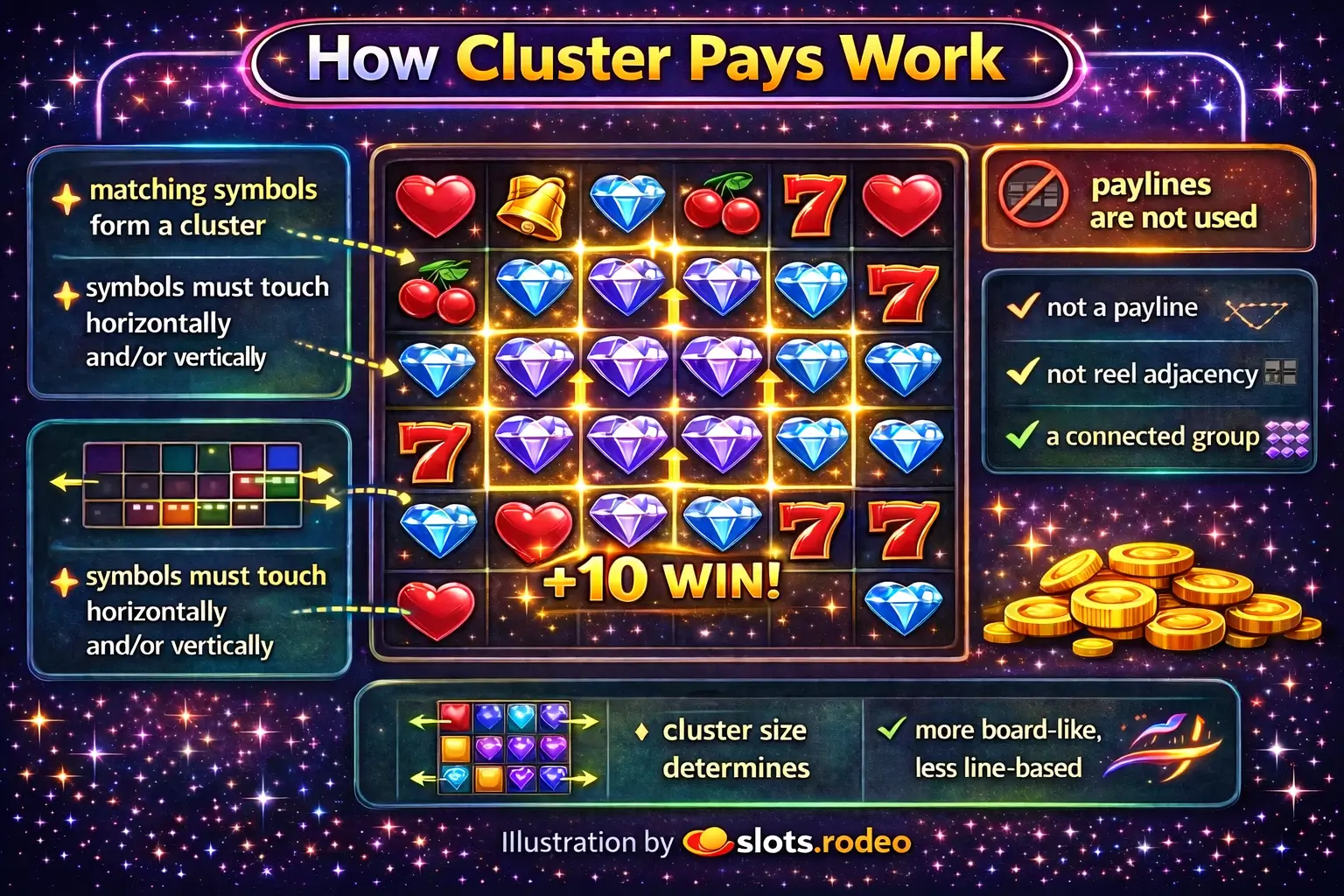
ALT: Example of a slot grid showing how cluster pays use connected matching symbols instead of paylines
Caption: Cluster pays slots count connected symbol groups on a grid rather than wins along preset paylines.
How a cluster win is formed
A cluster win usually needs a minimum number of matching symbols touching each other. A common rule is 5 or more connected symbols, but this is not universal. Some games use 4, 6, or another number.
The connection rule matters more than the total number of visible symbols. You can have many copies of the same symbol on the screen, but if they are split into separate groups, they may create multiple smaller clusters or no valid win at all.
For that reason, players should think in terms of connected shape, not simple symbol count.
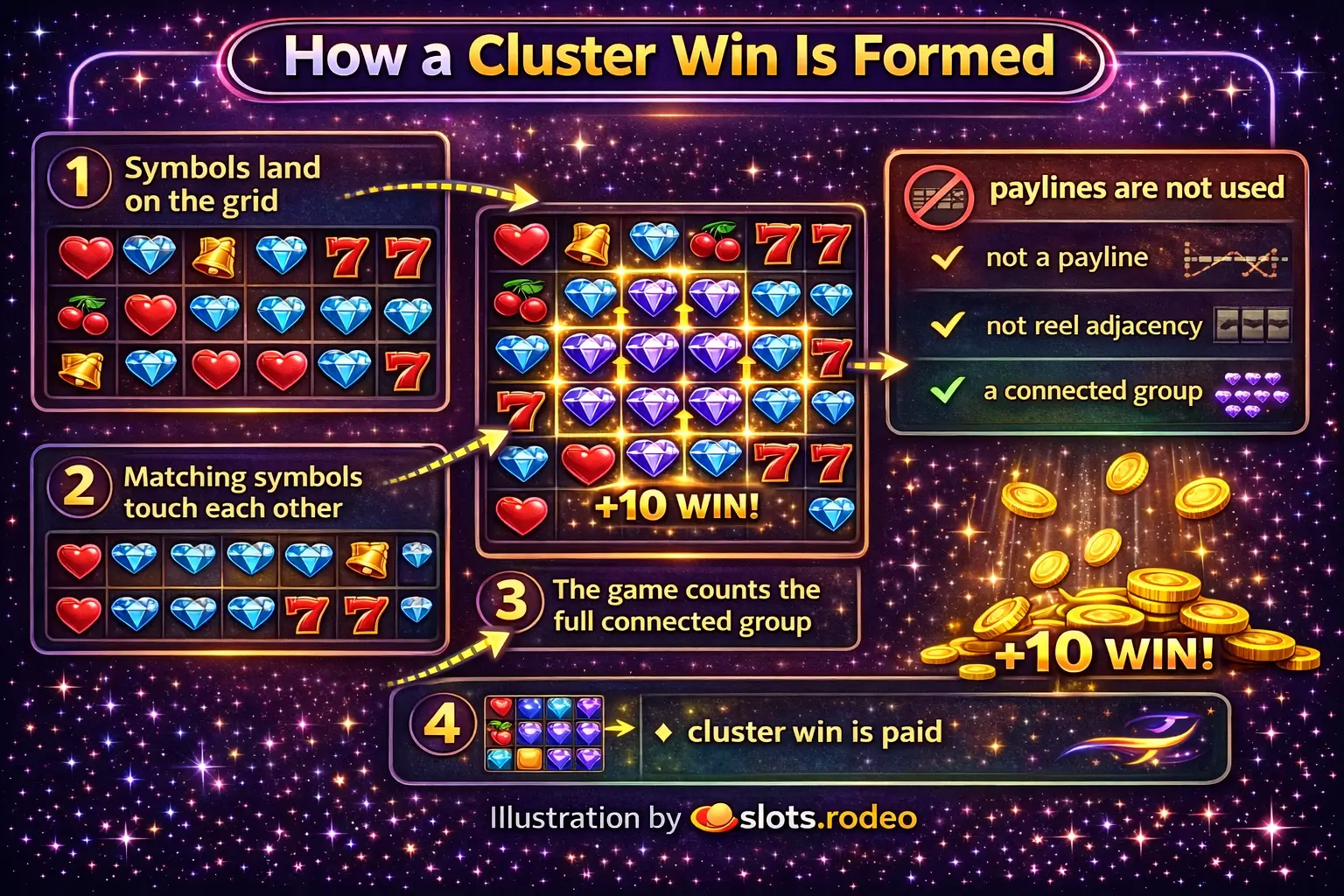
ALT: Illustration showing how a valid cluster win is formed from touching matching symbols on a slot grid
Caption: A cluster win depends on connected matching symbols, not on line direction or reel order.
The rule that matters most: what counts as "connected"
This is the first thing to verify in any cluster pays slot.
In most games, symbols count as connected when they touch:
- horizontally
- vertically
Some titles may also allow diagonal connections, but you should never assume that. This single rule changes how easy it is for clusters to form.
| Rule to check | Why it matters |
|---|---|
| Minimum cluster size | Tells you how many matching symbols are needed for a win |
| Connection type | Shows whether only side-to-side contact counts or diagonal contact is included |
| Grid size | A larger grid can create more possible cluster shapes |
| Symbol removal after wins | Affects whether new symbols drop in and continue the sequence |
| Wild role | Some cluster games allow wilds to complete clusters |
| Multiplier behavior | Some games apply growing multipliers during consecutive cascades |
Minimum cluster size
Why it matters
Tells you how many matching symbols are needed for a win
Connection type
Why it matters
Shows whether only side-to-side contact counts or diagonal contact is included
Grid size
Why it matters
A larger grid can create more possible cluster shapes
Symbol removal after wins
Why it matters
Affects whether new symbols drop in and continue the sequence
Wild role
Why it matters
Some cluster games allow wilds to complete clusters
Multiplier behavior
Why it matters
Some games apply growing multipliers during consecutive cascades
A player who skips the paytable can easily misread the screen. In a cluster slot, the symbols may look close enough to form a win, but if they do not follow the exact connection rule, the game will not count them.
Why cluster pays are often linked to cascading mechanics
Cluster pays and cascades often appear together because they fit the same screen logic.
A typical sequence looks like this:
- a cluster forms
- the cluster pays
- those winning symbols disappear
- new symbols fall into the empty spaces
- another cluster may form
This is why many cluster slots feel more like a chain reaction than a spin-by-spin line game. The mechanic is based on grid replacement, not on a fixed reel stop result that ends immediately after one evaluation.
That does not mean all cluster pays slots use cascades, but the combination is common because it works naturally with connected groups on a grid.
Cluster pays versus paylines and ways to win
Cluster pays is not just a visual variation. It is a different win logic.
| System | What the game checks | Usual layout |
|---|---|---|
| Traditional paylines | Whether symbols land on preset line paths | Reel-based |
| Ways to win | Whether matching symbols appear on adjacent reels | Reel-based |
| Cluster pays | Whether matching symbols touch and form a connected group | Grid-based |
Traditional paylines
What the game checks
Whether symbols land on preset line paths
Usual layout
Reel-based
Ways to win
What the game checks
Whether matching symbols appear on adjacent reels
Usual layout
Reel-based
Cluster pays
What the game checks
Whether matching symbols touch and form a connected group
Usual layout
Grid-based
This difference affects how players read the screen.
In a payline slot, the same symbols can appear and still not pay because they are off-line.
In a ways-to-win slot, the same symbols can pay if they appear on consecutive reels.
In a cluster pays slot, reel order usually matters much less than group shape and direct contact.
Why cluster games often look busier
Cluster pays slots tend to place more focus on the whole board rather than on one reel strip at a time.
That usually leads to:
- square or near-square grids
- more symbol positions visible at once
- chain reactions after wins
- expanding or transforming symbol groups
- mechanics that change the board during the sequence
This can make the format more readable for some players and less readable for others.
A beginner used to traditional slots may first look for left-to-right logic and miss the real rule. In cluster pays, the important question is not "which line hit?" but "which connected group qualified?"
What cluster pays does not tell you
The cluster pays format explains how wins are counted, but it does not tell you:
- how volatile the game is
- how often clusters appear
- how often cascades continue
- how strong the bonus round is
- how large the max win can be
Two cluster pays slots can use the same core mechanic and still play very differently. One may produce frequent small removals. Another may depend on rare board-building moments and bonus features.
So the format matters, but it is only one part of the game model.
Common mistakes when reading a cluster pays slot
Counting separated symbols as one group
Players often see many matching symbols and assume they all combine. They do not unless they are connected according to the game's rule.
Assuming diagonals always count
Some games allow it, many do not. This must be checked in the rules.
Treating scatters like cluster symbols
Scatter symbols often follow separate trigger rules and may not need to be connected at all.
Ignoring wild behavior
In some cluster pays slots, wilds help complete a group. In others, their role is limited or feature-specific.
A quick board-reading method that actually helps
When you open a cluster pays game, check these in order:
- the minimum cluster size
- whether only horizontal/vertical contact counts
- whether diagonal contact is included
- whether wins remove symbols from the board
- whether new symbols fall in after removal
- whether multipliers or modifiers build during cascades
That short check tells you far more than the label "cluster pays" on its own.
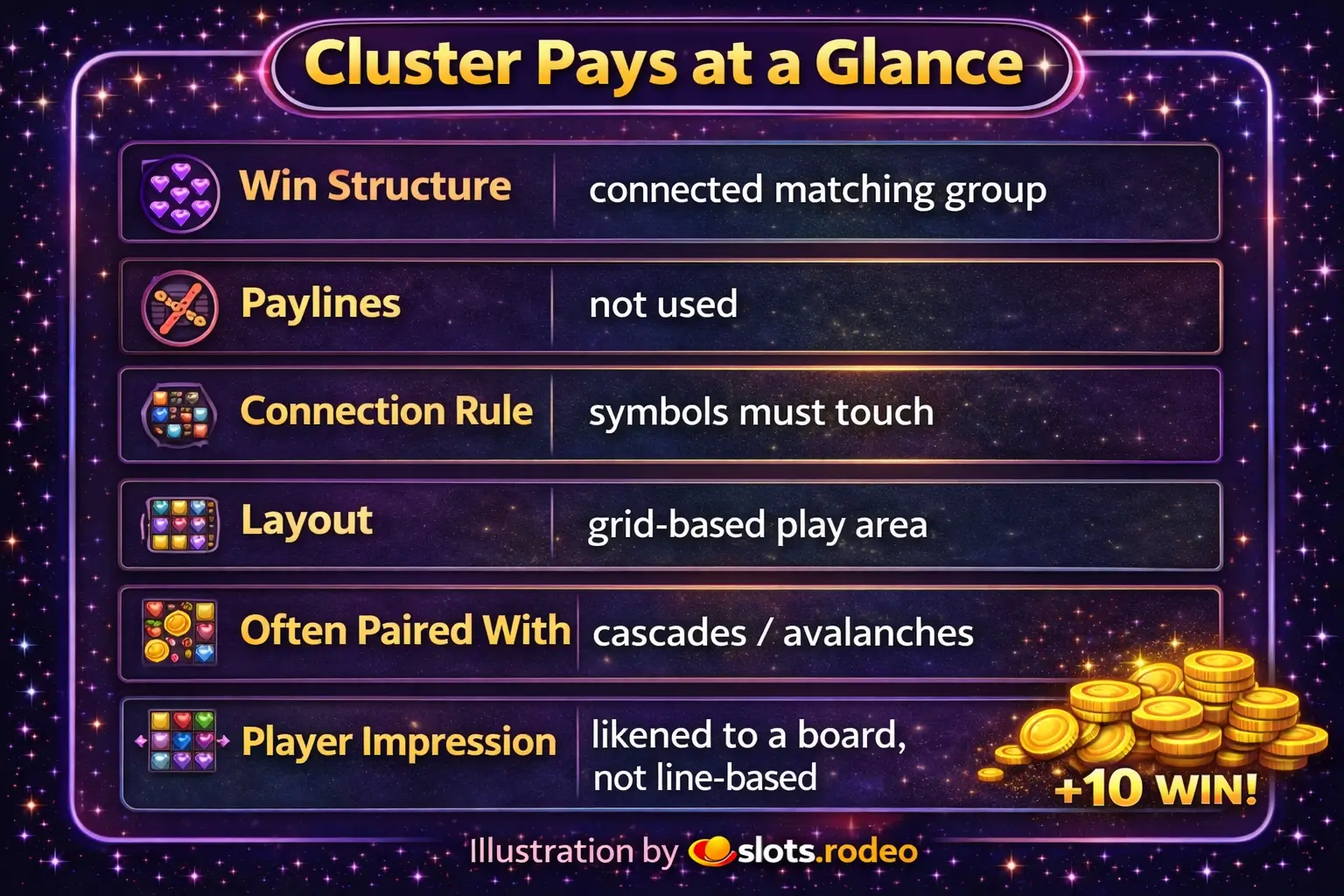
ALT: Overview graphic summarizing the main rules and characteristics of cluster pays slots
Caption: Cluster pays slots focus on connected matching symbol groups, often on grid layouts and often with cascades after wins.
Where cluster pays usually makes the biggest difference
This format matters most when the game includes mechanics that change the board after the first win. That is where cluster pays becomes more than a win-counting method.
Examples include:
- cascades or avalanches
- symbol upgrades
- expanding clusters
- sticky modifiers on the grid
- feature progress built through repeated removals
In those games, the cluster system supports a board that evolves during the sequence rather than resetting the logic after every single result.
FAQ
Common questions about this topic.
No. A cluster pays slot does not rely on preset paylines. It usually pays when enough matching symbols connect on the grid.
It depends on the game. Many titles use 5 or more connected symbols, but the required number can differ.
Sometimes, but not always. You need to check the paytable or help screen for the exact connection rule.
No, but the combination is common. Cluster pays works naturally with symbol removal and replacement mechanics.
For some players, yes. For others, no. It depends on whether connected groups feel more intuitive than line-based win paths.


