

Classic slots and video slots are built on the same basic idea: you spin reels and the game checks whether a valid winning combination is formed.
But in practice, they can feel very different.
A classic slot usually keeps things simple. A video slot usually adds more symbols, more mechanics, more feature depth, and a more complex game structure.
If you are new to slots, this is one of the most useful distinctions to understand. It helps explain why one game feels straightforward and another feels much busier, even before you look at RTP, volatility, or bonus rules.
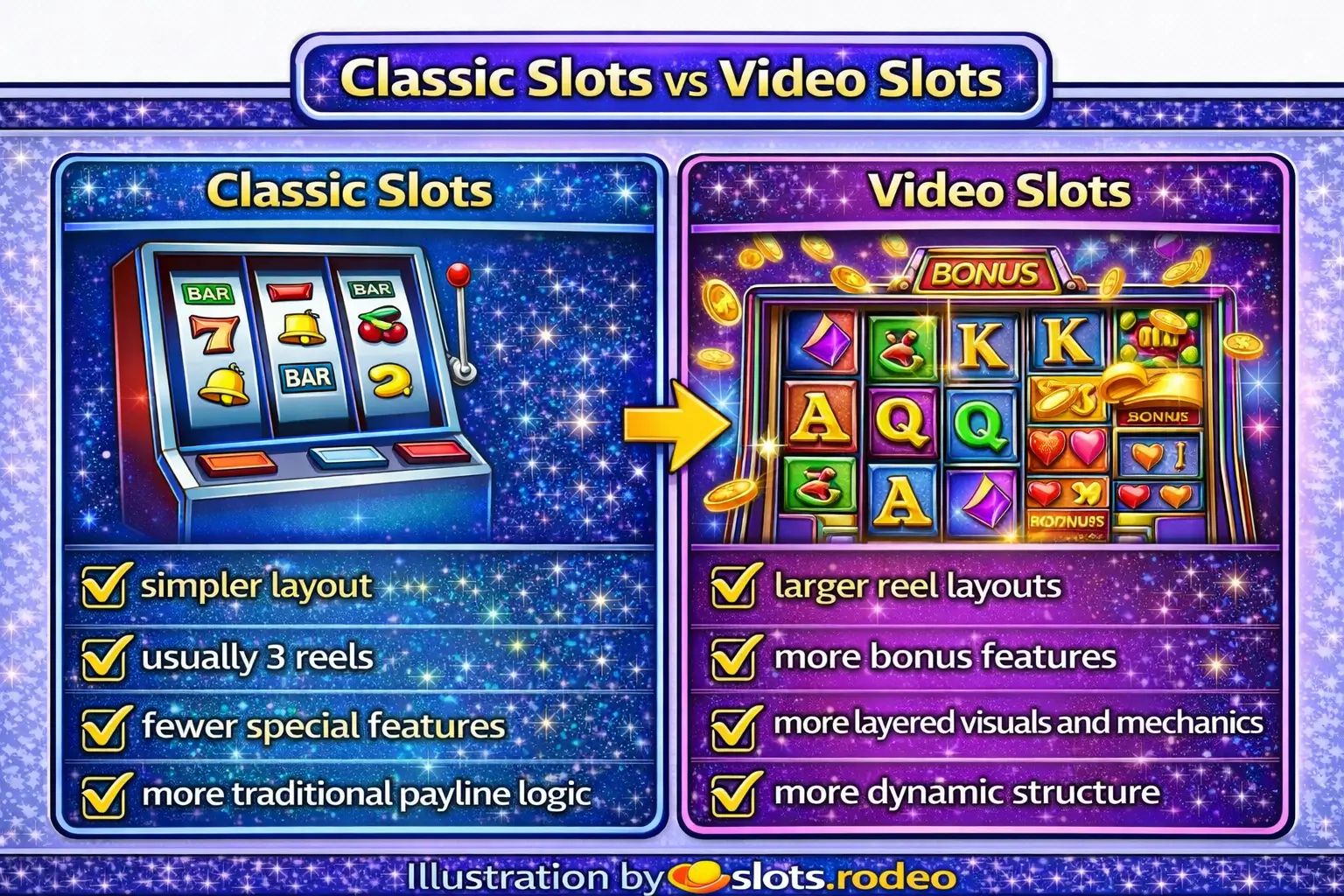
What a classic slot is
A classic slot is the simpler, older-style slot format.
It often uses:
- 3 reels
- a smaller number of paylines
- simpler symbols
- fewer bonus mechanics
- a more direct paytable
Classic slots are often based on traditional slot imagery such as:
- fruits
- bars
- sevens
- bells
- lucky symbols
Not every classic slot is identical, but the general structure is usually lighter and easier to read.
What a video slot is
A video slot is the broader modern slot format.
It usually uses:
- 5 reels or more
- more rows or variable reel layouts
- animated graphics
- more complex symbol sets
- free spins, wilds, scatters, multipliers, bonus rounds, or other layered mechanics
Video slots often use stronger themes and deeper feature design. They usually put more emphasis on how the game unfolds over time, not just on the base spin result.
The main difference in one sentence
A classic slot usually focuses on simple reel outcomes.
A video slot usually focuses on a wider game system, where the base game, special symbols, and bonus features all work together.
Typical structure: classic vs video
| Feature | Classic Slots | Video Slots |
|---|---|---|
| Reel count | Usually 3 | Usually 5 or more |
| Layout | Simpler and fixed | More varied and often more layered |
| Symbols | Traditional and limited | Wider symbol range, often theme-based |
| Bonus features | Usually few | Often several |
| Visual style | Simple | More animated and detailed |
| Win logic | Usually easier to track | Often more complex |
| Paytable depth | Shorter | Often much longer |
Reel count
Classic Slots
Usually 3
Video Slots
Usually 5 or more
Layout
Classic Slots
Simpler and fixed
Video Slots
More varied and often more layered
Symbols
Classic Slots
Traditional and limited
Video Slots
Wider symbol range, often theme-based
Bonus features
Classic Slots
Usually few
Video Slots
Often several
Visual style
Classic Slots
Simple
Video Slots
More animated and detailed
Win logic
Classic Slots
Usually easier to track
Video Slots
Often more complex
Paytable depth
Classic Slots
Shorter
Video Slots
Often much longer
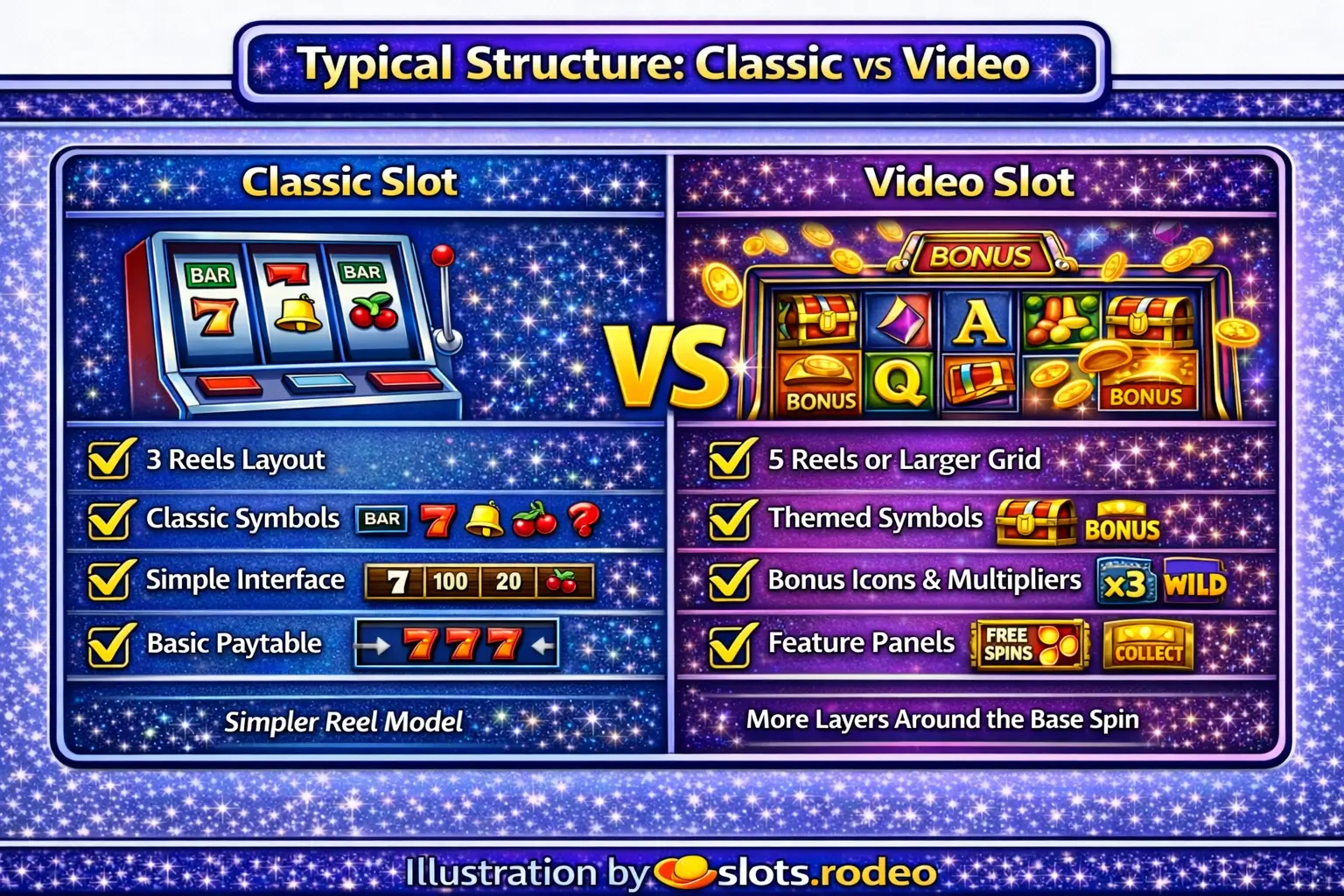
Reel layout is usually simpler in classic slots
Classic slots are often built around a smaller reel window, most commonly 3 reels.
That matters because it keeps the game easier to read. You can usually see the structure quickly:
- fewer symbols on screen
- fewer possible win paths
- shorter paytable
- less feature text to interpret
This does not automatically make classic slots better or worse. It just makes their structure more direct.
Video slots usually expand the reel framework
Video slots often use 5 reels, and many go further with:
- extra rows
- expanding reel areas
- ways-to-win systems
- cluster pays
- Megaways-style layouts
- cascading mechanics
This gives video slots more room for layered design, but it also makes them more complex to read.
Classic slots usually rely less on bonus depth
A classic slot may include some special mechanics, but the format is usually more restrained.
Common classic-slot elements include:
- simple wild symbols
- basic multipliers
- small reel modifiers
- straightforward payline wins
Many classic slots do not depend on large feature trees or multi-step bonus systems.
That creates a different play feel: more of the game happens in the base structure itself.
Video slots usually rely more on special features
Video slots often build a large part of their identity around bonus features.
Common examples include:
- free spins
- scatter triggers
- bonus pick rounds
- respins
- sticky wilds
- expanding wilds
- multipliers
- cascading wins
- symbol upgrades
- feature modes with changed rules
This makes video slots feel deeper, but it also means the game may depend more on special events than a simple reel result.
Symbol sets are usually different too
Classic slots often use a shorter, more familiar symbol ladder.
You may see:
- fruit symbols
- bar symbols
- seven symbols
- classic lucky icons
Video slots usually use:
- theme-based premium symbols
- lower-value filler symbols
- multiple special symbols
- bonus-specific visual elements
That larger symbol set often supports a more detailed feature structure.
Paytables are usually shorter in classic slots
One practical difference for beginners is paytable length.
A classic slot often has a shorter help section because there are fewer rules to explain.
A video slot often needs more paytable screens because it may include:
- symbol values
- wild rules
- scatter rules
- free spins rules
- bonus round rules
- multiplier logic
- special feature limitations
This is one reason video slots can feel harder to learn at first.
Win structure can feel more direct in classic slots
Classic slots often use a more traditional payout structure, such as:
- fixed paylines
- simpler symbol combinations
- fewer overlapping mechanics
That can make the result easier to understand spin by spin.
You see the reels stop, the game checks the line result, and the payout is easier to trace.
Video slots often feel more layered
A video slot may involve more than one active system at the same time.
For example, one spin might include:
- a ways-to-win match
- a wild substitution
- a multiplier
- a cascade
- a scatter that helps trigger free spins
That layered design is part of why video slots often feel more dynamic, but also less simple.
Classic slots are not always "basic" in quality
It is important not to confuse simple structure with weak design.
A classic slot can still be:
- well balanced
- clear in its payout logic
- strong in symbol readability
- satisfying in short sessions
- effective for players who prefer less visual noise
The simpler format is a design choice, not automatically a limitation.
Video slots are not always "better" because they have more features
More mechanics do not automatically mean better gameplay.
A video slot may offer:
- more variety
- more bonus depth
- more visual activity
But it may also require:
- more reading
- more patience with the base game
- more attention to feature rules
- more understanding of how value is distributed
So the difference is not just "old vs new." It is also simple structure vs layered structure.
Feature comparison at a glance
| Feature area | Classic Slots | Video Slots |
|---|---|---|
| Free spins | Less common or simpler | Very common |
| Scatters | Often limited or absent | Common |
| Bonus rounds | Usually simpler | Often deeper |
| Multipliers | Usually simpler | Often more varied |
| Wild behavior | Usually basic | Often expanded, sticky, stacked, or feature-linked |
| Reel modifiers | Less common | More common |
| Cascades or drops | Rare | Common in many modern formats |
Free spins
Classic Slots
Less common or simpler
Video Slots
Very common
Scatters
Classic Slots
Often limited or absent
Video Slots
Common
Bonus rounds
Classic Slots
Usually simpler
Video Slots
Often deeper
Multipliers
Classic Slots
Usually simpler
Video Slots
Often more varied
Wild behavior
Classic Slots
Usually basic
Video Slots
Often expanded, sticky, stacked, or feature-linked
Reel modifiers
Classic Slots
Less common
Video Slots
More common
Cascades or drops
Classic Slots
Rare
Video Slots
Common in many modern formats
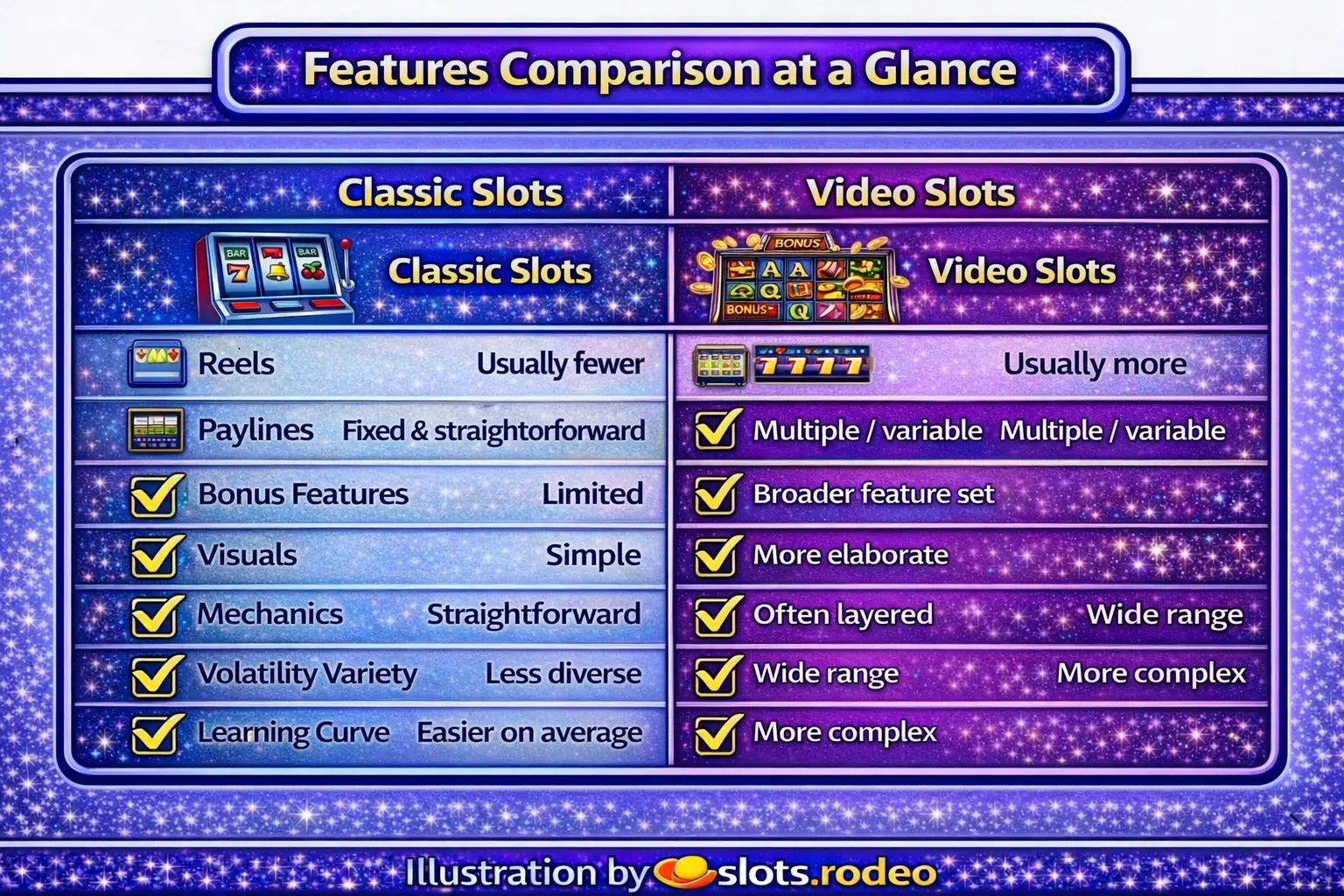
Session feel is often different
Even without looking at the exact math, these formats often feel different in practice.
Classic slots often feel:
- cleaner
- more direct
- easier to follow
- less feature-heavy
Video slots often feel:
- busier
- more event-driven
- more layered
- more dependent on special triggers and feature flow
This changes how players interpret the same amount of action.
Why beginners often understand classic slots faster
For a new player, classic slots are usually easier to read because there are fewer moving parts.
You often need to learn only:
- the payline structure
- the symbol values
- whether a wild exists
- how the game pays
A video slot often requires more time because the player also needs to understand:
- scatter logic
- free spins
- multiplier rules
- feature conditions
- special symbol interactions
- possible mode changes
Common beginner mistakes
Thinking classic slots cannot have features
They can. They are just usually more limited in feature depth.
Thinking video slots always pay better
They do not. More features do not automatically mean better payouts.
Assuming reel count tells the full story
It helps, but the real difference is broader: structure, rules, and feature depth.
Ignoring paytable complexity
A longer paytable usually signals more layered slot logic.
Treating classic slots as outdated by default
Some players prefer simpler games because they are easier to read and follow.
What to check in the paytable
Before deciding whether a slot is classic or video-led in structure, check these points:
| What to check | Why it matters |
|---|---|
| Reel count and layout | Gives the first clue about the game format |
| Win system | Shows whether the slot uses simple paylines or a more modern structure |
| Special symbols | Helps measure feature complexity |
| Bonus feature depth | Distinguishes simple base games from layered video slots |
| Number of paytable screens | Often reflects how much rule detail the slot has |
| Mode changes | Many video slots alter rules inside bonus features |
Reel count and layout
Why it matters
Gives the first clue about the game format
Win system
Why it matters
Shows whether the slot uses simple paylines or a more modern structure
Special symbols
Why it matters
Helps measure feature complexity
Bonus feature depth
Why it matters
Distinguishes simple base games from layered video slots
Number of paytable screens
Why it matters
Often reflects how much rule detail the slot has
Mode changes
Why it matters
Many video slots alter rules inside bonus features
Classic slots vs video slots in practical terms
A simple way to frame the difference is this:
| Question | Classic Slots | Video Slots |
|---|---|---|
| Is the game easier to read at a glance? | Usually yes | Usually less so |
| Are there fewer mechanics to learn? | Usually yes | Usually no |
| Is the feature structure lighter? | Usually yes | Usually more layered |
| Is the reel layout simpler? | Usually yes | Usually more complex |
| Does the game rely more on bonus depth? | Usually less | Usually more |
Is the game easier to read at a glance?
Classic Slots
Usually yes
Video Slots
Usually less so
Are there fewer mechanics to learn?
Classic Slots
Usually yes
Video Slots
Usually no
Is the feature structure lighter?
Classic Slots
Usually yes
Video Slots
Usually more layered
Is the reel layout simpler?
Classic Slots
Usually yes
Video Slots
Usually more complex
Does the game rely more on bonus depth?
Classic Slots
Usually less
Video Slots
Usually more
What this comparison does not tell you by itself
The format alone does not tell you:
- RTP
- volatility
- hit frequency
- max win
- feature frequency
- average win size
A classic slot can still be volatile. A video slot can still be simple compared with other video slots. The format explains the structure, not the full math profile.
FAQ
Common questions about this topic.
Classic slots usually have a simpler reel structure and fewer features. Video slots usually have more reels, more mechanics, and deeper bonus systems.
Often yes, but not always. The key idea is simpler structure, not just reel count alone.
Not always, but they usually have more special mechanics than classic slots.
Usually yes, because the rules and paytable are often simpler.
Not automatically. They are more complex, but that does not make them better for every player.


