

Not all slots spread the experience in the same way.
Some games put a large share of the action into bonus rounds, free spins, modifiers, or feature chains. Others keep more of the play inside the base game, with less dependence on a separate feature to create momentum.
That difference matters because it changes how a session feels. Two slots can have the same reel count and similar symbols, but one may feel quiet until a bonus lands, while the other gives more of its identity away in the main game.
The real question: where does the game do most of its work?
A good way to compare these formats is not to ask which one is "better," but to ask:
Where does most of the session experience come from?
- In a bonus-heavy slot, the answer is often: from triggered features, free spins, special rounds, or bonus-state modifiers.
- In a base-game slot, the answer is often: from the standard spin cycle itself, without needing a separate feature to define the session.
This is not a formal category used in every paytable. It is a practical way to read how the game is built.
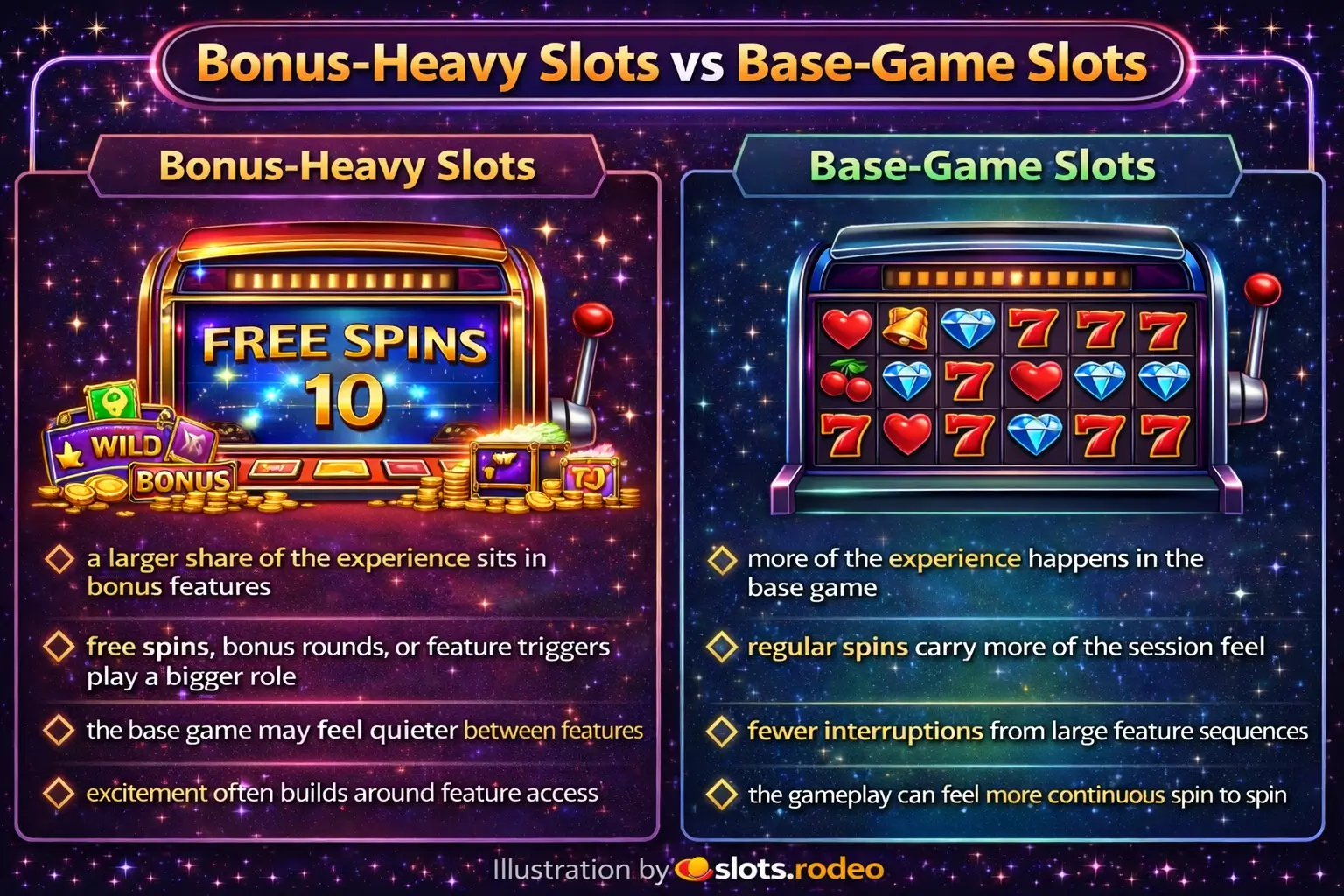
ALT: Comparison showing the difference between bonus-heavy slots and slots where more of the experience stays in the base game
Caption: Some slots are built around bonus rounds and feature triggers, while others keep more of the session inside the regular base-game spin cycle.
What usually makes a slot feel bonus-heavy
A slot often feels bonus-heavy when the base game mainly acts as a path toward a bigger feature.
Typical signs include:
- a strong focus on free spins or a bonus round
- large differences between ordinary spins and feature mode
- special multipliers or modifiers that mostly appear in the bonus
- a session that feels flat until the main feature is triggered
- marketing and game presentation centered on the bonus mechanic
In these games, players often judge the session by whether they reached the feature and how strong that feature was.
What usually makes a slot feel base-game driven
A base-game slot usually gives more of its character during standard spins.
That can mean:
- the main spin cycle already includes useful symbol interactions
- wins, modifiers, or small mechanics happen without needing a bonus trigger
- the session can feel active even without entering free spins
- the base game itself is a meaningful part of the design, not just a waiting room
This does not mean the game has no bonus round. It means the core experience does not depend as heavily on one separate feature to feel complete.
The session does not flow the same way
The biggest practical difference is session rhythm.
| Area | Bonus-Heavy Slots | Base-Game Slots |
|---|---|---|
| Where the main excitement often sits | In bonus rounds or free spins | In the regular spin cycle |
| Base game role | Often acts as a lead-in to features | Often carries more of the session on its own |
| Session rhythm | May feel quiet between feature hits | May feel more evenly distributed |
| Perception of progress | Often tied to feature triggers | Often tied to regular in-session activity |
| Common player reaction | "Need the bonus to see the game properly" | "The game already shows its style in the base game" |
Where the main excitement often sits
Bonus-Heavy Slots
In bonus rounds or free spins
Base-Game Slots
In the regular spin cycle
Base game role
Bonus-Heavy Slots
Often acts as a lead-in to features
Base-Game Slots
Often carries more of the session on its own
Session rhythm
Bonus-Heavy Slots
May feel quiet between feature hits
Base-Game Slots
May feel more evenly distributed
Perception of progress
Bonus-Heavy Slots
Often tied to feature triggers
Base-Game Slots
Often tied to regular in-session activity
Common player reaction
Bonus-Heavy Slots
"Need the bonus to see the game properly"
Base-Game Slots
"The game already shows its style in the base game"
Where the session experience usually comes from
In bonus-heavy slots, the player often waits for a state change. That state change might be free spins, a hold-and-win mode, a pick bonus, or another feature that changes the payout behavior or adds special modifiers.
In base-game driven slots, more of the session comes from what happens on ordinary spins. That may include regular symbol interactions, built-in cascades, minor modifiers, reel changes, or other mechanics that do not require a full bonus entry to matter.
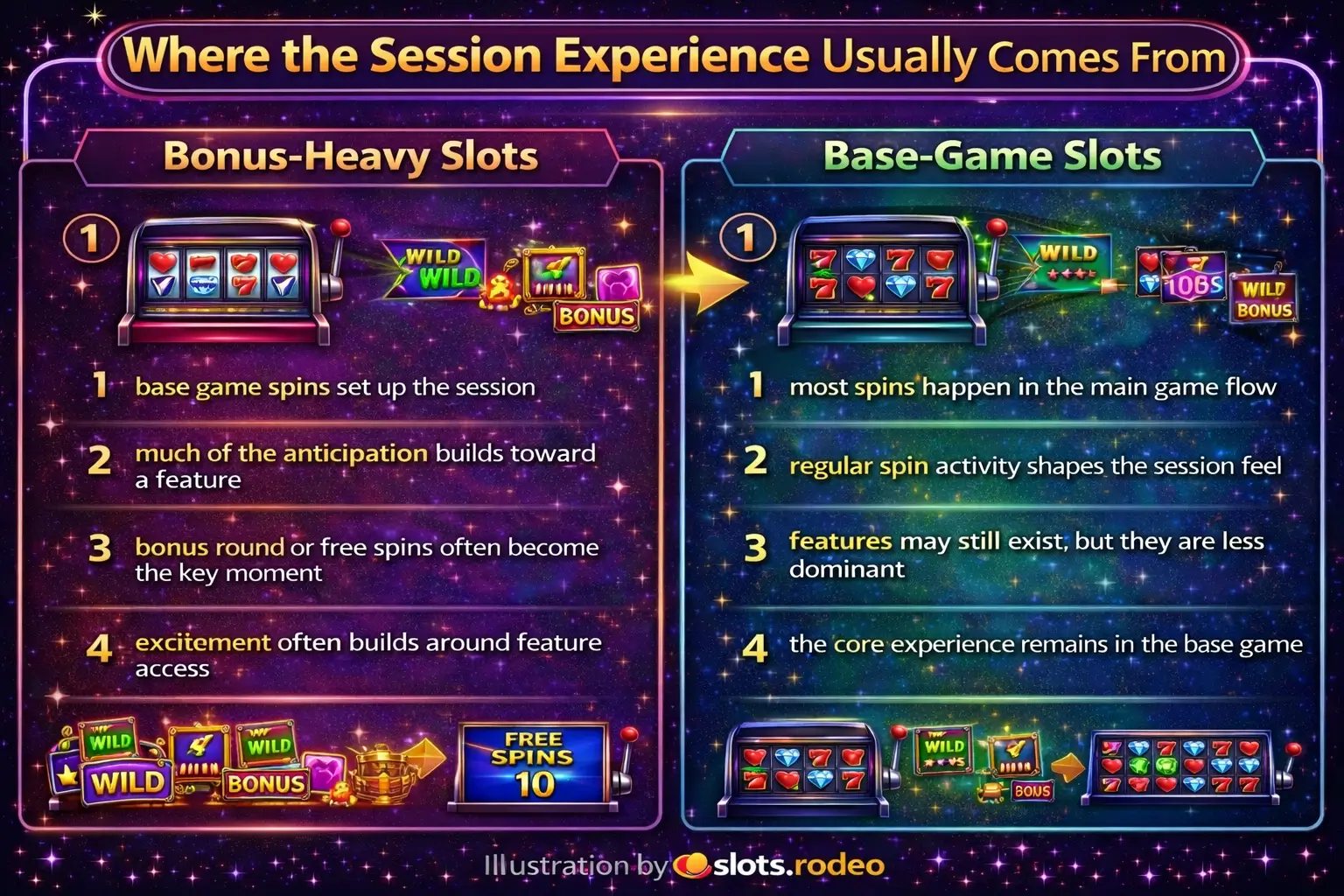
ALT: Illustration showing how the player experience in some slots comes mostly from bonus features and in others from the base game
Caption: In some games, the defining moments sit in free spins or bonus modes; in others, the main game already does more of the work.
Why this matters before you play
This comparison helps set expectations.
A player who chooses a bonus-heavy slot should expect that much of the session identity may be concentrated in less frequent but more distinct feature moments.
A player who chooses a more base-game-driven slot should expect the game to show more of itself during the standard spin cycle, even if the bonus still matters.
This matters for user experience because frustration often comes from mismatch between expectation and structure. A player may think a game is dull, when in reality it was built to save most of its identity for the feature. Another player may ignore a strong base-game slot because it has a less dramatic bonus headline.
A practical way to spot the difference in the paytable
Before playing, check where the rules place most of the detail.
If the help screen spends most of its space on:
- free spins upgrades
- feature-only multipliers
- bonus round special symbols
- persistent modifiers inside a triggered mode
then the game is likely more bonus-heavy.
If the help screen gives real weight to:
- standard symbol interactions
- base-game modifiers
- regular cascades or replacements
- features that occur during ordinary spins
then the game may be more base-game driven.
This is not perfect, but it is a useful reading method.
Common misconceptions
"Bonus-heavy means better payouts"
No. A slot can be bonus-heavy and still produce weak sessions. Concentrating action inside features does not guarantee stronger overall value.
"Base-game slots are boring"
Not necessarily. Some base-game-led slots are more readable, steadier in feel, and less dependent on one event to create interest.
"If a slot has free spins, it is bonus-heavy"
Not always. Many slots have free spins, but the game may still deliver a large part of its identity in the base game.
"A quiet base game means the slot is bad"
Not necessarily. It may simply mean the design is built around a feature cycle. The key is whether that structure matches what the player wants.
Comparing the two formats more directly
| Question | Bonus-Heavy Slots | Base-Game Slots |
|---|---|---|
| Does the session rely heavily on a feature trigger? | Often yes | Usually less |
| Can the main game feel complete without a bonus? | Sometimes less | More often yes |
| Are major modifiers concentrated in bonus mode? | Often yes | Less often |
| Is the session identity tied to free spins or bonus states? | Commonly | Not as strongly |
| Is more of the game visible during normal spins? | Often less | Usually more |
Does the session rely heavily on a feature trigger?
Bonus-Heavy Slots
Often yes
Base-Game Slots
Usually less
Can the main game feel complete without a bonus?
Bonus-Heavy Slots
Sometimes less
Base-Game Slots
More often yes
Are major modifiers concentrated in bonus mode?
Bonus-Heavy Slots
Often yes
Base-Game Slots
Less often
Is the session identity tied to free spins or bonus states?
Bonus-Heavy Slots
Commonly
Base-Game Slots
Not as strongly
Is more of the game visible during normal spins?
Bonus-Heavy Slots
Often less
Base-Game Slots
Usually more
Why bonus-heavy slots are common in modern design
Many modern slots are built around a "destination" moment. That makes the feature easier to present, easier to market, and easier for players to remember.
A strong free-spins mode or hold-and-win feature gives the game a clear center. It also lets the developer separate ordinary play from enhanced play.
That structure is common, but it is not the only valid one. A slot can still be strong when its base game does more of the work.
When a base-game slot can be the better choice
A base-game-driven slot may suit a player better when they want:
- a clearer sense of how the game behaves on normal spins
- less dependence on one trigger
- more regular interaction during the session
- a format that feels readable without waiting for bonus entry
This does not guarantee lower volatility or smaller wins. It simply means more of the game is happening in the main cycle.
What this comparison does not tell you
This article explains where a slot places more of its experience, but it does not tell you:
- RTP
- volatility
- hit frequency
- max win
- bonus trigger rate
- how strong the feature is when it lands
A bonus-heavy slot can still be low or high volatility. A base-game slot can still have an important bonus. This comparison is about design balance, not a full performance profile.
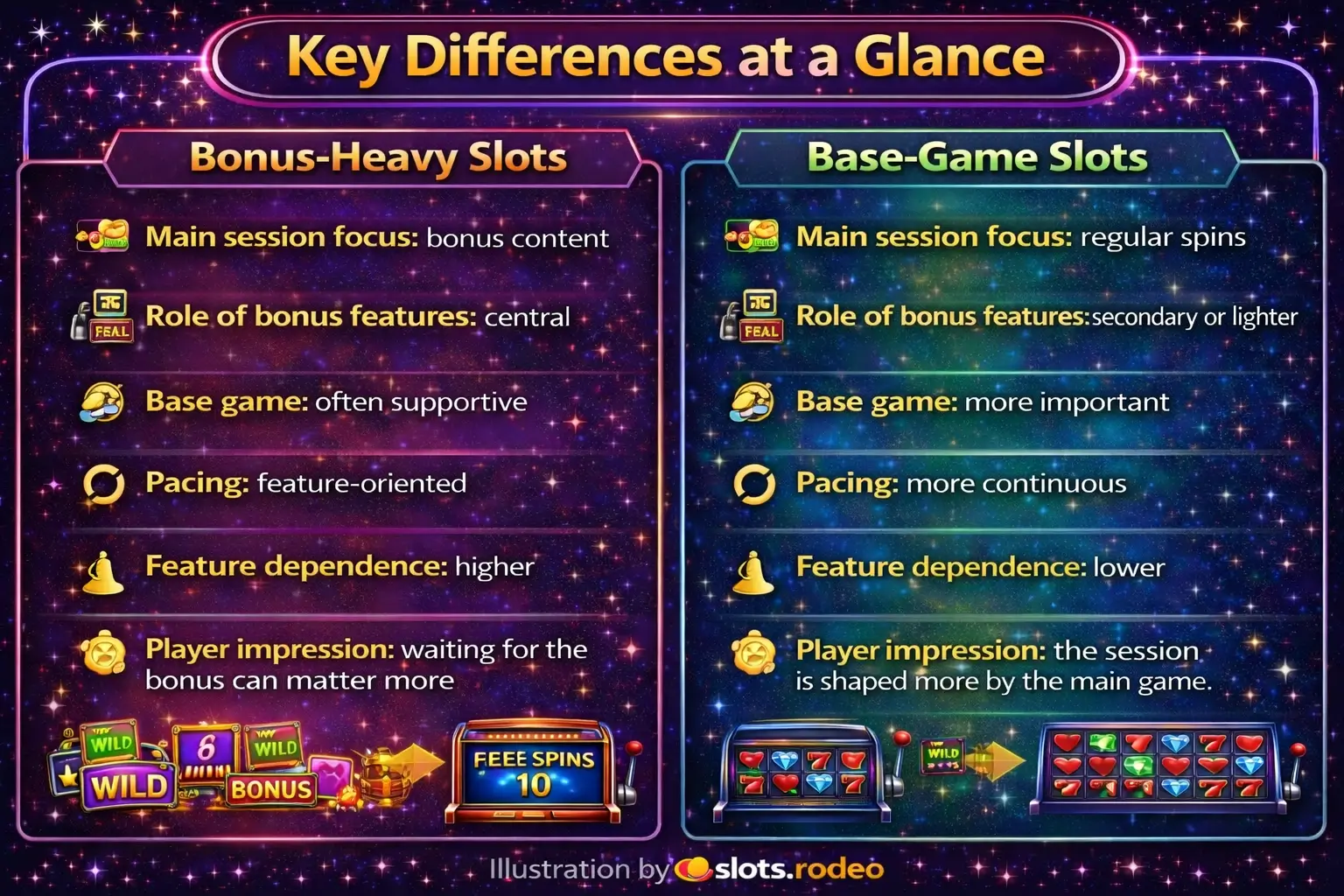
ALT: Summary graphic showing the main design differences between bonus-heavy slots and base-game-driven slots
Caption: The key difference is where the game places most of the session identity: in triggered features or in the regular base game.
What to check before you decide a slot fits your style
| What to check | Why it matters |
|---|---|
| Feature description | Shows whether the game saves most modifiers for bonus mode |
| Base game rules | Helps you see whether ordinary spins have enough activity on their own |
| Trigger conditions | Reveals how dependent the session may be on entering a feature |
| Paytable structure | Often shows whether the main game or the bonus gets most of the design depth |
| Bonus buy option, if present | Can signal how central the bonus is to the game concept |
| Demo session feel | Helps confirm whether the base game is active or mostly transitional |
Feature description
Why it matters
Shows whether the game saves most modifiers for bonus mode
Base game rules
Why it matters
Helps you see whether ordinary spins have enough activity on their own
Trigger conditions
Why it matters
Reveals how dependent the session may be on entering a feature
Paytable structure
Why it matters
Often shows whether the main game or the bonus gets most of the design depth
Bonus buy option, if present
Why it matters
Can signal how central the bonus is to the game concept
Demo session feel
Why it matters
Helps confirm whether the base game is active or mostly transitional
A better way to use this comparison
Do not use this as a quality label. Use it as a fit label.
Some players prefer games where the bonus round is the clear centerpiece. Others prefer slots where more of the identity is already visible in the base game.
The useful question is not "Which is better?"
It is: Do you want a slot that builds toward a feature, or a slot that gives more of its character on ordinary spins?


