

The number of reels changes more than the shape of the screen.
A 3-reel slot usually points to a simpler format: fewer symbol positions, fewer line patterns, and a structure closer to older mechanical slot machines. A 5-reel slot usually gives the game more room for line combinations, bonus mechanics, and feature layering.
This does not mean that one format is automatically better. It means they are built for different kinds of play.
Start with the screen itself
A 3-reel slot is usually compact. The layout is often narrow, the symbol set is smaller, and the result is easier to read at a glance.
A 5-reel slot has more space. That extra reel width allows more symbol combinations, more line structures, and more room for features such as wilds, scatters, free spins, multipliers, expanding reels, or bonus symbols.
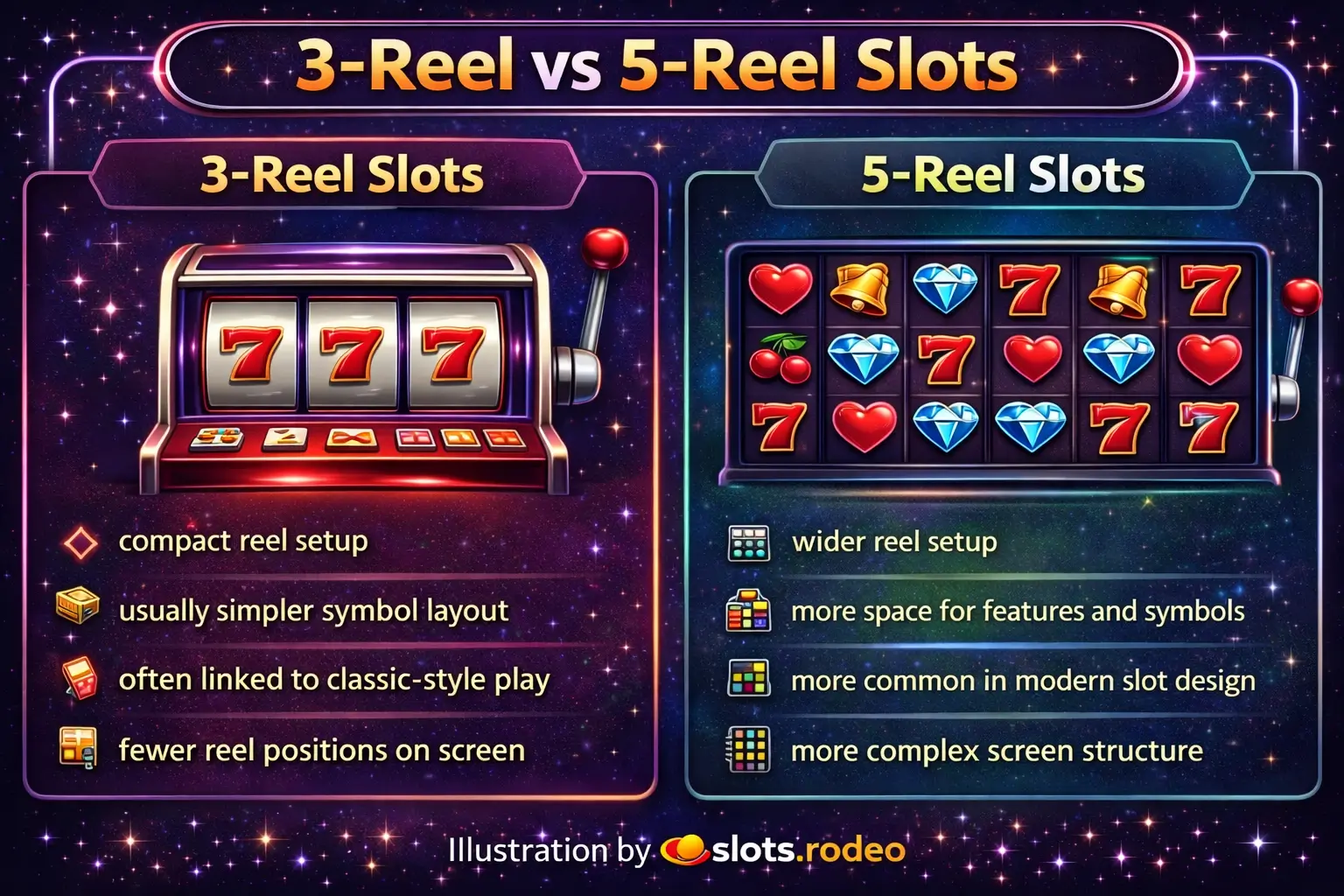
ALT: Side-by-side comparison of a classic 3-reel slot layout and a modern 5-reel slot layout
Caption: A 3-reel slot usually has a tighter, simpler layout, while a 5-reel slot gives more room for paylines, symbols, and feature design.
What changes when two extra reels are added
Two extra reels do not just create more screen space. They change how the whole game can be designed.
With 3 reels, the game often focuses on direct symbol matching across a small number of positions. With 5 reels, the designer can build a wider paytable, more line routes, more feature triggers, and more layers inside the same spin.
That is why many 3-reel slots feel straightforward, while many 5-reel slots feel more complex even before the bonus round starts.
The layout affects the format, not just the look
| Area | 3-Reel Slots | 5-Reel Slots |
|---|---|---|
| Screen width | Narrower | Wider |
| Typical structure | More compact | More flexible |
| Common association | Classic slot style | Modern video slot style |
| Payline complexity | Usually lower | Usually higher |
| Feature space | More limited | More room for bonus design |
| Reading the result | Often faster | Often more detailed |
Screen width
3-Reel Slots
Narrower
5-Reel Slots
Wider
Typical structure
3-Reel Slots
More compact
5-Reel Slots
More flexible
Common association
3-Reel Slots
Classic slot style
5-Reel Slots
Modern video slot style
Payline complexity
3-Reel Slots
Usually lower
5-Reel Slots
Usually higher
Feature space
3-Reel Slots
More limited
5-Reel Slots
More room for bonus design
Reading the result
3-Reel Slots
Often faster
5-Reel Slots
Often more detailed
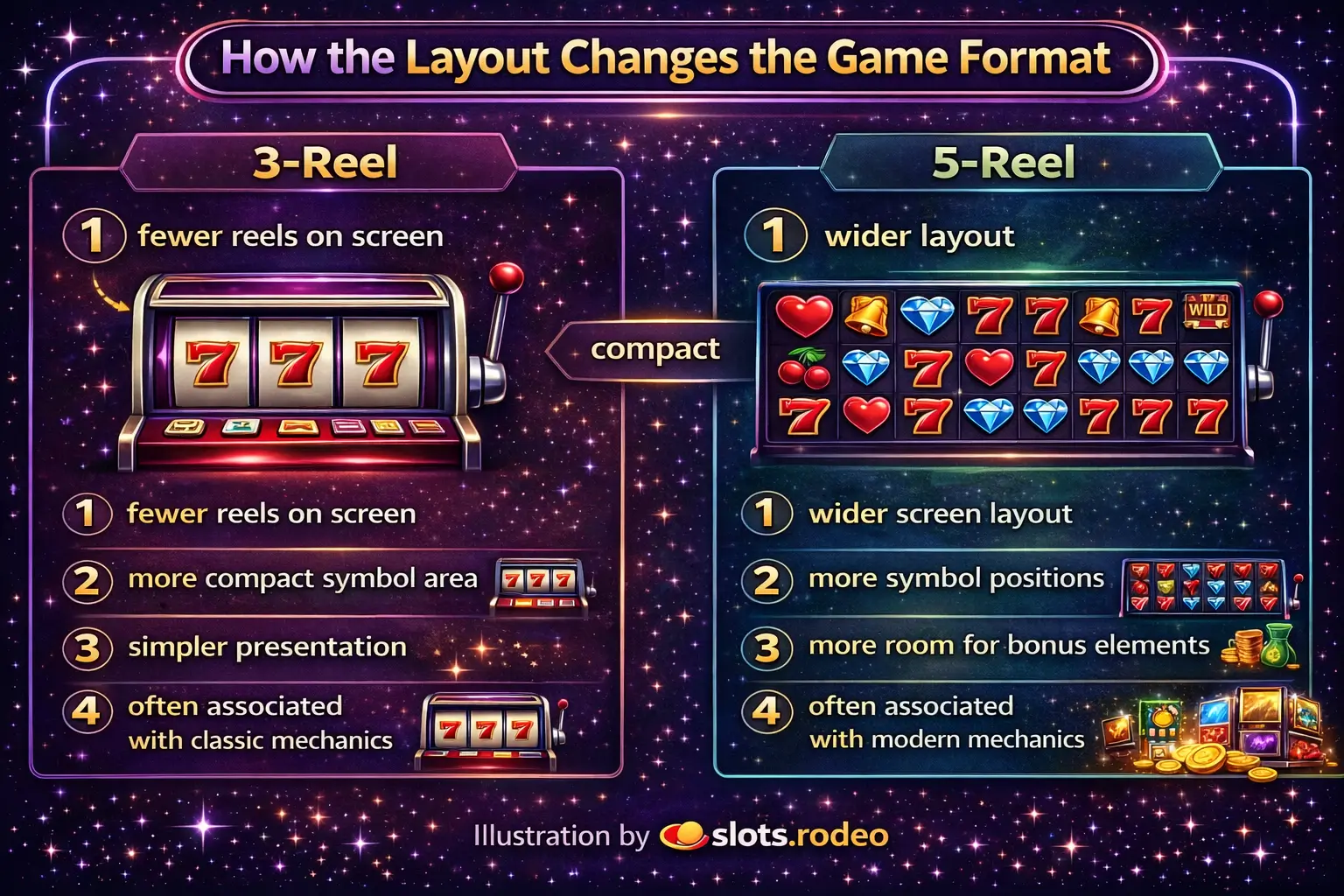
ALT: Illustration showing how a 3-reel layout and a 5-reel layout lead to different game formats and feature depth
Caption: Reel count affects the structure of the game: compact 3-reel slots often stay simpler, while 5-reel slots can support broader feature design.
Why 3-reel slots are often linked to classic slot design
The 3-reel format is closely tied to the older slot model.
That usually means:
- a smaller set of standard symbols
- fewer visual layers
- less complex bonus structure
- stronger focus on the base game itself
Many 3-reel games are built to feel closer to traditional fruit machines or early mechanical slots. The interface is often cleaner because there is less happening on the screen at once.
For a beginner, this can make the game easier to understand. You usually do not need to track as many special symbols or side mechanics.
Why 5-reel slots became the dominant modern format
The 5-reel layout became standard because it gives game developers more design options.
A wider screen makes it easier to add:
- more paylines or alternative win systems
- scatters and bonus triggers
- free spins rounds
- stacked or expanding symbols
- reel modifiers
- secondary mechanics during the base game
This is one reason why most modern video slots use 5 reels. The format gives more room for variation without needing to change the core idea of reel-based play.
The number of reels does not tell you everything
A common mistake is to treat reel count as a full description of how a slot plays.
That is not enough.
A 3-reel slot can still be volatile.
A 5-reel slot can still be simple.
A 5-reel slot can use fixed paylines, ways to win, or another system entirely.
A 3-reel slot can still include special symbols or a bonus feature.
Reel count tells you a lot about the format, but it does not replace the paytable, the rules screen, or the feature description.
What usually changes for the player
Visual reading
A 3-reel slot is often easier to scan because fewer positions are in play. A 5-reel slot may require more attention because more symbols and interactions are visible at once.
Win structure
A 3-reel slot often has a tighter win structure. A 5-reel slot can support more line combinations and more varied symbol interactions.
Feature depth
A 3-reel game often keeps the focus on standard symbol hits. A 5-reel game is more likely to include layered features that shape the session.
Pace of understanding
A new player can usually understand the basic logic of a 3-reel slot faster. A 5-reel slot may take longer because the screen contains more information.
One useful comparison: base game focus vs feature space
This is where the difference becomes practical.
| Question | 3-Reel Slots | 5-Reel Slots |
|---|---|---|
| Is the base game the main focus? | More often yes | Not always |
| Is there room for multiple special symbols? | Usually less | Usually more |
| Are bonus mechanics often central? | Less often | More often |
| Is the screen easier to read quickly? | Usually yes | Often less so |
| Is the format strongly linked to classic slots? | Yes | Usually no |
Is the base game the main focus?
3-Reel Slots
More often yes
5-Reel Slots
Not always
Is there room for multiple special symbols?
3-Reel Slots
Usually less
5-Reel Slots
Usually more
Are bonus mechanics often central?
3-Reel Slots
Less often
5-Reel Slots
More often
Is the screen easier to read quickly?
3-Reel Slots
Usually yes
5-Reel Slots
Often less so
Is the format strongly linked to classic slots?
3-Reel Slots
Yes
5-Reel Slots
Usually no
Where players often get confused
"3 reels means old and basic"
Often true, but not always. Some 3-reel slots still include modern elements.
"5 reels means better"
Not really. It means broader design space, not automatic quality.
"More reels means more winning chances"
Not by itself. Reel count alone does not tell you RTP, hit rate, volatility, or payout potential.
"3-reel slots are only for beginners"
No. Some players prefer them because they want a cleaner screen and a more direct format.
A better way to choose between them
Do not choose by reel count alone. Use reel count as a signal for the kind of game structure you are about to get.
A 3-reel slot may suit you better if you want:
- a simpler screen
- less feature clutter
- a format closer to classic slots
- faster visual understanding of each spin
A 5-reel slot may suit you better if you want:
- a broader feature set
- more special symbol interactions
- bonus rounds and layered mechanics
- a more modern video slot structure
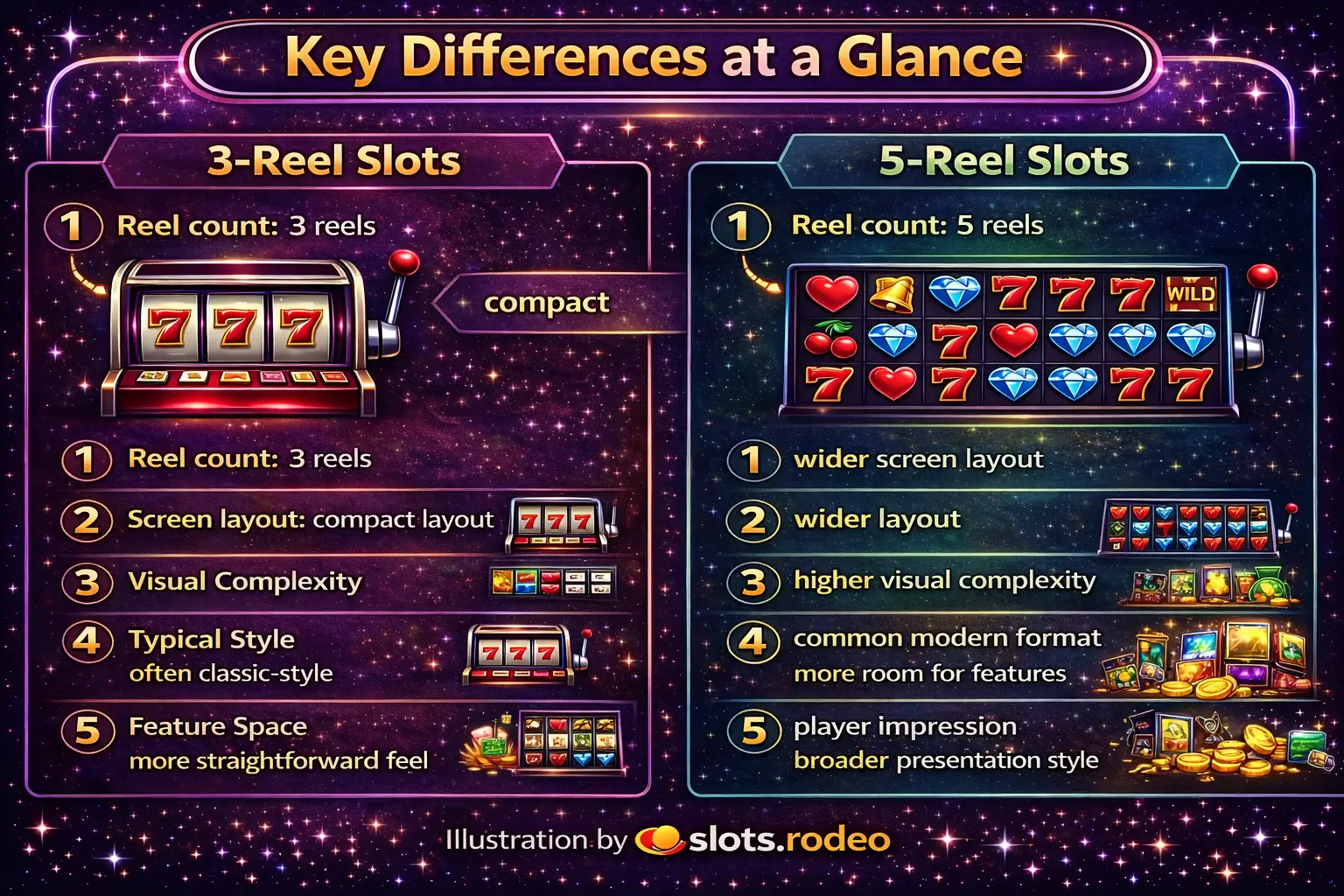
ALT: Summary graphic showing the main structural differences between 3-reel and 5-reel slot formats
Caption: The main difference is structural: 3-reel slots are usually tighter and simpler, while 5-reel slots allow more complex game design.
What to check before playing either format
Before you judge a slot by reel count, check these points in the paytable or rules:
| What to check | Why it matters |
|---|---|
| Pay system | A 5-reel slot may use paylines, ways to win, or another model |
| Bonus structure | Shows whether the game depends heavily on features |
| Wild and scatter rules | These often affect how the format actually plays |
| Reel layout | Some games use changing reel heights or unusual row counts |
| RTP version | Reel count does not tell you the actual RTP setting |
| Volatility label | A simple-looking game can still be high volatility |
Pay system
Why it matters
A 5-reel slot may use paylines, ways to win, or another model
Bonus structure
Why it matters
Shows whether the game depends heavily on features
Wild and scatter rules
Why it matters
These often affect how the format actually plays
Reel layout
Why it matters
Some games use changing reel heights or unusual row counts
RTP version
Why it matters
Reel count does not tell you the actual RTP setting
Volatility label
Why it matters
A simple-looking game can still be high volatility
When reel count matters most
Reel count matters most at the start, when you are trying to understand the format quickly.
It helps you predict whether the slot is likely to be:
- more classic or more modern
- more compact or more layered
- easier to read or more feature-heavy
After that, the more important questions come from the paytable and rules. Reel count sets the frame, but the rest of the game still depends on how that frame is used.


