

Walking Wilds Explained
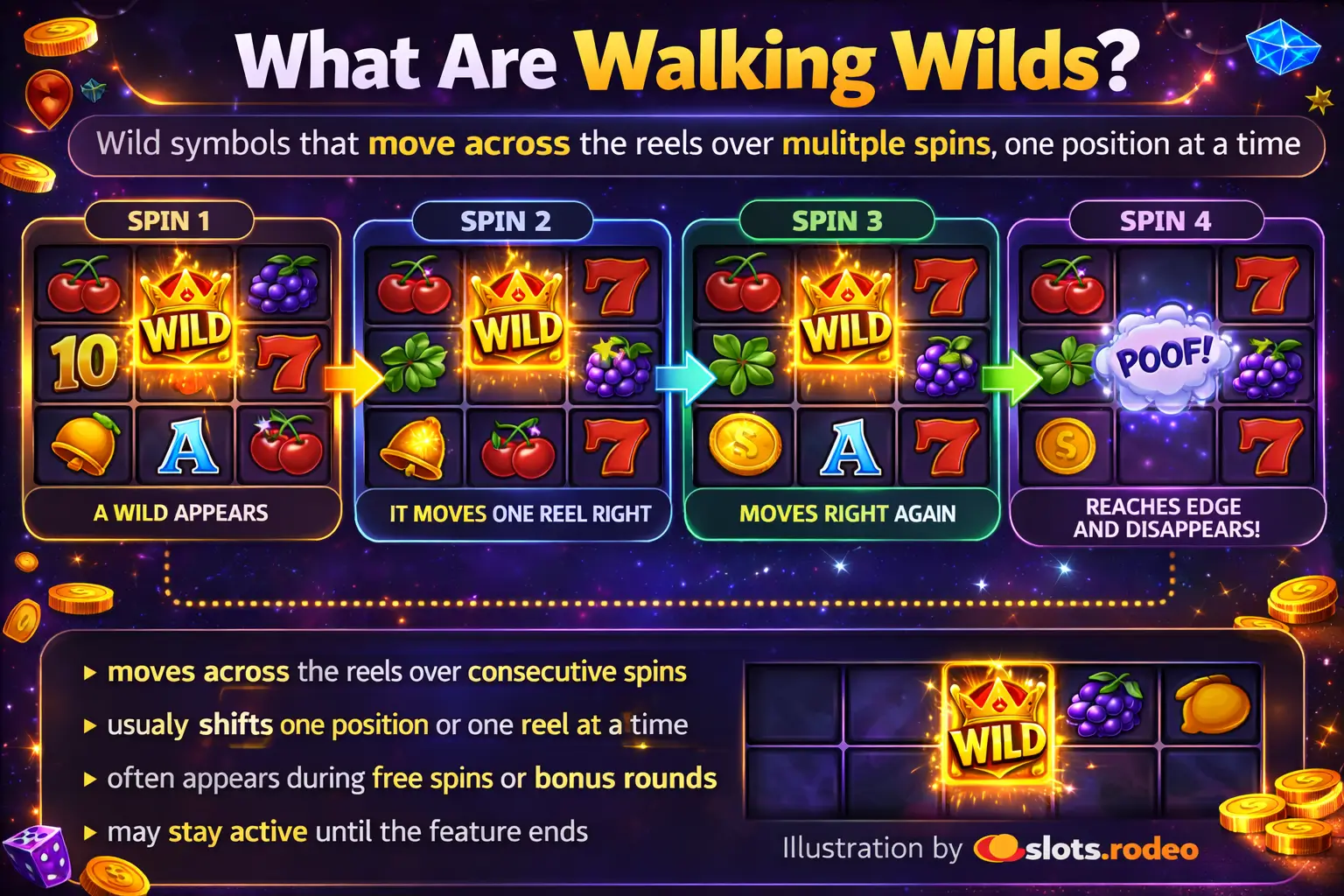
A walking wild is a wild symbol that does not stay fixed in one position. Instead, it moves across the reels or grid over consecutive spins or feature steps.
In simple terms, the wild lands, remains active, and then shifts to a new position on the next reel action according to the game rules. That movement can continue for several spins, often during free spins or a bonus feature.
This matters because the wild is not only helping on the current result. It is also changing the structure of later spins as it travels across the layout.
What "walking" means in slot mechanics
A regular wild usually affects one result and then disappears. A sticky wild stays in one place. A walking wild does something different: it keeps its presence but changes location.
The most common version looks like this:
- a walking wild lands
- it stays active for the next spin
- it shifts one reel to the left or right
- the next spin starts with the wild in its new position
- the movement continues until the feature ends or the wild exits the screen
That is why the mechanic is called "walking." The symbol moves step by step through the reel layout instead of remaining static.
| Wild type | Main behavior | What changes over time? |
|---|---|---|
| Regular wild | Helps on one result | Nothing carries over |
| Sticky wild | Stays in one fixed position | Duration |
| Walking wild | Remains active but moves | Position |
Regular wild
Main behavior
Helps on one result
What changes over time?
Nothing carries over
Sticky wild
Main behavior
Stays in one fixed position
What changes over time?
Duration
Walking wild
Main behavior
Remains active but moves
What changes over time?
Position
How walking wilds usually work
The mechanic is easiest to understand as a sequence.
A wild lands or is triggered
The feature may start when a special wild appears in the base game, during free spins, or inside another bonus structure.
The wild becomes persistent
Instead of disappearing after the result is paid, the wild stays active for the next reel action.
The wild moves
On the next spin or feature step, the wild shifts according to the game rules. In many slots, it moves one reel at a time. In others, it may move across positions in a defined pattern.
The rest of the reels update around it
The moving wild remains part of the active screen while the rest of the symbols change.
The movement ends under a defined rule
The walking sequence usually stops when:
- the feature round ends
- the wild reaches the last reel
- the wild moves off the screen
- the slot resolves a defined bonus event
That means the mechanic is not just about substitution. It is also about screen progression.
The most common movement patterns
Not every slot uses the same walking rule. These are the most common versions:
| Movement pattern | How it behaves |
|---|---|
| Reel-to-reel walk | Wild moves one reel left or right each spin |
| Row-based walk | Wild moves across positions in the same row |
| Full-reel walk | An expanded or stacked wild shifts as one block |
| Feature-only path | Wild follows a scripted route during a bonus |
| Multi-wild walk | More than one walking wild moves at the same time |
Reel-to-reel walk
How it behaves
Wild moves one reel left or right each spin
Row-based walk
How it behaves
Wild moves across positions in the same row
Full-reel walk
How it behaves
An expanded or stacked wild shifts as one block
Feature-only path
How it behaves
Wild follows a scripted route during a bonus
Multi-wild walk
How it behaves
More than one walking wild moves at the same time
So when a game says "walking wilds," the key question is not just that they move, but how they move and for how long.
Where walking wilds are usually used
Walking wilds are most common in features where the game wants the player to follow a visible progression from one spin to the next.
They often appear in:
- free spins rounds
- bonus features with reel progression
- wild-based respin mechanics
- features built around accumulating reel coverage
- slots where movement itself is part of the feature identity
They are less common as a simple one-off base game effect because their value comes from continuation over several reel actions.
Why walking wilds can change win potential
A walking wild does not guarantee a win, but it can make a feature more dynamic than a fixed wild effect.
Its value depends on:
- which reel it starts on
- which direction it moves
- how many spins remain
- whether more walking wilds can appear
- whether the wild is single-position, stacked, or expanded
- how the slot's pay system uses reel connections
A walking wild can become more useful as it reaches central reels, or less useful if it starts too late in the feature. Timing matters as much as placement.
Why movement matters
A sticky wild helps by staying in one useful spot. A walking wild helps by creating different useful spots over time.
That can matter when the slot wants to:
- open different payline connections over several spins
- sweep through more of the reel layout
- create visible buildup during free spins
- turn one wild event into a multi-spin mechanic
Walking wilds are often tied to free spins
This is where the mechanic is easiest to read.
A common feature structure looks like this:
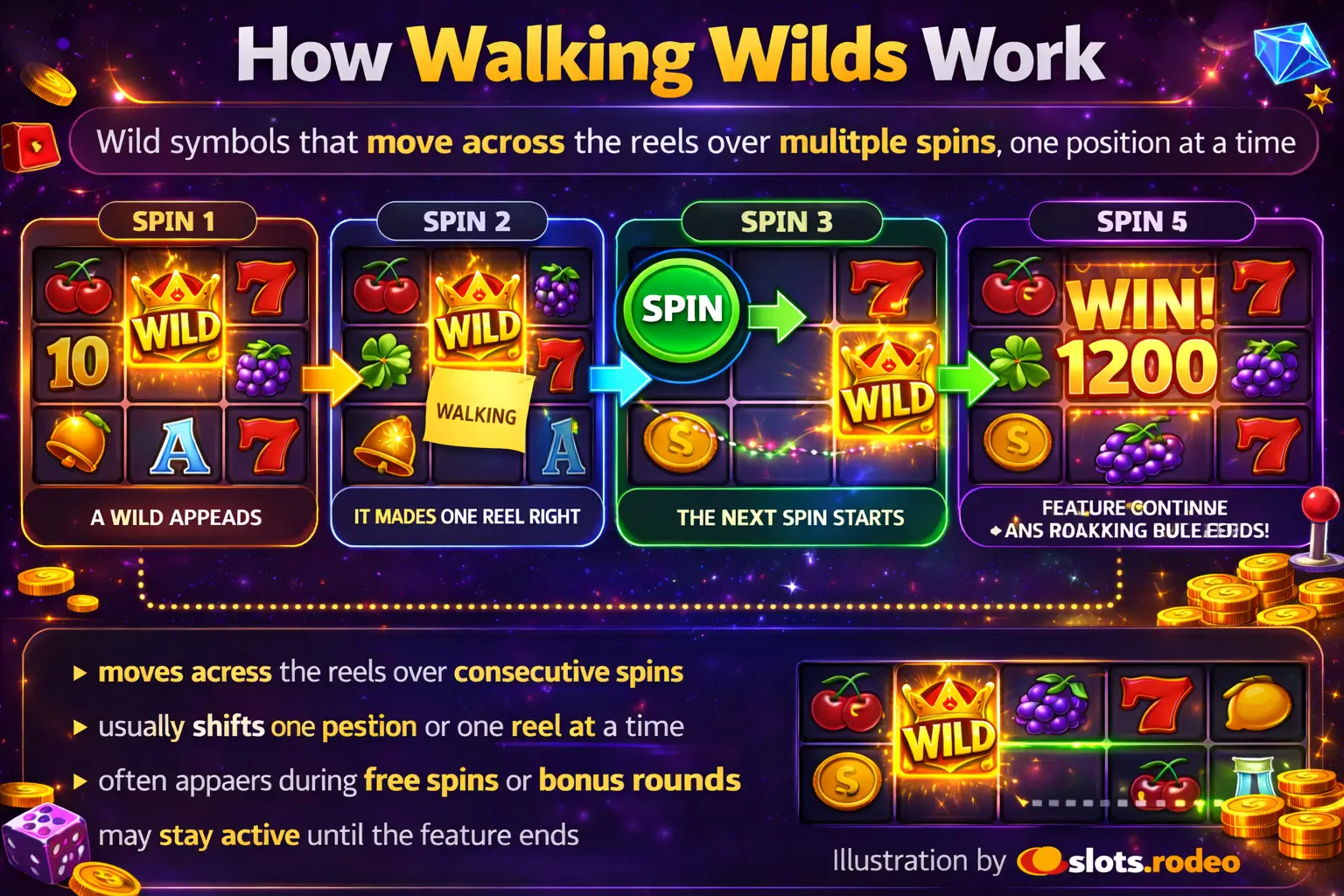
| Spin in feature | What happens |
|---|---|
| Spin 1 | Walking wild lands |
| Spin 2 | Wild moves one reel and stays active |
| Spin 3 | Wild moves again |
| Later spins | Movement continues until the rule ends |
Spin 1
What happens
Walking wild lands
Spin 2
What happens
Wild moves one reel and stays active
Spin 3
What happens
Wild moves again
Later spins
What happens
Movement continues until the rule ends
This works well in free spins because the player can see the wild advancing through the round. It gives the bonus a sense of progression without making the rules too complicated.
Some slots also add:
- extra free spins when a walking wild appears
- more than one walking wild at once
- stacked walking wilds
- multipliers attached to the moving wild
- expanding movement patterns during the feature
Not all walking wilds are single symbols
A walking wild can appear in different forms:
| Walking wild format | What moves |
|---|---|
| Single-position walking wild | One wild symbol changes reel or position |
| Stacked walking wild | A vertical stack moves together |
| Full-reel walking wild | A full reel of wild coverage shifts across the screen |
| Modified walking wild | The moving wild carries a multiplier or other effect |
Single-position walking wild
What moves
One wild symbol changes reel or position
Stacked walking wild
What moves
A vertical stack moves together
Full-reel walking wild
What moves
A full reel of wild coverage shifts across the screen
Modified walking wild
What moves
The moving wild carries a multiplier or other effect
This matters because a stacked or full-reel walking wild can reshape the screen much more strongly than a one-position version.
Walking wild vs sticky wild vs expanding wild
These mechanics are related because they all involve enhanced wild behavior, but they work in different ways.
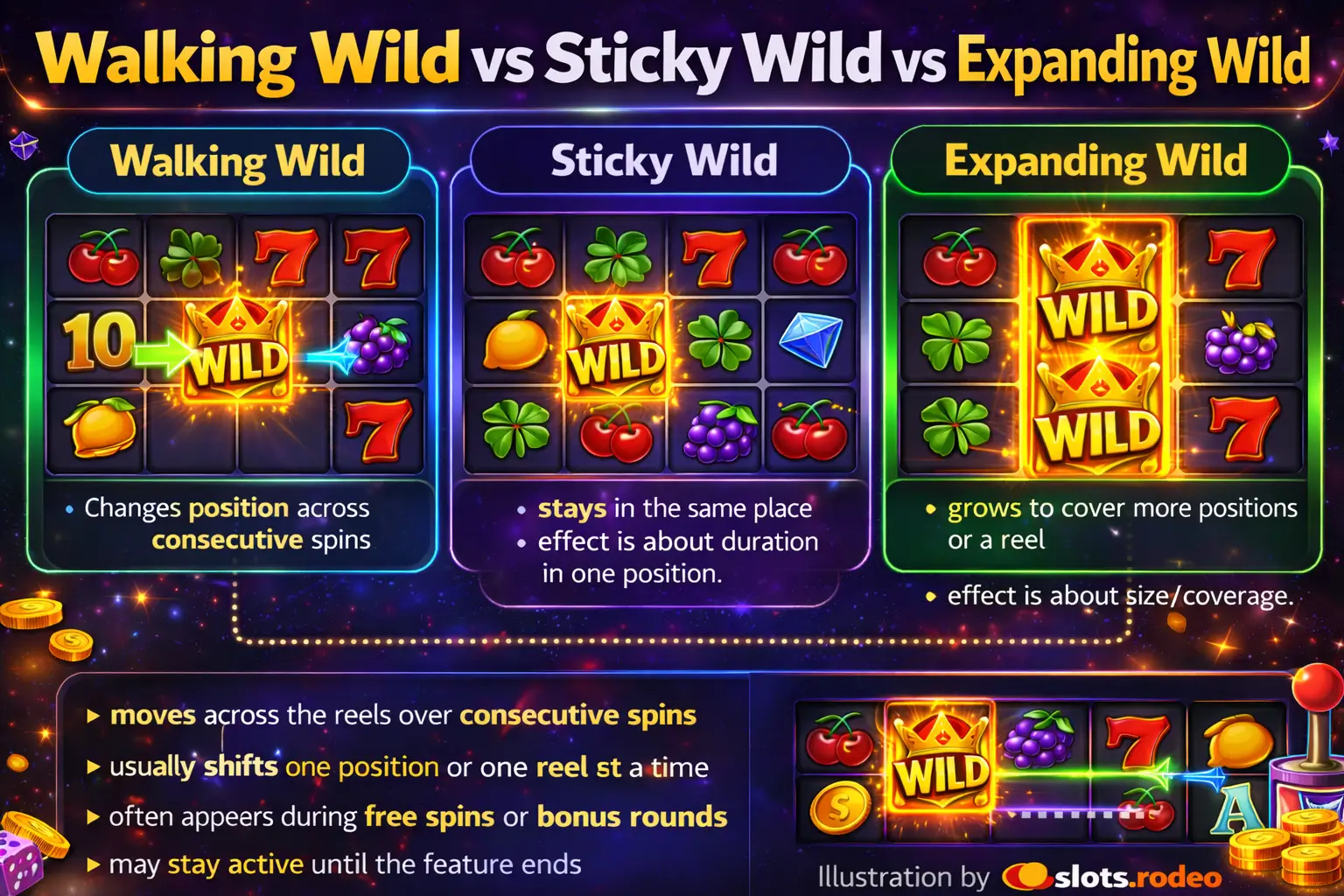
| Wild type | Main effect | What changes? | Typical use |
|---|---|---|---|
| Walking wild | Moves across later spins | Position | Free spins, progressing bonus features |
| Sticky wild | Stays active in one spot | Duration | Feature buildup across several spins |
| Expanding wild | Covers more positions at once | Screen coverage | Reel or area transformation |
Walking wild
Main effect
Moves across later spins
What changes?
Position
Typical use
Free spins, progressing bonus features
Sticky wild
Main effect
Stays active in one spot
What changes?
Duration
Typical use
Feature buildup across several spins
Expanding wild
Main effect
Covers more positions at once
What changes?
Screen coverage
Typical use
Reel or area transformation
The simplest difference is this:
- walking wild = movement
- sticky wild = persistence in one place
- expanding wild = larger area
A slot can combine these ideas. For example, a walking wild may be stacked, or a moving full-reel wild may behave like both a walking and expanding mechanic.
What to check in the paytable or help screen
Walking wilds sound clear, but the details matter a lot.
| What to check | Why it matters |
|---|---|
| Where the walking wild can first appear | Starting position affects later value |
| Which direction it moves | Left-to-right and right-to-left movement can play differently |
| Whether it moves every spin | Some versions move only during a defined feature state |
| Whether it stays for the whole feature | Duration changes total impact |
| Whether more walking wilds can appear | Multiple moving wilds can reshape the feature |
| Whether it is single, stacked, or full-reel | Strongly affects screen coverage |
| Whether it carries multipliers or extra effects | Sometimes the added modifier matters more than the movement |
Where the walking wild can first appear
Why it matters
Starting position affects later value
Which direction it moves
Why it matters
Left-to-right and right-to-left movement can play differently
Whether it moves every spin
Why it matters
Some versions move only during a defined feature state
Whether it stays for the whole feature
Why it matters
Duration changes total impact
Whether more walking wilds can appear
Why it matters
Multiple moving wilds can reshape the feature
Whether it is single, stacked, or full-reel
Why it matters
Strongly affects screen coverage
Whether it carries multipliers or extra effects
Why it matters
Sometimes the added modifier matters more than the movement
These details are usually more important than the feature label itself.
A simple example
Imagine a slot with 8 free spins:
- on spin 2, a stacked walking wild lands on reel 2
- on spin 3, that stack shifts to reel 3
- on spin 4, it shifts to reel 4
- on each spin, the rest of the screen updates around it
- the wild continues moving until the bonus ends or the rule says it leaves the layout
In that setup, the same wild event can influence several different reel connections across the feature.
Why slot designers use walking wilds
Walking wilds are popular because they create visible movement with ongoing value. The player can follow the mechanic easily, and the feature feels active even when the rule itself is simple.
They are especially useful when a slot wants:
- bonus rounds with clear progression
- wild effects that develop over time
- stronger visual identity during free spins
- a mechanic that changes position instead of only size or duration
They are one of the clearest examples of a feature that adds motion without making the slot hard to read.
FAQ
Common questions about this topic.
Not always. Some stay for the whole feature, while others move for a limited number of spins or until they exit the reel layout.
No. Sticky wilds stay in one place. Walking wilds remain active but move to new positions.
Yes. Some slots use stacked or even full-reel walking wilds instead of single-position versions.
No. They are most common in free spins and bonus rounds, but some slots can use them in other special feature states too.
No. They change the feature structure and can improve future reel setups, but the actual payout still depends on symbol placement, pay system, and feature timing.

