

Hold and Win is a slot bonus format built around locked special symbols and a limited number of reset respins.
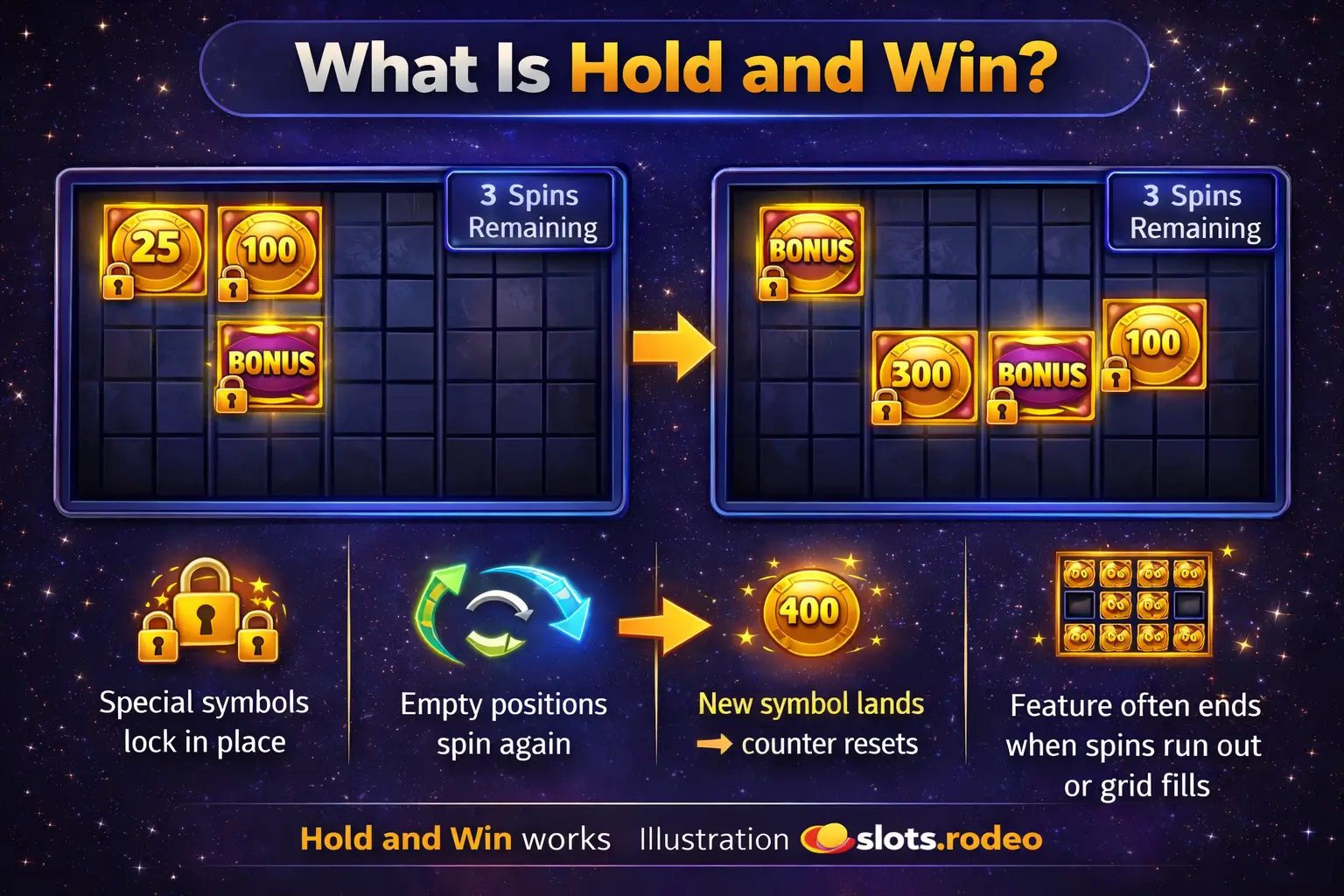
In simple terms, the feature starts when the game lands enough qualifying symbols, usually coins, cash symbols, or other value symbols. Those symbols stay locked in place, the empty positions spin again, and the player gets a small number of respins to try to land more qualifying symbols. Each time a new qualifying symbol lands, the respin counter resets.
This format is common because it is easy to follow on screen. The player can see what is already secured, what is still empty, and whether the feature is extending.
The core idea behind Hold and Win
A Hold and Win feature does not behave like a normal spin and does not behave like a standard free spins round either. It is a locked-grid bonus sequence.
The usual structure looks like this:
- The base game lands enough triggering symbols.
- The Hold and Win feature starts.
- Triggering or value symbols lock in place.
- The game gives a set number of respins, often 3.
- Only the empty positions spin again.
- If a new qualifying symbol lands, it locks and the respin count resets.
- The feature ends when no new qualifying symbol lands before the counter reaches 0, or when the grid fills.
That sequence is the basis of most Hold and Win versions, even when the visual theme changes.
Why the name "Hold and Win" is used
The name describes the structure directly:
- Hold = qualifying symbols stay fixed on the screen
- Win = those locked symbols usually carry cash values, jackpots, modifiers, or bonus effects
In many games, the player is trying to build a screen of value symbols during the feature. In others, the goal is not only to collect values but also to land special symbols such as:
- jackpot symbols
- collect symbols
- multipliers
- upgrade symbols
- extra respin symbols
So the format stays similar even when the reward logic changes.
How Hold and Win usually starts
The trigger is normally simple: land a required number of special symbols in the base game. But the exact requirement varies by slot.
| Trigger setup | Typical example | What it leads to |
|---|---|---|
| Count anywhere | 6 coins anywhere on screen | Hold and Win bonus starts |
| Fixed number on grid | 5 or 6 bonus symbols in view | Locked-symbol feature begins |
| Value-symbol trigger | Enough cash symbols land together | Respin-based bonus opens |
| Mixed trigger | Value symbols plus a collector or bonus icon | Enhanced Hold and Win variation |
Count anywhere
Typical example
6 coins anywhere on screen
What it leads to
Hold and Win bonus starts
Fixed number on grid
Typical example
5 or 6 bonus symbols in view
What it leads to
Locked-symbol feature begins
Value-symbol trigger
Typical example
Enough cash symbols land together
What it leads to
Respin-based bonus opens
Mixed trigger
Typical example
Value symbols plus a collector or bonus icon
What it leads to
Enhanced Hold and Win variation
A beginner mistake is assuming that every coin-style trigger uses the same math. It does not. Two games can both use a Hold and Win structure but have different trigger rates, value ranges, jackpot rules, or reset behavior.
How the mechanic works step by step
The best way to understand Hold and Win is to break it into small parts.
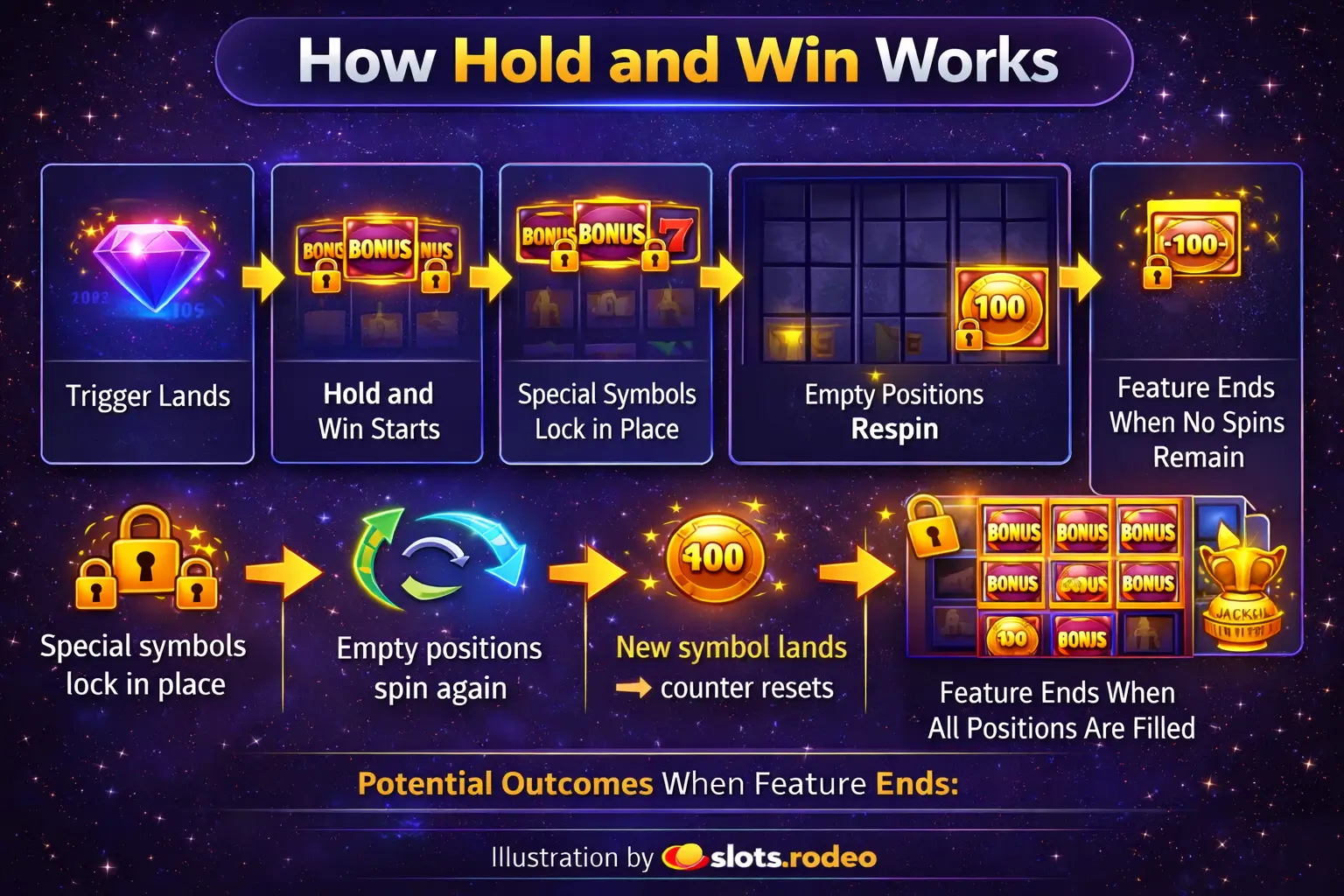
1. Trigger symbols appear
The base game lands enough special symbols to activate the bonus. These are often coins, money bags, or symbols with printed values.
2. Those symbols lock in place
Once the feature starts, the qualifying symbols usually stay where they landed. They do not disappear between respins.
3. The game gives a limited number of respins
Most Hold and Win features begin with 3 respins, though the exact number depends on the slot.
4. Empty positions spin again
Only the unfilled positions are active. The locked symbols remain visible and secured.
5. New symbols reset the counter
If a new qualifying symbol lands, it locks in place and the respin count resets back to the starting number.
6. The feature ends or completes the grid
The round usually ends in one of two ways:
- the player runs out of respins
- the grid fills completely
Many slots give an extra prize for filling the entire screen.
What the locked symbols can represent
Not every Hold and Win feature uses the same type of locked symbol. That is important because the symbol content defines what the feature is actually building toward.
| Locked symbol type | What it can mean in the feature |
|---|---|
| Cash value symbol | Adds a fixed prize amount |
| Jackpot symbol | Can award Mini, Minor, Major, or Grand-style jackpot prizes |
| Multiplier symbol | Boosts values collected during the feature |
| Collector symbol | Collects or sums other symbol values |
| Upgrade symbol | Increases values or changes other symbols |
| Extra spin symbol | Adds more chances or resets in a different way |
Cash value symbol
What it can mean in the feature
Adds a fixed prize amount
Jackpot symbol
What it can mean in the feature
Can award Mini, Minor, Major, or Grand-style jackpot prizes
Multiplier symbol
What it can mean in the feature
Boosts values collected during the feature
Collector symbol
What it can mean in the feature
Collects or sums other symbol values
Upgrade symbol
What it can mean in the feature
Increases values or changes other symbols
Extra spin symbol
What it can mean in the feature
Adds more chances or resets in a different way
This is why the phrase "Hold and Win" tells you the format, but not the full payout structure.
The reset-spin rule is the most important part
The feature would be much weaker without the reset mechanic.
A typical Hold and Win round starts with 3 respins. If nothing new lands for 3 consecutive respins, the feature ends. But every time a new qualifying symbol appears, the count resets back to 3.
That reset rule is what creates the tension. The player is not just watching extra spins. The player is watching whether the feature stays alive.
What ends the feature
Hold and Win features normally end when one of these conditions is met:
| End condition | What it means |
|---|---|
| Respins reach 0 | No new qualifying symbol landed in time |
| Grid fills completely | All available positions are occupied |
| Prize condition is completed | Some games end after a defined collection state |
| Special symbol resolves the round | Certain variations end after a collector or finalizer symbol appears |
Respins reach 0
What it means
No new qualifying symbol landed in time
Grid fills completely
What it means
All available positions are occupied
Prize condition is completed
What it means
Some games end after a defined collection state
Special symbol resolves the round
What it means
Certain variations end after a collector or finalizer symbol appears
The most common version is still the simplest one: the feature ends when the counter reaches 0, unless the screen fills first.
Hold and Win is not always just "collect coins"
That is the standard version, but many slots add variations. For example:
- jackpot symbols can be mixed into the grid
- collector symbols can gather all visible values
- special modifiers can upgrade locked amounts
- one reel or row may behave differently from the others
- the feature can include progressive stages
- a full grid may open a second bonus screen
So while the visual structure is familiar, the actual bonus depth can vary a lot from slot to slot.
Hold and Win vs respin feature vs free spins
These terms are related, but they are not interchangeable.
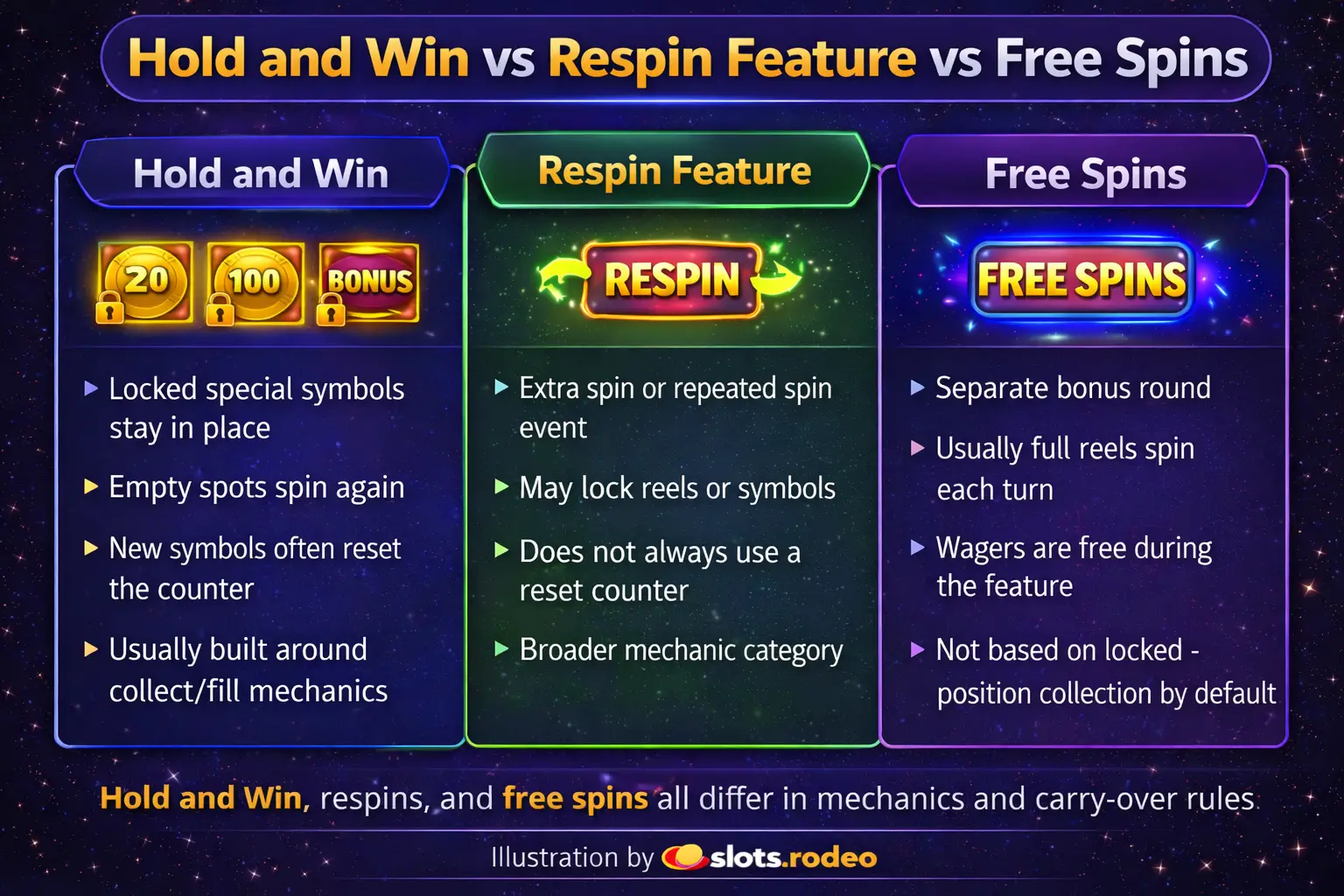
| Mechanic | Main structure | Locked symbols? | Counter reset on new symbol? | Starts from fresh screen? |
|---|---|---|---|---|
| Hold and Win | Bonus grid or reel set with value symbols | Usually yes | Usually yes | No |
| Respin feature | Any extra reel action under special rules | Sometimes | Sometimes | Not always |
| Free spins | Separate series of bonus spins | Sometimes | Usually no | Usually yes |
Hold and Win
Main structure
Bonus grid or reel set with value symbols
Locked symbols?
Usually yes
Counter reset on new symbol?
Usually yes
Starts from fresh screen?
No
Respin feature
Main structure
Any extra reel action under special rules
Locked symbols?
Sometimes
Counter reset on new symbol?
Sometimes
Starts from fresh screen?
Not always
Free spins
Main structure
Separate series of bonus spins
Locked symbols?
Sometimes
Counter reset on new symbol?
Usually no
Starts from fresh screen?
Usually yes
The practical difference is simple:
- Hold and Win is a specific locked-symbol bonus format
- Respin feature is a broader mechanic category
- Free spins are a separate bonus mode with full spins under bonus rules
So every Hold and Win feature usually uses respins, but not every respin feature is Hold and Win.
What to check in the paytable or help screen
If a slot advertises Hold and Win, these are the details that matter most:
| What to check | Why it matters |
|---|---|
| How many symbols trigger the feature | Defines entry condition |
| How many respins you start with | Sets the base feature length |
| What symbols can land during the bonus | Shows what the round can build toward |
| Whether jackpots are included | Important for prize structure |
| Whether collectors or multipliers exist | Changes the feature value logic |
| What happens on a full screen | Some games award a top prize or extra stage |
| Whether values are fixed or variable | Affects how the bonus behaves in practice |
How many symbols trigger the feature
Why it matters
Defines entry condition
How many respins you start with
Why it matters
Sets the base feature length
What symbols can land during the bonus
Why it matters
Shows what the round can build toward
Whether jackpots are included
Why it matters
Important for prize structure
Whether collectors or multipliers exist
Why it matters
Changes the feature value logic
What happens on a full screen
Why it matters
Some games award a top prize or extra stage
Whether values are fixed or variable
Why it matters
Affects how the bonus behaves in practice
This tells you far more than the game's short promotional description.
A simple example
Imagine a 5x3 slot where 6 coin symbols trigger Hold and Win.
- 6 coins land in the base game
- the feature starts with 3 respins
- those 6 coins lock in place
- the remaining empty spots respin
- a new coin lands on the second respin
- that coin locks, and the counter resets back to 3
- the process continues until the player either fills the screen or runs out of respins
That is the standard Hold and Win loop.
What Hold and Win does not tell you by itself
The feature name sounds clear, but it does not tell you:
- how often the trigger happens
- how strong the average bonus is
- how wide the value range is
- whether jackpots are realistic or mostly top-end labels
- whether the slot is low or high volatility overall
A game can have Hold and Win and still feel very different from another slot with the same feature label.
Why this format became so common
Hold and Win became popular because it is easy to understand and easy to present visually:
- secured symbols stay visible
- the reset counter creates tension
- jackpots fit naturally into the structure
- the player can follow progress without reading much text
It is one of the clearest examples of a feature that works well for both game design and player readability.
FAQ
Common questions about this topic.
No. Hold and Win is usually a locked-symbol respin bonus. Free spins are a separate set of bonus spins that usually start from a fresh screen state.
Not exactly. Hold and Win is a specific feature format built on respins, locked symbols, and reset counts. "Respin feature" is a broader category.
Usually yes. That is one of the defining rules of the format.
In most Hold and Win versions, yes. But the help screen should always be checked because some slots add special exceptions or modifiers.
Not always. Some games award a special full-screen prize, jackpot, or extra stage, while others simply total the locked values. The paytable gives the exact rule.


