

A winning combination in a slot is the symbol pattern the game accepts as a payout. The exact rule depends on the slot format.
In one game, a win may require matching symbols on a payline from left to right. In another, the same symbol can pay anywhere on adjacent reels. In a cluster game, symbols may need to touch each other instead of landing on a line.
That is why two slots with similar symbols can still calculate wins in very different ways.
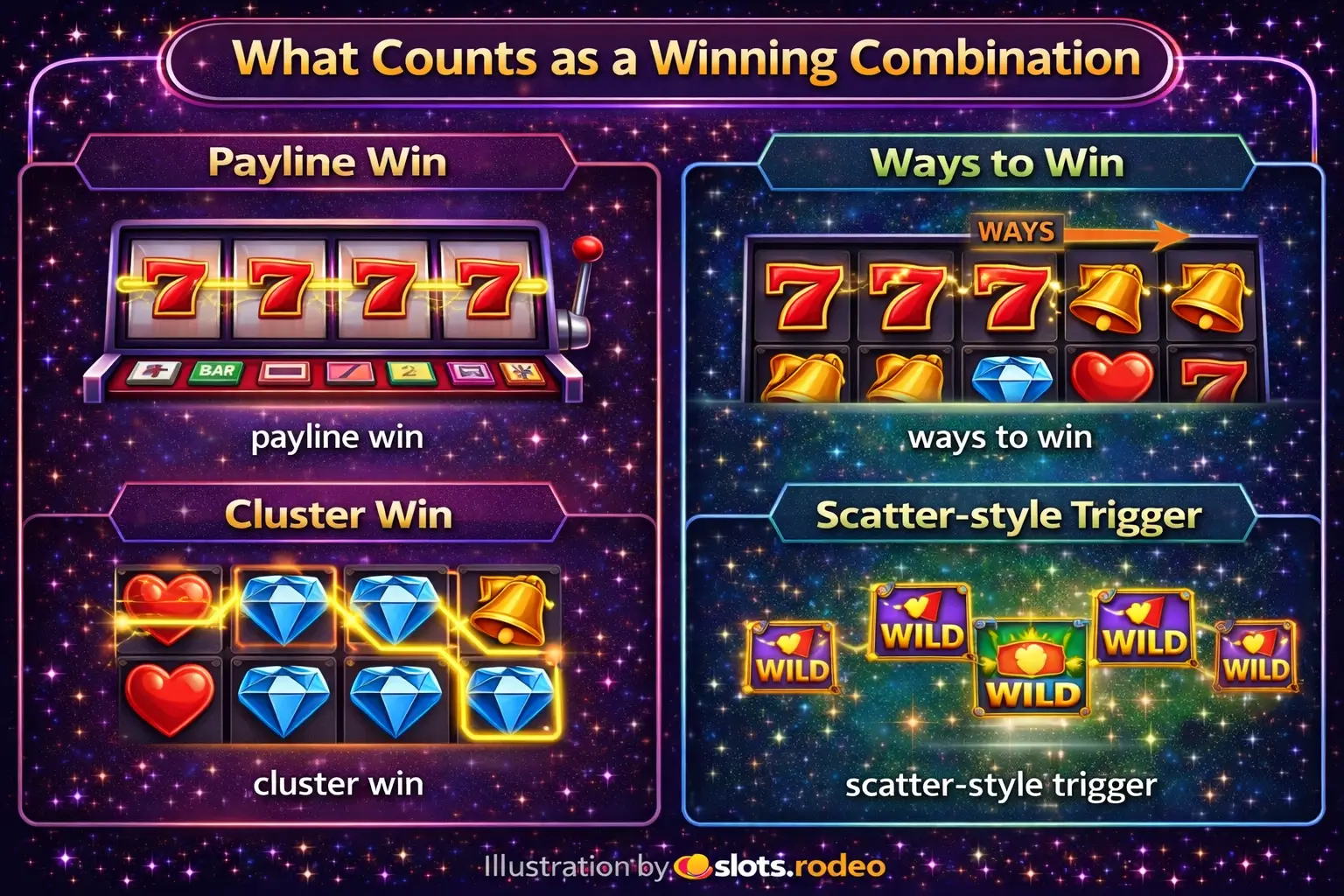
A slot only pays patterns defined by its rules
A slot does not pay any random group of matching symbols. It only pays combinations that fit the game's payout logic.
Usually, that logic is based on four things:
- the pay system used by the slot
- the minimum number of matching symbols required
- the direction in which the combination must form
- whether special symbols such as wilds can help complete the win
The paytable or help screen defines these rules. If you want to know what counts as a win in a specific slot, that is the first place to check.
A winning combination is not always just "3 matching symbols"
Many new players assume every slot works like an old 3-reel machine: match 3 symbols and get paid.
That is only one model.
Modern slots may use:
- fixed paylines
- adjustable paylines
- ways to win
- cluster pays
- all-ways systems such as Megaways
- feature-specific rules during bonus rounds
So the real question is not "Did I match enough symbols?" It is "Did I match them in the way this slot accepts?"
How winning combinations work in different slot formats
Paylines slots: the symbols must land on a valid line
In a payline slot, symbols must land on a specific line pattern shown by the game.
That line may be straight, zig-zag, V-shaped, or another preset shape. A combination only pays if the matching symbols land on one of the active paylines.
Most payline slots also require the combination to start on the leftmost reel, unless the rules say the game pays both ways.
For example:
- 3 matching symbols on payline 7 may pay
- the same 3 symbols in the same row may not pay if they do not sit on an active payline
- 4 matching symbols usually pay more than 3
- 5 matching symbols usually pay more than 4
In this format, the line pattern matters as much as the symbol match.
Ways-to-win slots: the symbols must appear on adjacent reels
In a ways-to-win slot, symbols do not need to land on a fixed payline. Instead, matching symbols usually need to appear on adjacent reels from left to right.
For example, in a 5-reel ways slot:
- reel 1 has a premium symbol in 2 positions
- reel 2 has the same symbol in 3 positions
- reel 3 has the same symbol in 1 position
That creates 2 x 3 x 1 = 6 winning ways for a 3-reel match.
This is why one spin in a ways slot can produce many combinations at once. The game counts every valid route across consecutive reels.
Cluster-pay slots: the symbols must connect
In a cluster-pay slot, symbols usually do not need paylines or reel-by-reel alignment. Instead, a win forms when a minimum number of matching symbols touch each other horizontally and/or vertically. Some games also count diagonal contact, but only if the rules say so.
A cluster slot may require:
- 4 connected matching symbols
- 5 connected matching symbols
- 9 or more connected matching symbols
The exact threshold depends on the game.
In this format, the key factor is contact, not line position.
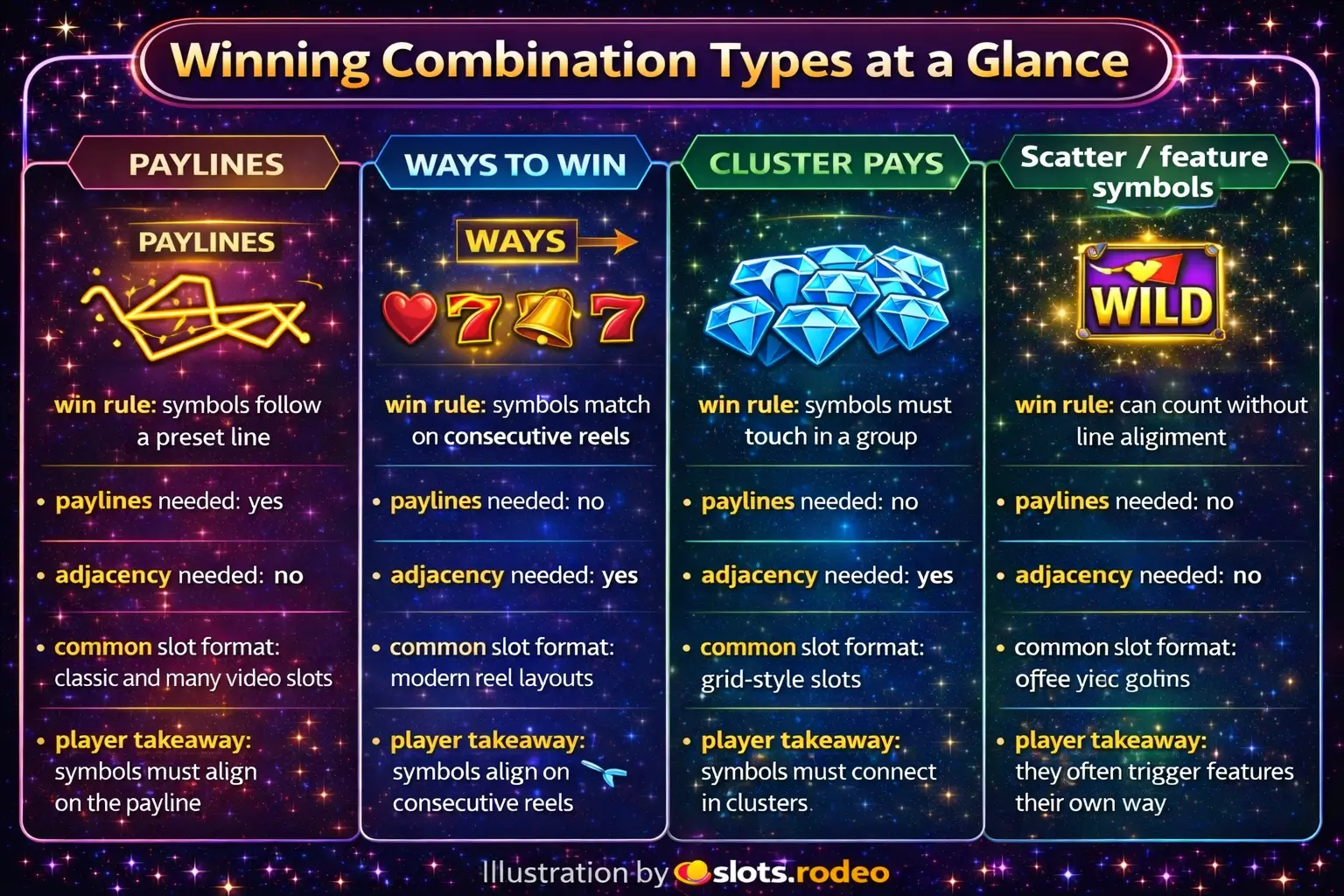
How win formation changes by slot type
| Slot format | What forms the win | Usual starting rule | What matters most |
|---|---|---|---|
| Paylines | Matching symbols on a defined payline | Often left to right | Line pattern |
| Ways to win | Matching symbols on adjacent reels | Usually left to right | Reel-to-reel continuity |
| Cluster pays | Matching connected symbols | No line start needed | Symbol contact |
Paylines
What forms the win
Matching symbols on a defined payline
Usual starting rule
Often left to right
What matters most
Line pattern
Ways to win
What forms the win
Matching symbols on adjacent reels
Usual starting rule
Usually left to right
What matters most
Reel-to-reel continuity
Cluster pays
What forms the win
Matching connected symbols
Usual starting rule
No line start needed
What matters most
Symbol contact
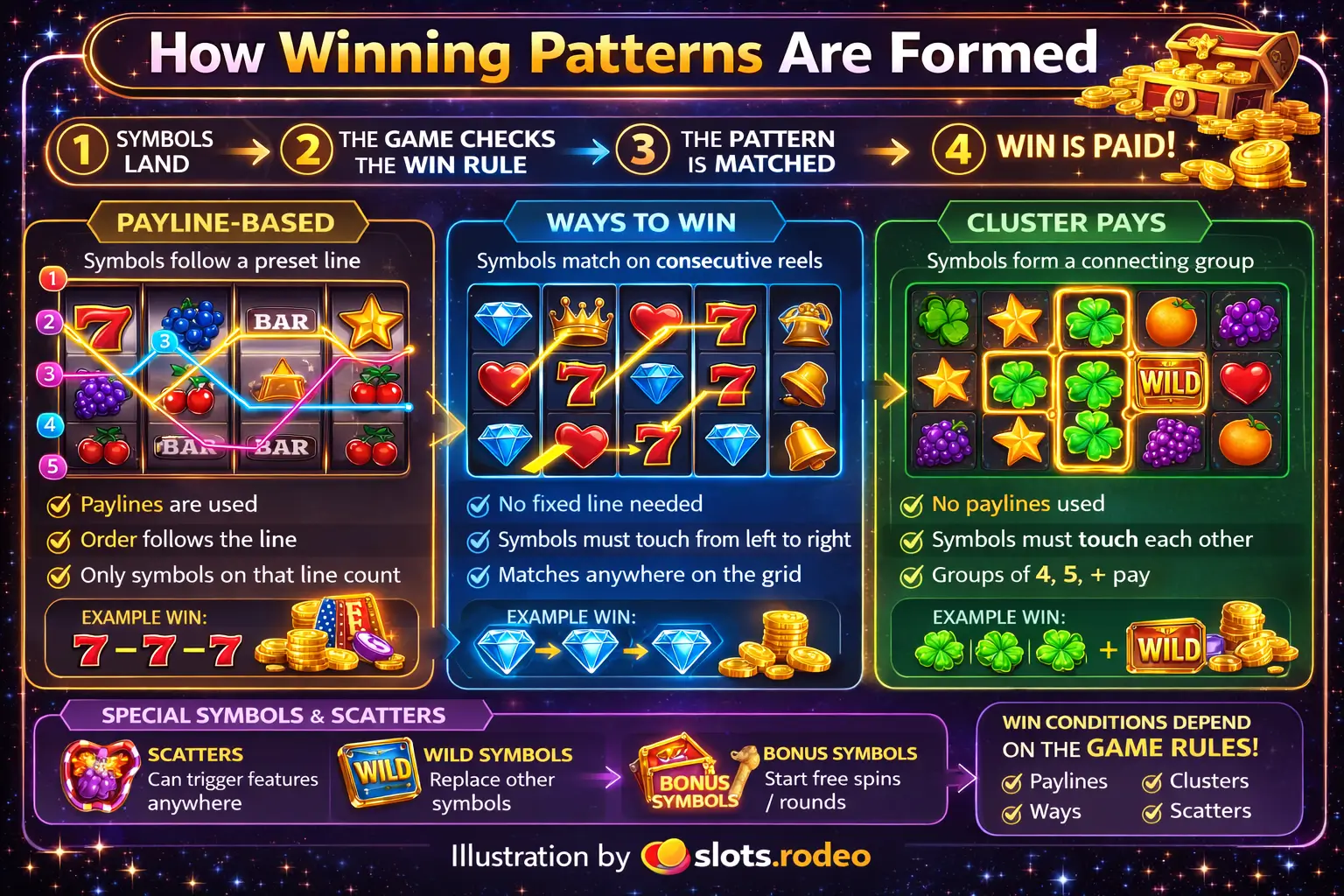
What usually decides whether the combination pays
Minimum match count
Every slot sets a minimum number of matching symbols required for a payout.
Common examples:
- low-value symbols may pay from 3
- premium symbols may pay from 3
- some high-value symbols may only pay from 4
- clusters may require 4, 5, or more connected symbols
Do not assume all symbols use the same threshold.
Position rule
A symbol match may still fail if it forms in the wrong place.
Typical position rules include:
- must start from the leftmost reel
- must land on an active payline
- must appear on consecutive reels
- must be connected in a cluster
- may pay both left-to-right and right-to-left in some games
This is one of the most common reasons players think they should have won when the slot shows no payout.
Active game mode
Some slots change win formation rules during free spins, respins, or bonus features.
Examples:
- extra paylines may activate
- wild symbols may become more frequent
- symbol heights may change in Megaways games
- clusters may cascade and create new wins from one paid result
A combination that is rare in the base game may become much easier to form in a feature.
Where wild symbols fit into a winning combination
Wilds often help complete winning combinations, but they do not work the same way in every slot.
A wild may:
- substitute for regular paying symbols
- fail to substitute for scatter or bonus symbols
- only work on certain reels
- expand, stick, or move during special features
This matters because a pattern that looks like a win may still not pay if the wild cannot replace the missing symbol under that game's rules.
Why a pattern that looks right may still not pay
Players often see matching symbols on the screen and assume the game missed a payout. In most cases, the issue is one of these:
| Common reason | Why it does not pay |
|---|---|
| Symbols are not on an active payline | Payline slots only pay listed line paths |
| Match does not start in the required position | Many games require leftmost-reel start |
| Symbols are not on consecutive reels | Ways systems usually need adjacent reels |
| Connected symbols do not meet the cluster rule | The group may be too small or not connected correctly |
| Wild does not substitute in that case | Some symbols cannot be replaced by wilds |
Symbols are not on an active payline
Why it does not pay
Payline slots only pay listed line paths
Match does not start in the required position
Why it does not pay
Many games require leftmost-reel start
Symbols are not on consecutive reels
Why it does not pay
Ways systems usually need adjacent reels
Connected symbols do not meet the cluster rule
Why it does not pay
The group may be too small or not connected correctly
Wild does not substitute in that case
Why it does not pay
Some symbols cannot be replaced by wilds
What to check in the paytable before you judge a win
Before assuming a slot paid correctly or incorrectly, check these points in the paytable:
- Pay system - paylines, ways, or clusters
- Minimum symbol count - how many matching symbols are needed
- Direction rule - left to right, both ways, or no direction rule
- Wild behavior - what wilds can and cannot replace
- Special feature rules - whether the bonus round changes win formation
These five checks explain most payout questions.
Winning combination vs total payout
A winning combination is only the pattern that qualifies for a payout. It does not tell you the final amount on its own.
The actual payout also depends on:
- the symbol value
- how many matching symbols are included
- your bet size
- how many ways or lines were involved
- whether multiple wins are counted together on the same spin
So there are two separate questions:
- Did a valid winning combination form?
- How much is that combination worth?
A player should separate those two ideas. The first is about game logic. The second is about payout calculation.
What beginners usually get wrong
A few misunderstandings appear again and again:
"Matching symbols anywhere should pay"
Not true. A slot only pays combinations that match its rules.
"If 3 symbols pay, then any 3 of that symbol should pay"
Not true. They may need to be on a payline, on adjacent reels, or in a connected cluster.
"Wild always fixes the combination"
Not true. Wilds often have restrictions.
"If the symbols look close enough, the slot should count it"
Not true. Slot logic is exact. Near-miss layouts do not matter unless they meet the rule set.
FAQ
Common questions about this topic.
No. Some slots pay from 2 symbols, many pay from 3, and cluster games may require 4, 5, or more connected symbols.
Yes. The result depends on the pay system and the rules in the paytable.
No. Many slots use left-to-right rules, but some pay both ways and cluster games usually do not use a left-start rule at all.
No. Many wilds substitute for regular symbols, but they often do not replace scatters, bonus symbols, or other special symbols.
Check the paytable for the pay system, minimum match count, direction rule, and wild limitations. Those four points usually tell you how the game decides what counts as a winning combination.


