

A slot paytable explains how the game works. It shows which symbols pay, how wins are formed, and what special features can affect the result.
If you do not read the paytable, you are guessing. You may see symbols on the reels, but you will not know which ones matter most, how much they pay, or what triggers free spins or bonus rounds.
For a beginner, the paytable is the single most useful screen in any slot.
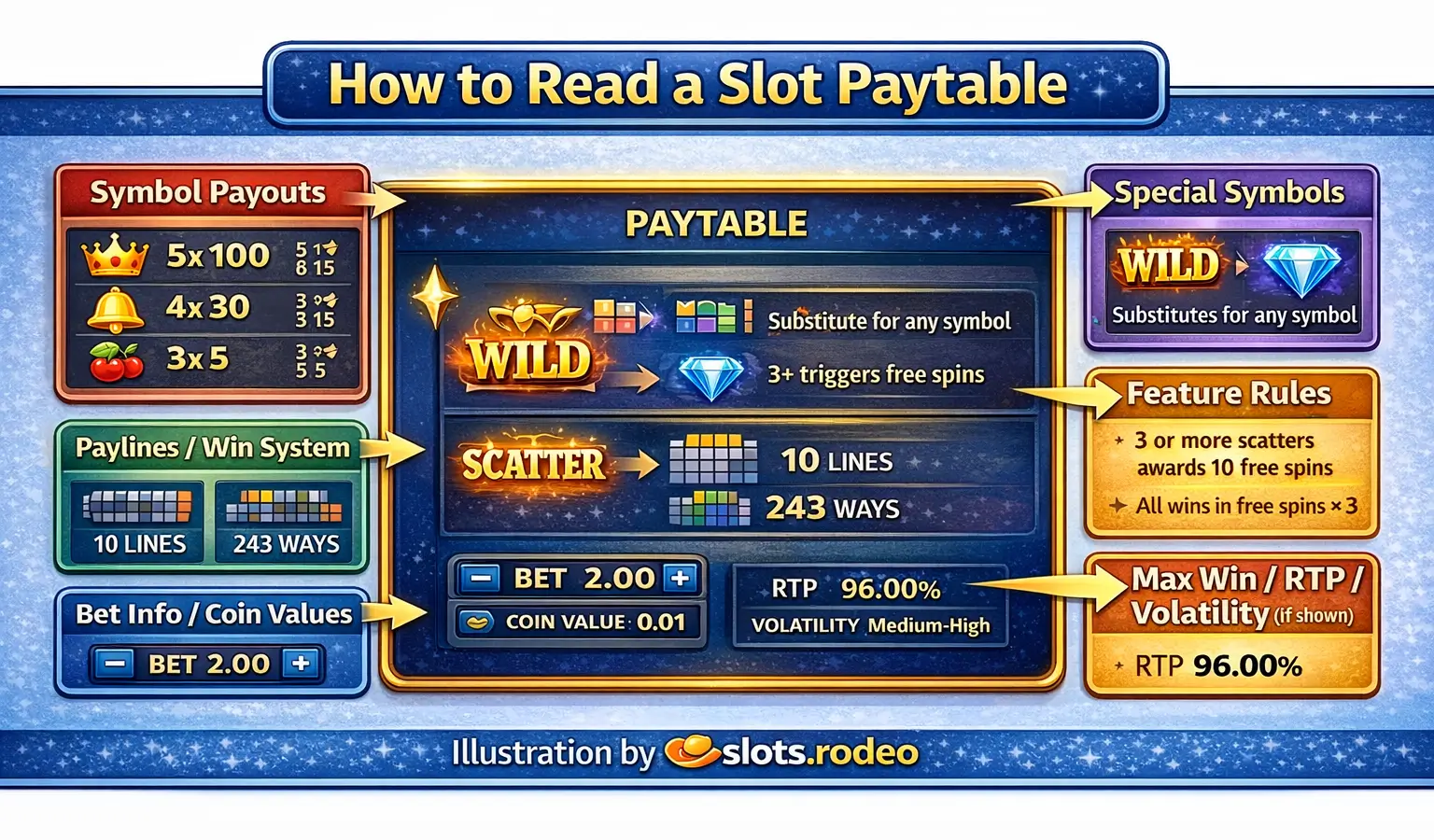
What a slot paytable is
A paytable is the game's rule and payout reference.
It usually tells you:
- which symbols are low-value and premium
- how many matching symbols you need for a payout
- how much each winning combination pays
- what wild symbols do
- what scatter symbols do
- how bonus features are triggered
- whether payouts depend on paylines, ways to win, or clusters
- how bet size affects displayed win values
A slot may also spread this information across several help screens instead of showing it in one single table. The function is the same.
Why the paytable matters
The paytable helps you answer practical questions before you spin:
- Which symbols are actually valuable?
- Does the game pay left to right only?
- Do scatters pay anywhere?
- Can wilds substitute for bonus symbols?
- How many scatters trigger free spins?
- Are wins shown as coins, credits, or bet multipliers?
- Does the slot use fixed paylines, Megaways, ways to win, or cluster pays?
Without those answers, it is easy to misread what happens on the reels.
The main sections you should look for
Most slot paytables include the same core parts.
| Paytable section | What it tells you | Why it matters |
|---|---|---|
| Symbol values | Which symbols pay and how much | Helps you spot high-value vs low-value symbols |
| Win rules | How combinations become valid | Explains whether the game uses lines, ways, or clusters |
| Wild rules | How wilds substitute or multiply | Shows whether wilds improve payouts or trigger features |
| Scatter rules | How scatters pay or trigger bonuses | Important for free spins and feature access |
| Bonus feature rules | What happens in free spins or bonus rounds | Helps you understand where larger wins may come from |
| Bet and payout display | Whether values are in coins, credits, or money | Prevents mistakes when reading win amounts |
Symbol values
What it tells you
Which symbols pay and how much
Why it matters
Helps you spot high-value vs low-value symbols
Win rules
What it tells you
How combinations become valid
Why it matters
Explains whether the game uses lines, ways, or clusters
Wild rules
What it tells you
How wilds substitute or multiply
Why it matters
Shows whether wilds improve payouts or trigger features
Scatter rules
What it tells you
How scatters pay or trigger bonuses
Why it matters
Important for free spins and feature access
Bonus feature rules
What it tells you
What happens in free spins or bonus rounds
Why it matters
Helps you understand where larger wins may come from
Bet and payout display
What it tells you
Whether values are in coins, credits, or money
Why it matters
Prevents mistakes when reading win amounts
Start with the symbol values
The most basic part of the paytable is the symbol list.
This section usually shows each paying symbol and its payout for different match counts, such as 3, 4, or 5 of a kind.
A simplified example might look like this:
| Symbol type | 3 of a kind | 4 of a kind | 5 of a kind |
|---|---|---|---|
| Low symbol | 0.5x bet | 1x bet | 2x bet |
| Mid symbol | 1x bet | 2x bet | 5x bet |
| Premium symbol | 2x bet | 10x bet | 25x bet |
Low symbol
3 of a kind
0.5x bet
4 of a kind
1x bet
5 of a kind
2x bet
Mid symbol
3 of a kind
1x bet
4 of a kind
2x bet
5 of a kind
5x bet
Premium symbol
3 of a kind
2x bet
4 of a kind
10x bet
5 of a kind
25x bet
This immediately tells you two things:
- not all symbols pay the same
- longer combinations usually pay more
In many slots, premium symbols matter much more than card ranks or low-tier themed symbols.
Check how wins are formed
A paytable is not only about symbol value. It also tells you how a winning combination is recognized.
Fixed paylines
The slot pays only when matching symbols land on preset line patterns.
Ways to win
The slot pays when matching symbols land on consecutive reels, usually from left to right, without needing a specific row pattern.
Megaways
The number of symbols per reel changes from spin to spin, so the total number of ways can also change on every spin.
Cluster pays
The slot pays when matching symbols form connected groups rather than lines or reel-to-reel chains.
This section is critical because the same screen can be a win in one slot and a non-win in another.
Learn the reading direction
Many slots pay from left to right, but not all.
Some games may include:
- left to right only
- both ways
- adjacent reels only
- anywhere rules for specific symbols
- cluster connection rules instead of directional rules
A beginner often assumes that matching symbols anywhere should pay. The paytable tells you whether that is true.
Understand wild symbols properly
Wilds are often misunderstood.
The paytable should explain:
- which symbols wilds can replace
- whether wilds substitute only in the base game or also in bonus features
- whether wilds can appear on all reels or only some reels
- whether wilds have their own payout
- whether wilds carry multipliers
- whether wilds expand, stack, stick, or move
A wild is not automatically the "best symbol." In some slots, the wild mainly helps complete combinations. In others, it is a major multiplier symbol. The paytable shows the difference.
Read the scatter rules carefully
Scatter symbols often work outside normal line rules.
The paytable may tell you:
- whether scatters pay anywhere
- how many scatters trigger free spins
- whether scatter payouts scale with total bet
- whether scatters can appear on all reels
- whether scatters need to land in view or in special positions only
Example:
| Number of scatters | Result |
|---|---|
| 2 scatters | No feature |
| 3 scatters | 10 free spins |
| 4 scatters | 15 free spins |
| 5 scatters | 20 free spins |
2 scatters
Result
No feature
3 scatters
Result
10 free spins
4 scatters
Result
15 free spins
5 scatters
Result
20 free spins
This is one of the most useful sections because many modern slots derive a large part of their value from feature access, not just base-game line hits.
Check whether payouts are shown as bet multipliers or fixed values
Paytables may display wins in different formats:
- x bet
- coins
- credits
- cash value based on current stake
This matters because a listed payout may look large without actually being large in money terms.
For example:
- 100 coins at coin value 0.01 = 1.00
- 100 coins at coin value 0.10 = 10.00
If you do not check the display method, you can easily overestimate or underestimate a payout.
Look for feature-specific rules
In many slots, the base paytable is only part of the story.
The help screens may also explain:
- free spin multipliers
- expanding wild mechanics
- respins
- bonus pick rounds
- symbol upgrades
- locked reels
- cascading wins
- reel modifiers
- jackpot triggers
These rules matter because the slot may pay very differently in the bonus feature than in the base game.
For example, a premium symbol may pay the same in both modes, but a 2x or 3x multiplier in free spins can change the practical outcome a lot.
Pay attention to exclusions and limitations
This is where many players make mistakes.
The paytable may include small but important limits such as:
- wild does not substitute for scatter
- scatter does not pay in free spins
- only the highest win per way is paid
- only the highest symbol on a payline counts
- multipliers apply only in bonus mode
- bonus symbols appear only on reels 2, 3, and 4
- stacked wilds appear only in the base game
These details can completely change how you interpret the reels.
A simple order for reading any paytable
If you want a practical method, use this order:
1. Check the win system
Is it paylines, ways, Megaways, or clusters?
2. Read symbol values
Which symbols pay the most? How many matches are needed?
3. Check the direction and validity rules
Left to right, both ways, adjacent reels, or anywhere?
4. Read the wild rules
What can wilds substitute for? Do they multiply wins?
5. Read the scatter and bonus rules
How are features triggered? How many symbols are needed?
6. Check the payout format
Are values shown in coins, credits, or x bet?
7. Read any special restrictions
Look for exceptions, exclusions, and mode-specific rules.
Example: how to read a paytable in practice
Imagine you open a slot and see this:
- 5 premium masks = 20x bet
- wild substitutes for all regular symbols
- 3 scatters = 10 free spins
- slot pays left to right on 25 fixed paylines
- all wins are based on total bet
From this, you already know:
- premium masks are important
- you need line-based combinations, not random matches
- wilds can help complete regular wins
- free spins start at 3 scatters
- payout values scale from total stake, not from symbol count alone
That is enough to understand the game's structure before making any judgment about its payouts.
Common beginner mistakes when reading a paytable
Looking only at the biggest listed win
The top symbol payout matters, but it does not explain how often it can realistically happen.
Ignoring the win system
A strong symbol means little if you do not understand how wins are actually formed.
Skipping the special symbol rules
Wilds and scatters often shape the slot more than regular symbols do.
Confusing coins with real money
A coin payout must be converted through coin value or total bet.
Missing the exception text
The smallest lines in the help screen are often where the most important restrictions appear.
What a paytable does not tell you directly
A paytable is essential, but it does not explain everything on its own.
It usually does not fully tell you:
- how often a symbol lands
- how hard it is to trigger the bonus
- how the game feels over a short session
- how volatile the slot feels in practice
- how much of total theoretical return comes from the bonus round
For that, you need other game information such as RTP, volatility label, feature structure, and real gameplay context.
Quick checklist before you leave the paytable
Before you start playing, make sure you can answer these questions:
| Question | Why you should know it |
|---|---|
| How does this slot form wins? | Prevents basic misreading of the reels |
| Which symbols pay the most? | Helps you understand symbol hierarchy |
| What does the wild actually do? | Wild behavior varies a lot between slots |
| What triggers free spins or bonus rounds? | Features often drive the game's value |
| Are payouts shown in x bet, coins, or cash? | Prevents payout confusion |
| Are there any exclusions or special conditions? | Small exceptions can change the whole reading |
How does this slot form wins?
Why you should know it
Prevents basic misreading of the reels
Which symbols pay the most?
Why you should know it
Helps you understand symbol hierarchy
What does the wild actually do?
Why you should know it
Wild behavior varies a lot between slots
What triggers free spins or bonus rounds?
Why you should know it
Features often drive the game's value
Are payouts shown in x bet, coins, or cash?
Why you should know it
Prevents payout confusion
Are there any exclusions or special conditions?
Why you should know it
Small exceptions can change the whole reading
FAQ
Common questions about this topic.
No. The paytable explains payout rules and symbol values. RTP is a separate long-term theoretical return figure.
No. They only pay if they meet the slot's winning rules, such as paylines, ways, or cluster conditions.
Not always. In some slots, wilds mainly substitute. In others, they also pay directly or apply multipliers.
Not always. The paytable tells you whether scatters pay directly, trigger features, or do both.
Because it shows the actual game rules. Without it, you are guessing how the slot pays and what the special symbols do.


