

Slot payouts are based on a few core parts: the paytable, the winning system, the symbols involved, and your total bet.
A slot does not pay "random amounts" without rules. Every win is calculated from the game's payout logic. If you understand that logic, it becomes much easier to read a slot correctly, compare games, and avoid common mistakes.
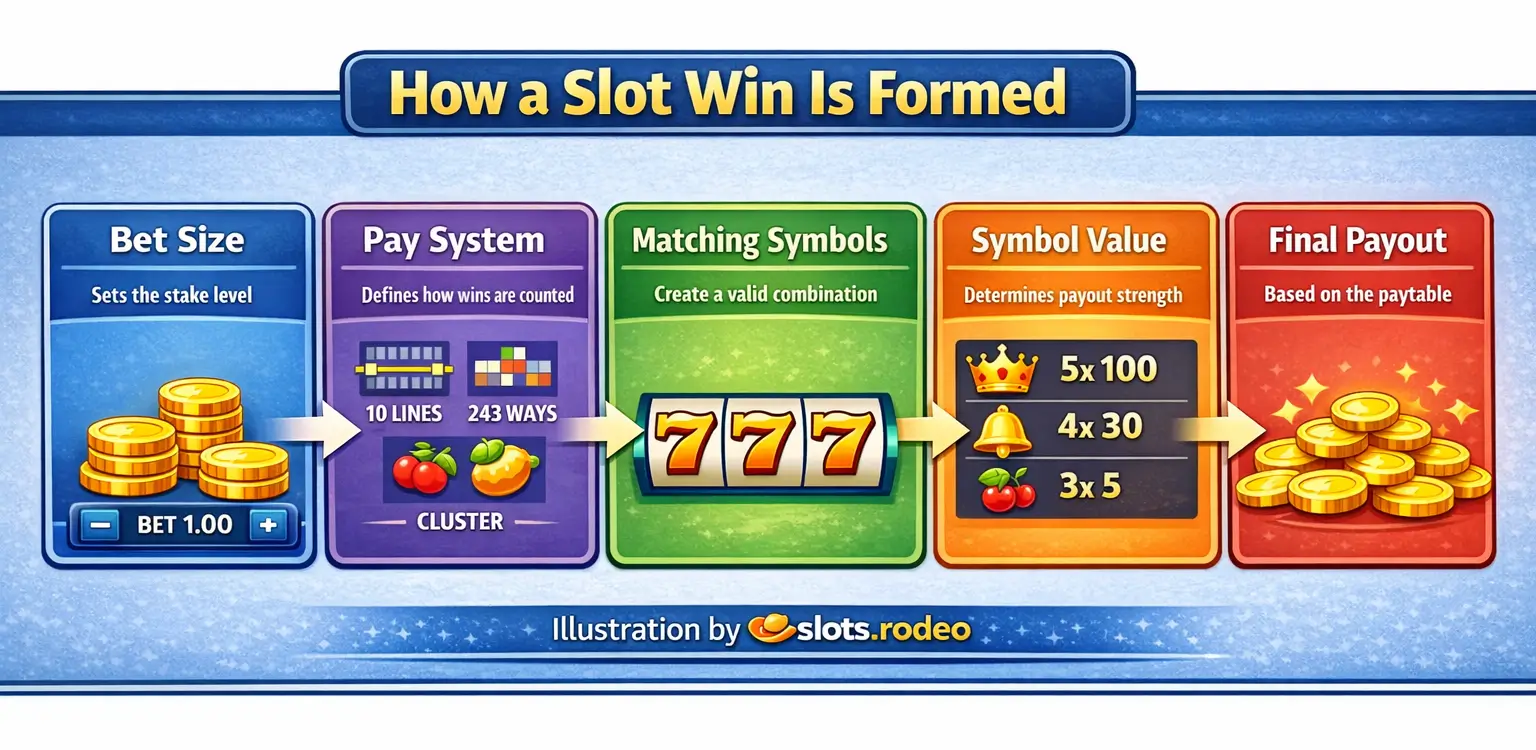
What a slot payout actually means
A slot payout is the amount the game gives back after a winning result.
That amount is usually based on:
- which symbols landed
- how many matching symbols formed the win
- where they landed according to the game's rules
- your current bet size
- the game's paytable
In simple terms, the slot first checks whether a valid win was formed. If yes, it looks at the paytable and applies the payout value to your bet structure.
The paytable is the main reference point
The paytable is the rulebook for payouts.
It tells you:
- which symbols pay
- how many matching symbols you need
- which symbols pay more than others
- whether payouts are shown as coins, credits, or bet multipliers
- how bonus symbols, wilds, or scatters are handled
If you want to understand payouts in any slot, the paytable is the first place to look.
The three things that decide most payouts
Most slot payouts come from the interaction of three variables:
| Factor | What it does | Why it matters |
|---|---|---|
| Symbol value | Sets how strong each symbol is | Premium symbols usually pay more than low symbols |
| Win system | Defines how a combination becomes valid | A payline slot works differently from a ways-to-win slot |
| Bet size | Scales the final amount | The same symbol hit can pay more or less depending on stake |
Symbol value
What it does Sets how strong each symbol is
Why it matters
Premium symbols usually pay more than low symbols
Win system
What it does Defines how a combination becomes valid
Why it matters A payline slot works differently from a ways-to-win slot
Bet size
What it does Scales the final amount
Why it matters The same symbol hit can pay more or less depending on stake
This is why two wins that "look similar" on the screen may not pay the same amount.
Symbol values: not all symbols pay equally
Slots usually divide symbols into groups.
Low-value symbols
These are often card ranks or simple themed symbols. They usually pay smaller amounts and often need more matches to produce a noticeable return.
Premium symbols
These are higher-paying themed symbols. They usually produce stronger payouts for the same number of matches.
Special symbols
Wilds, scatters, bonus symbols, and jackpots follow separate rules. Some substitute. Some trigger features. Some pay on their own. Some do not pay directly at all.
A common beginner mistake is assuming that every matching symbol should pay roughly the same. That is not how slot math works. Symbol hierarchy matters.
Winning systems change how payouts are formed
The game must define how a win is recognized before it can calculate how much it pays.
Paylines
In a payline slot, symbols must land on preset line patterns. A combination only pays if it follows one of those lines.
Ways to win
In a ways slot, matching symbols usually need to land on adjacent reels from left to right, regardless of exact row position.
Cluster pays
In a cluster slot, payouts usually come from groups of connected or touching matching symbols rather than lines or reel-by-reel chains.
The same screen layout can produce different results depending on the win system. That is why you should never judge payouts by symbol appearance alone.
How bet size affects payouts
In most slots, payouts scale with the stake.
That means:
- higher bet = larger absolute win
- lower bet = smaller absolute win
- the paytable value itself usually stays proportional
For example, if a symbol combination pays 10x your bet:
- at a $0.20 bet, it pays $2
- at a $1.00 bet, it pays $10
- at a $2.00 bet, it pays $20
The important point is that the multiplier stays the same, while the money amount changes.
Coins, credits, and total bet
Some slots display payouts in money. Others show them in coins or credits.
This can confuse new players because the screen may show a win like 250 coins, but that does not automatically mean 250 units of real money.
The real value depends on:
- coin value
- number of coins bet
- total stake configuration
Here is a simplified example:
| Displayed win | Coin value | Real payout |
|---|---|---|
| 100 coins | $0.01 | $1.00 |
| 100 coins | $0.10 | $10.00 |
| 100 coins | $0.20 | $20.00 |
100 coins
Coin value $0.01
Real payout $1.00
100 coins
Coin value $0.10
Real payout $10.00
100 coins
Coin value $0.20
Real payout $20.00
This is why two players can see "100 coins" and receive very different cash amounts.
Why the same number of symbols can pay different amounts
A 3-symbol hit does not always equal another 3-symbol hit.
Possible reasons:
- the symbols are from different value tiers
- the win was formed on a different payline or system
- one result used a premium symbol and the other used a low symbol
- one slot uses different payout balance than another slot
- the bet size was different
For example, 3 low symbols may pay 0.5x to 1x bet, while 3 premium symbols may pay 5x to 20x bet, depending on the game.
Wilds and scatters can change the payout logic
Special symbols often work outside the basic payout structure.
Wilds
Wilds may substitute for standard paying symbols. This can help complete a higher-paying combination. Some wilds also carry multipliers.
Scatters
Scatters often pay anywhere on the reels, without following normal line rules. In many slots, they are more important for feature triggers than for base-game payouts.
Bonus symbols
Bonus symbols often trigger free spins, bonus rounds, respins, or other mechanics. In many cases, their real value comes from the feature they unlock rather than their direct symbol payout.
Payout amount is not the same thing as RTP
This is an important distinction.
A payout is the result of one winning event.
RTP is a long-term theoretical return built into the game math across many spins.
A slot can have a high RTP and still produce many small wins, long dry spells, or uneven short sessions. Reading a single payout tells you nothing about the game's long-term return by itself.
A simple payout formula
In practical terms, slot payouts often follow a structure close to this:
payout = symbol payout value x bet factor
The exact internal formula depends on the game design, but for most players the key idea is simple:
- the slot checks whether the result is a valid win
- it identifies the symbol and match length
- it finds that combination in the paytable
- it applies your current bet size
- it returns the final payout amount
Example: how a payout is calculated
Imagine a slot where:
- 3 premium symbols pay 5x bet
- your total bet is $0.40
Then:
5 x $0.40 = $2.00
If your total bet becomes $1.00, the same hit becomes:
5 x $1.00 = $5.00
The combination did not become "better." The payout increased because the stake increased.
Why payout reading matters
Understanding payouts helps you:
- read paytables correctly
- compare slots more accurately
- avoid misreading coin-based wins
- separate symbol value from bet size
- understand why one win feels stronger than another
It also helps you avoid false conclusions such as:
- "this slot paid badly because I matched symbols"
- "100 coins is always a good win"
- "more matching symbols always means a large payout"
- "all wins on the screen are equal"
What to check before you judge a slot's payouts
Before judging whether a slot pays well or poorly, check these points:
| Check | Why it matters |
|---|---|
| Paytable | Shows actual symbol values and payout steps |
| Win system | Explains how combinations become valid |
| Bet display | Tells you whether values are shown in money, coins, or credits |
| Special symbols | May alter payout logic or trigger stronger features |
| Total stake | Directly affects the real-money value of the win |
Paytable
Why it matters Shows actual symbol values and payout steps
Win system
Why it matters Explains how combinations become valid
Bet display
Why it matters Tells you whether values are shown in money, coins, or credits
Special symbols
Why it matters May alter payout logic or trigger stronger features
Total stake
Why it matters Directly affects the real-money value of the win
Common beginner mistakes
Looking only at symbol count
More matching symbols often help, but the symbol type still matters.
Ignoring the bet level
A payout can look small or large only because the stake changed.
Confusing coins with cash
A win shown in coins is not meaningful until you know the coin value.
Expecting all games to pay the same way
Different slots use different win systems, symbol ladders, and payout balance.
Final point
Slot payouts are rule-based, not arbitrary. The slot checks the winning pattern, reads the paytable, applies the current stake, and then returns the amount.
Once you understand symbol value, win structure, and bet scaling, slot payouts become much easier to read in a practical way.
FAQ: How Slot Payouts Work
Common questions about how slot payouts are calculated.
No. They also depend on the game's win system, the paytable, and your bet size.
No. A higher bet usually increases the payout amount proportionally, but it does not change the symbol hierarchy in the paytable.
Common reasons include low-value symbols, a small stake, coin-based display, or misunderstanding the game's winning rules.
No. In many slots, scatters are more important for triggering features than for direct symbol payouts.
Not by itself. You need to know the coin value and total stake before you can judge the real payout.


