

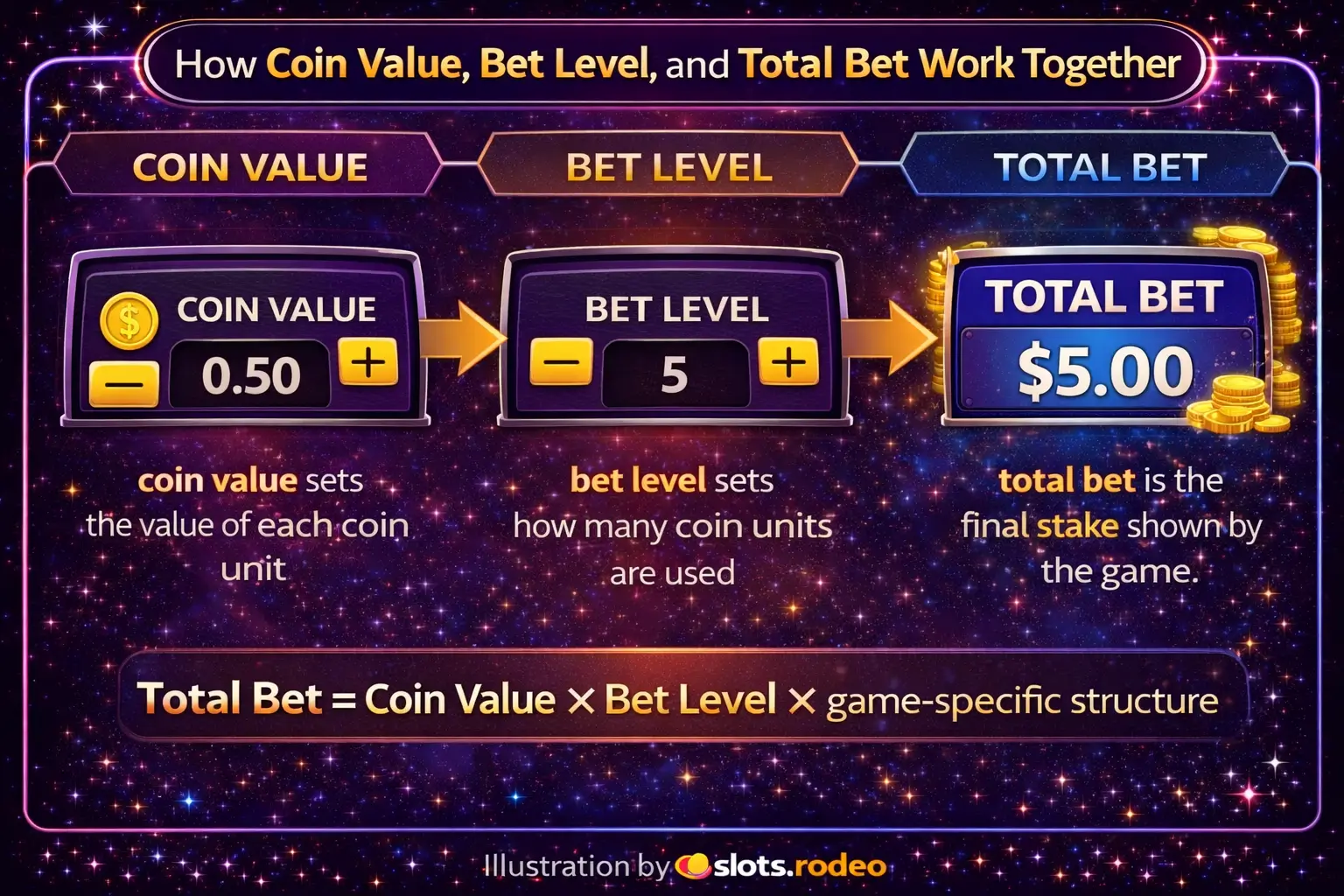
Slot bet panels often show several numbers at once. Common labels include coin value, bet level, coins, and total bet. For a new player, that can make a simple question look more complicated than it is:
How much am I actually staking on one spin?
The answer is usually the total bet.
Coin value and bet level are parts of that calculation.
This matters for two reasons:
- it tells you the real cost of each spin
- it affects how wins are calculated in games that use coin-based paytables
Start with the one number that matters most: total bet
If you only want to know how much money leaves your balance when you spin, look at total bet.
That is the final stake for one paid spin.
In practical terms:
- if the total bet is $0.20, one spin costs $0.20
- if the total bet is $1.00, one spin costs $1.00
- if the total bet is $2.50, one spin costs $2.50
Everything else in the bet panel is there to build that number.
What coin value means
Coin value is the monetary value of one coin unit in the slot.
Typical examples:
- $0.01
- $0.02
- $0.05
- $0.10
It is not always shown in dollars or euros. In some games it may appear in your local currency, and in some older-style interfaces it may just be called value or denomination.
Changing coin value changes the base amount used in the bet calculation.
For example:
- coin value $0.01 = each coin unit is worth one cent
- coin value $0.05 = each coin unit is worth five cents
If the rest of the settings stay the same, a higher coin value means a higher total bet.
What bet level means
Bet level is a multiplier or step setting applied on top of the coin value.
It often appears as a small number such as:
- 1
- 2
- 5
- 10
In many slots, bet level does not mean money by itself. It only matters together with coin value and, in some games, the number of coins or lines.
So if a player increases bet level from 1 to 5, the stake usually rises even if coin value stays the same.
Bet level is one of the most common reasons a player raises the stake without noticing how much the real cost has changed.
How total bet is usually calculated
There is no single universal slot formula, because interfaces differ from one provider to another. But the most common logic is close to this:
Total Bet = Coin Value x Bet Level x Number of Coins / Lines / Ways Unit
The exact third factor depends on the slot design.
In many modern slots, the game hides most of the internal structure and simply shows the final total bet. In older or more detailed interfaces, you may still see separate controls for coins, level, and paylines.
A simple example
Here is a basic example using a coin-based setup:
- coin value = $0.01
- bet level = 5
- coins = 10
Formula:
$0.01 x 5 x 10 = $0.50 total bet
Now change only the coin value:
- coin value = $0.02
- bet level = 5
- coins = 10
Formula:
$0.02 x 5 x 10 = $1.00 total bet
The structure stayed the same, but the stake doubled.
The three settings compared
| Setting | What it means | What it directly changes |
|---|---|---|
| Coin Value | Monetary value of one coin unit | Base size of the stake |
| Bet Level | Multiplier or step applied to the bet | Stake size and often payout scaling |
| Total Bet | Final amount staked per spin | Real cost of one spin |
Coin Value
What it means
Monetary value of one coin unit
What it directly changes
Base size of the stake
Bet Level
What it means
Multiplier or step applied to the bet
What it directly changes
Stake size and often payout scaling
Total Bet
What it means
Final amount staked per spin
What it directly changes
Real cost of one spin
Why slots still use coin-based language
Many modern online slots no longer need coin-style terminology, but the format is still common because it comes from older machine logic.
That is why you still see paytables saying things like:
- 5 symbols pay 500 coins
- jackpot pays 10,000 coins
This does not automatically mean the game pays fixed money amounts.
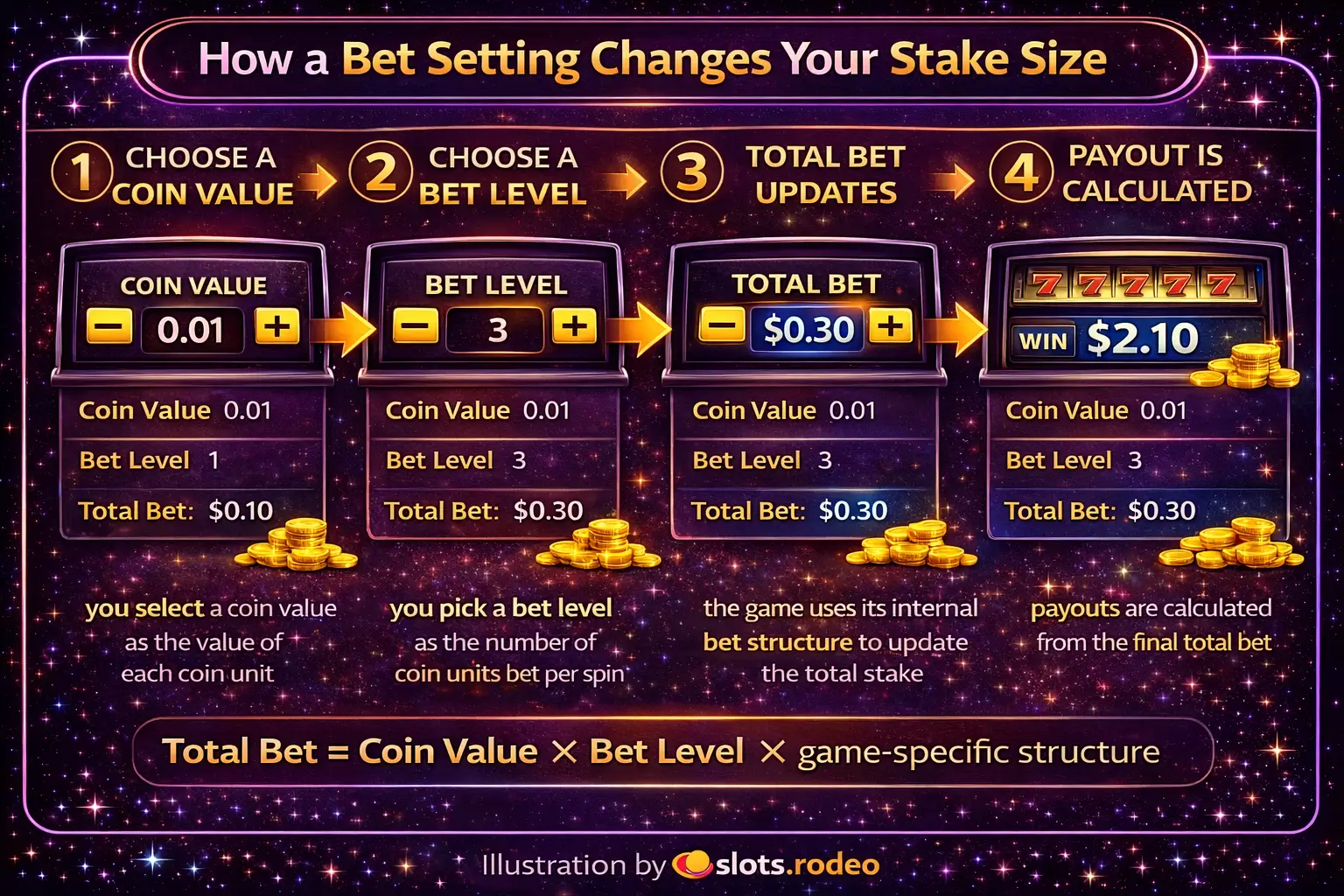
It means the game first calculates the result in coin units, then converts that amount using your current bet settings.
So if the paytable shows 100 coins for a symbol combination, the cash value depends on your active stake structure.
How bet settings affect payouts
These settings do not just change your spin cost. They also affect the value of wins.
In most slots:
- a higher total bet means higher win amounts in absolute currency terms
- the paytable scales with the active stake
- the hit pattern itself does not become more likely just because the bet is higher
That last point is important.
Changing coin value or bet level usually changes how much a win pays, not how often a win happens.
A bigger stake can produce a bigger payout because the same symbol result is being paid at a higher betting level. It does not usually improve the mathematical chance of landing that result.
What beginners often misunderstand
"Coin value is my total stake"
Not necessarily. Coin value is usually only one part of the full bet.
"Bet level is just a cosmetic setting"
No. Bet level usually changes the real cost of the spin.
"If I raise coin value, I only change the display"
No. In most slots, raising coin value raises the actual money behind each coin unit.
"Higher bet means better chances to win"
Usually no. A higher bet changes payout size, not the game's base probability structure.
Where this becomes risky for bankroll control
The biggest problem with coin value and bet level is that they can hide a fast increase in stake size.
For example, a player may think:
- coin value changed from $0.01 to $0.05
- bet level changed from 2 to 4
Those numbers may look small, but the total effect can be large.
Example:
- $0.01 x 2 x 10 = $0.20
- $0.05 x 4 x 10 = $2.00
That is a 10x jump in stake size.
This is why the safest habit is simple: after every change, look at the total bet, not just the small component you changed.
A practical way to read any slot bet panel
When a slot shows several betting controls, check them in this order:
- Total Bet - confirms the real spin cost
- Coin Value - shows the monetary size of each unit
- Bet Level - shows the multiplier step
- Extra fields such as coins, lines, or ways - explain how the game builds the final number
If the slot does not show all components clearly, rely on the final total bet display.
One example with payout scaling
Imagine the paytable says a certain combination pays 50 coins.
If your active setup makes one coin worth $0.01, then:
- 50 coins = $0.50
If your active setup makes one coin worth $0.05, then:
- 50 coins = $2.50
The symbol result stayed the same.
The payout changed because the active bet value behind each coin changed.
The main difference between older and newer slot interfaces
Older slot interfaces often expose more of the internal bet structure:
- coin value
- coins
- lines
- level
Newer interfaces often reduce this to a cleaner display:
- minus button
- total bet
- plus button
The math still exists in the background, but the player sees fewer moving parts.
That is why some slots feel easy to read while others require more checking before you spin.
Quick reference table: what changes when you adjust a setting
| If you change this | What usually happens | What you should watch |
|---|---|---|
| Coin Value | Base unit becomes more or less expensive | Total bet may jump fast |
| Bet Level | Multiplier changes the stake | Wins scale, but so does cost |
| Total Bet | Final stake changes directly | This is the number that matters most |
Coin Value
What usually happens
Base unit becomes more or less expensive
What you should watch
Total bet may jump fast
Bet Level
What usually happens
Multiplier changes the stake
What you should watch
Wins scale, but so does cost
Total Bet
What usually happens
Final stake changes directly
What you should watch
This is the number that matters most
What to remember before you spin
When a slot gives you several betting controls, do not focus on the labels in isolation. Read them as parts of one calculation.
The most useful rule is simple:
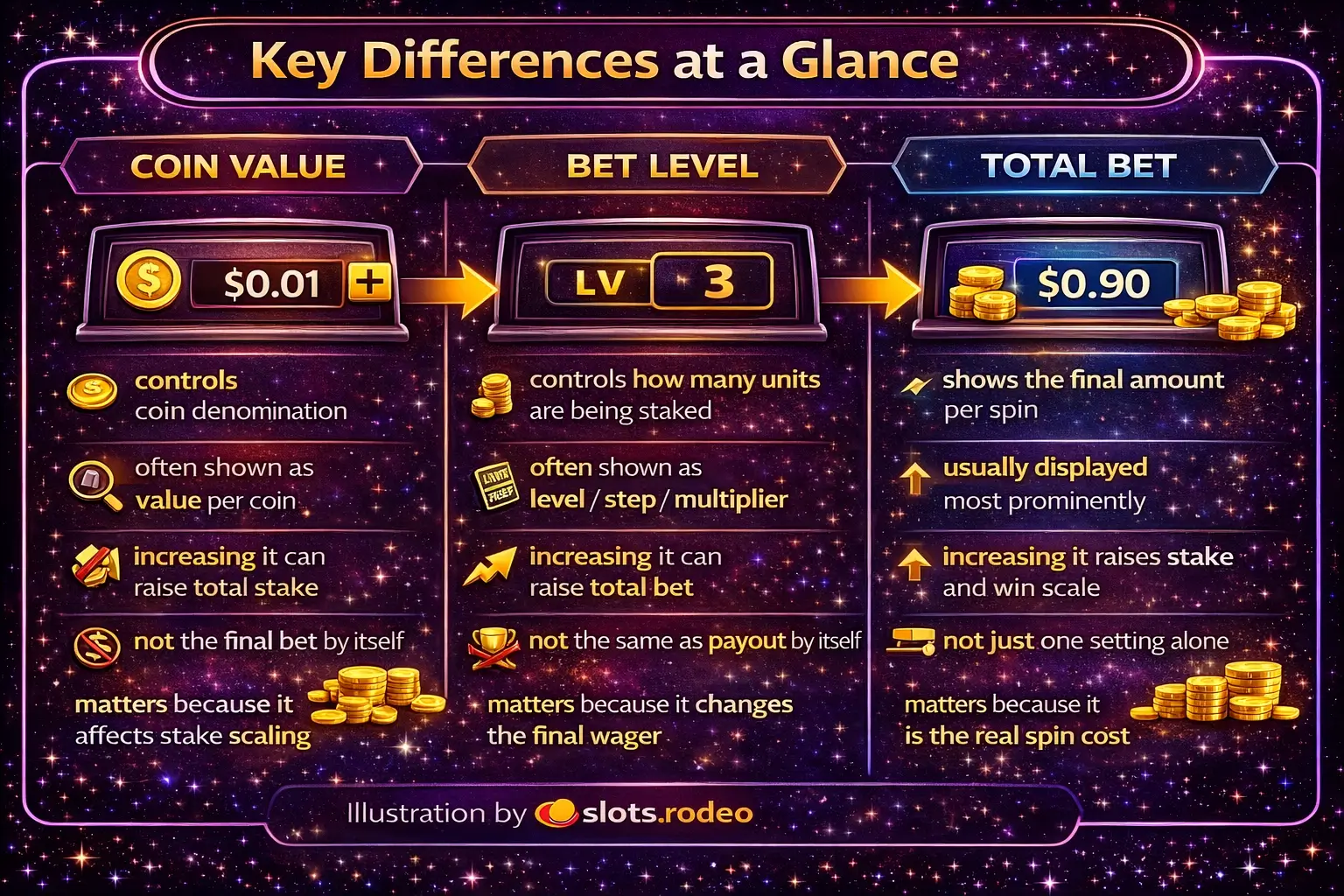
Coin value and bet level help build the stake. Total bet tells you the real cost.
If you understand that, you can read almost any slot bet panel correctly, compare stake sizes more easily, and avoid increasing your spend by accident.


