

Responsible gambling tools are not decorative account settings. They are practical controls that help a player limit time, spending, and access before gambling starts to affect decision-making.
A licensed casino will usually offer at least some safer gambling tools inside the account area, cashier, or help section. The exact menu differs by operator, but the core idea is the same: the player should be able to set restrictions before the session gets out of control.
This matters because once a player is chasing losses, increasing deposits under stress, or staying in session longer than planned, it becomes much harder to make clear decisions. A strong safer gambling setup gives the user a way to create friction before that happens.
The Main Tools Worth Checking First
The most useful responsible gambling tools usually fall into three groups:
- money controls
- time and access controls
- account blocking tools
These tools do not do the same job. A deposit limit is not the same as a cool-off period, and a cool-off period is not the same as self-exclusion. Good casinos make those differences clear.
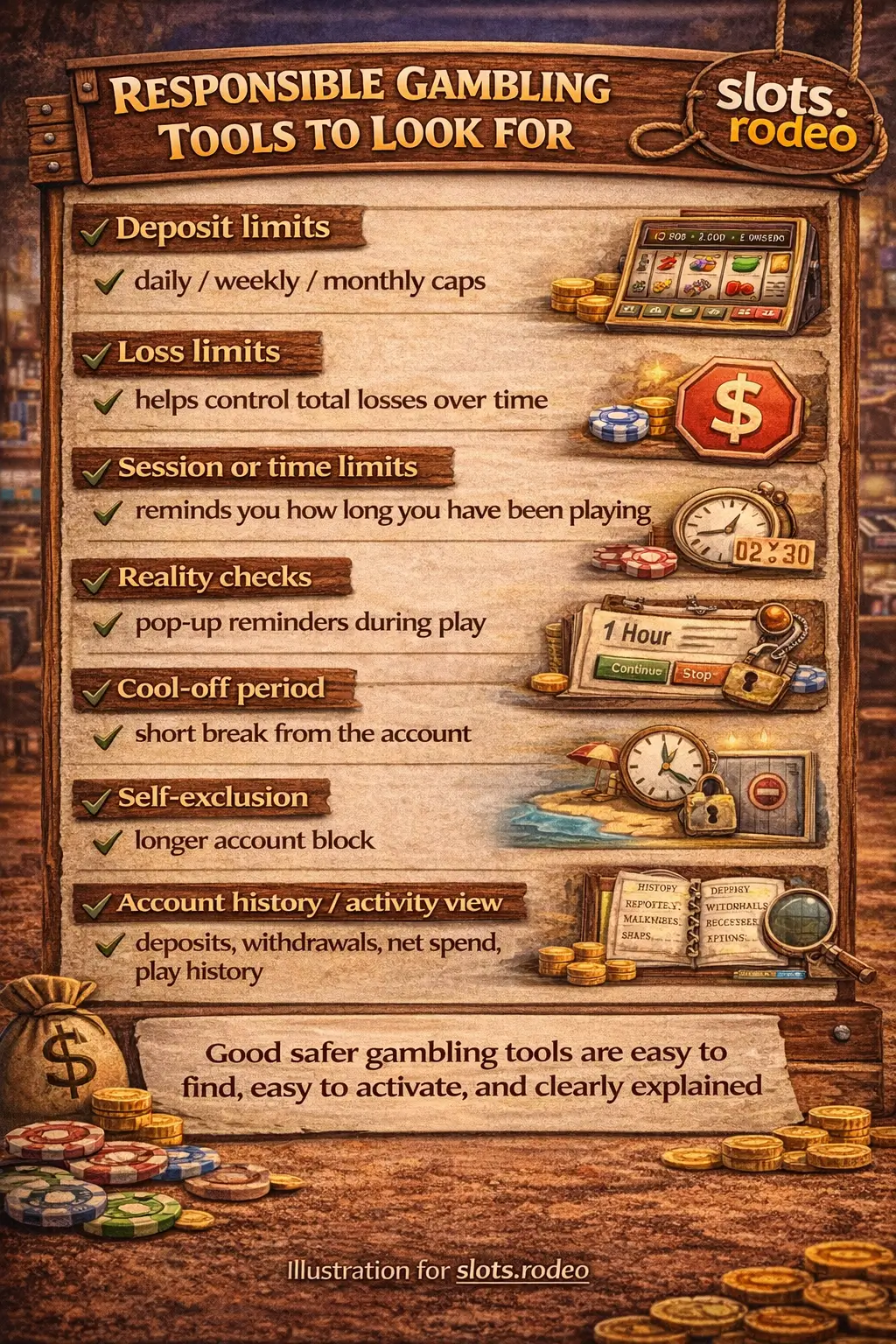
Deposit Limits: The First Thing Many Players Should Set
A deposit limit restricts how much money you can add to your casino account over a chosen period, usually daily, weekly, or monthly.
This is often the most important control because it works before the money is lost. Once funds are already in the account, other tools may still help, but deposit limits reduce the chance of repeated top-ups during a bad session.
A good casino should let you:
- set a daily, weekly, or monthly deposit cap
- lower the limit with immediate or near-immediate effect
- explain clearly when an increase takes effect
- see the active limit inside the account
A weak setup is one where the casino mentions "responsible gaming" in the footer but makes the actual limit tool hard to find or vague to use.
Other Spending Controls That Matter
Not every operator offers the same set of financial controls, but these are the ones worth checking.
| Tool | What it controls | Why it matters |
|---|---|---|
| Deposit limit | How much you can add to the account | Helps stop repeated re-funding |
| Loss limit | How much you can lose over a period | Adds a cap tied to net loss |
| Wager limit | How much total stake you can place | Useful for fast, high-volume play |
| Session limit | How long you can stay active | Helps control time, not just money |
| Reality check | Periodic reminder during play | Breaks autopilot behavior |
Deposit limit
What it controls
How much you can add to the account
Why it matters
Helps stop repeated re-funding
Loss limit
What it controls
How much you can lose over a period
Why it matters
Adds a cap tied to net loss
Wager limit
What it controls
How much total stake you can place
Why it matters
Useful for fast, high-volume play
Session limit
What it controls
How long you can stay active
Why it matters
Helps control time, not just money
Reality check
What it controls
Periodic reminder during play
Why it matters
Breaks autopilot behavior
A casino does not need every possible tool to be taken seriously, but it should offer a meaningful set of controls and explain them in plain language.
Limits, Cool-Off, and Self-Exclusion Do Different Jobs
Players often group these together, but they are not interchangeable.
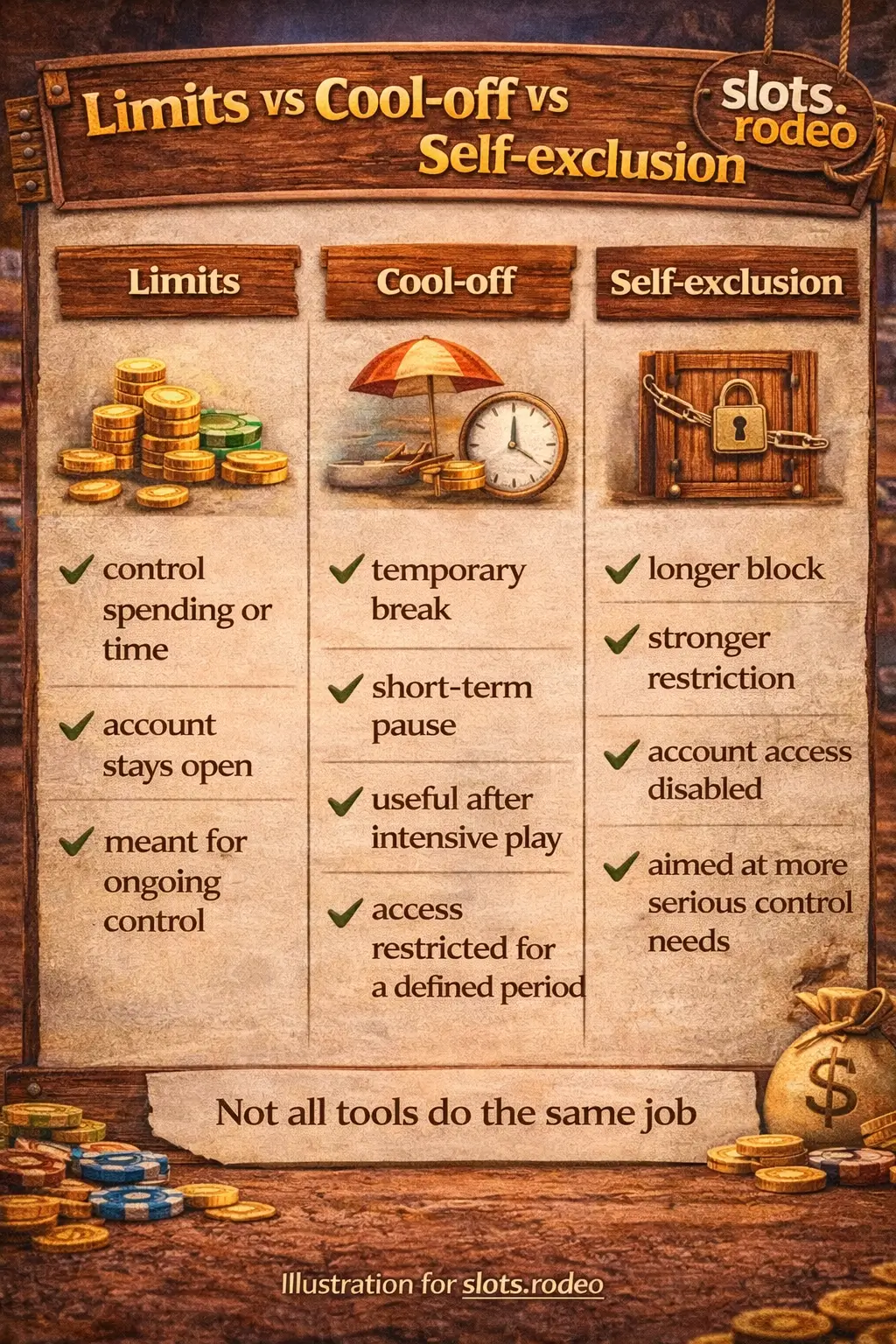
- A limit controls part of your activity
- A cool-off period blocks gambling access for a short defined period
- Self-exclusion is a stronger, longer account block
That difference matters because the right tool depends on the problem you are trying to solve.
Cool-Off Periods: Short Breaks With Real Value
A cool-off period is a temporary break from gambling access. It is usually designed for players who do not want to close the account permanently but need the account blocked for a short period.
Typical cool-off periods may last from a day to several weeks, depending on the operator and the rules in that market.
This tool is useful when a player notices signs such as:
- repeated deposits in one session
- difficulty stopping after losses
- playing longer than planned
- returning too quickly after saying "last try"
A proper cool-off tool should be easy to activate and should clearly explain:
- how long the block lasts
- whether deposits and gameplay are disabled
- whether the block can be reversed early
- what happens when the period ends
A serious safer gambling setup should not make short breaks harder than they need to be.
Self-Exclusion: A Stronger Account Block
Self-exclusion is more serious than a cool-off period. It usually blocks gambling access for a longer fixed term, and in stronger regulatory systems it may also restrict marketing contact and reactivation.
This tool is intended for situations where a player needs a firm barrier, not just a pause.
When reviewing a casino, check whether the self-exclusion policy is clear on these points:
- minimum exclusion period
- whether reactivation is automatic or manual
- whether the player can reopen early
- whether marketing messages stop
- whether linked brands are covered or only one site
- where to request help if the account needs to be blocked quickly
A vague self-exclusion policy is a bad sign. This is one area where clarity matters more than design.
Reality Checks and Session Tools
Not every gambling problem starts with large deposits. Sometimes the first issue is simply time drift. The player keeps spinning or betting longer than intended because the session has no break point.
That is why reality checks and session tools matter.
A reality check usually sends a popup reminder after a chosen period of play. It may show time spent, net result, or both. On its own, this does not block gambling, but it interrupts automatic play and forces the user to look at the session again.
A session-related tool is useful when it helps the player answer basic questions honestly:
- How long have I been here?
- How much have I spent?
- Was this my plan?
- Am I still choosing, or am I reacting?
How to Tell Whether a Casino's Safer Gambling Section Is Actually Good
Some casinos mention responsible gambling only because they have to. Others build real controls that players can actually use.
A stronger setup usually has these features:
| Good sign | Why it matters |
|---|---|
| Responsible gambling page is easy to find | Basic safety information is not buried |
| Tools are available inside account settings | The user can act without support delays |
| Limits are explained in plain language | Reduces confusion at the point of use |
| Decreases apply quickly | The player can tighten control immediately |
| Increases have delay rules | Prevents impulsive expansion of access |
| Self-exclusion terms are specific | Stronger protection and less ambiguity |
| Support can explain the tools clearly | Indicates the tools are part of real operations |
Responsible gambling page is easy to find
Why it matters
Basic safety information is not buried
Tools are available inside account settings
Why it matters
The user can act without support delays
Limits are explained in plain language
Why it matters
Reduces confusion at the point of use
Decreases apply quickly
Why it matters
The player can tighten control immediately
Increases have delay rules
Why it matters
Prevents impulsive expansion of access
Self-exclusion terms are specific
Why it matters
Stronger protection and less ambiguity
Support can explain the tools clearly
Why it matters
Indicates the tools are part of real operations
A weaker setup often has the opposite pattern: general wording, missing instructions, unclear timelines, and no practical separation between different tools.
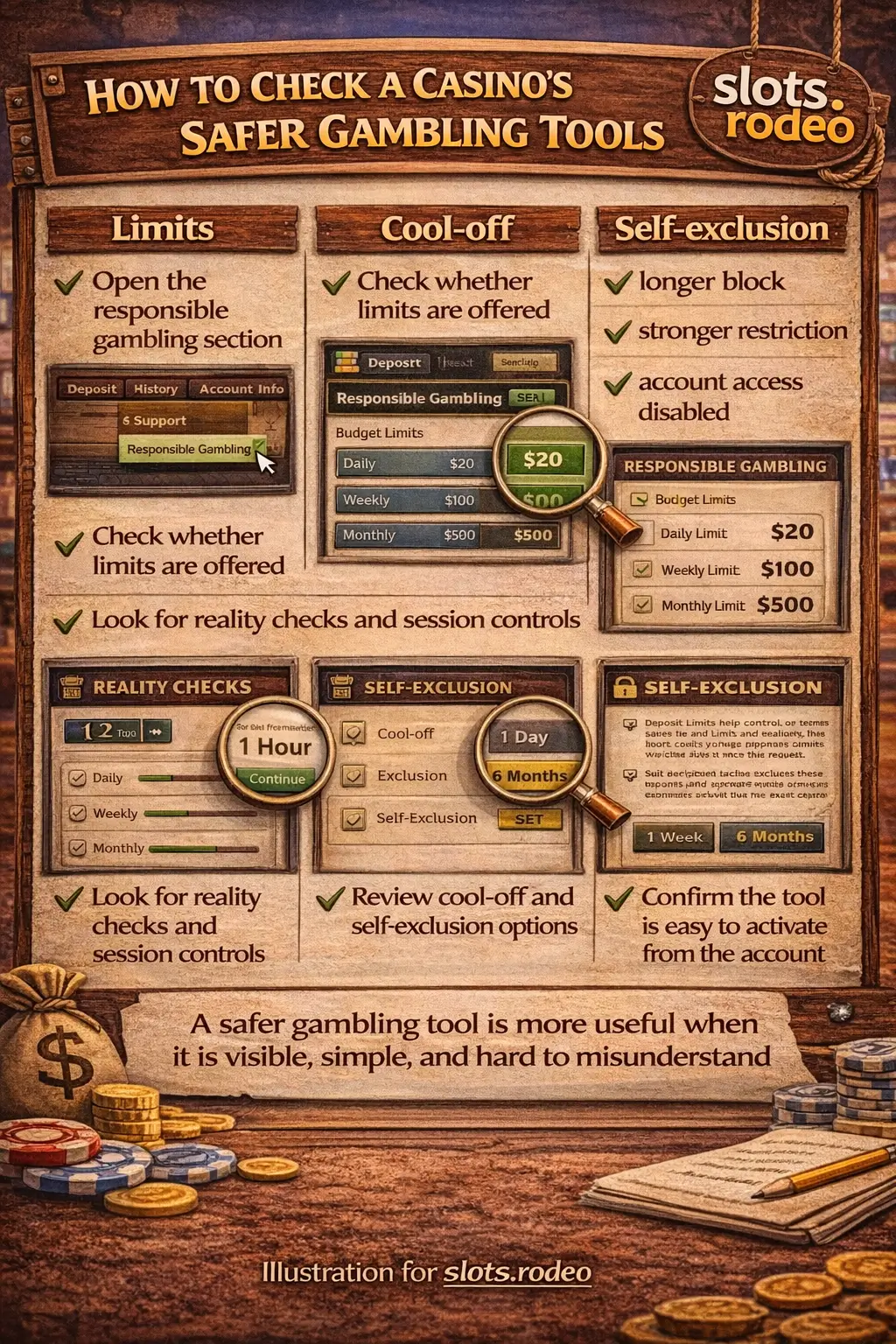
Where to Check Before You Deposit
Before using a casino for real-money play, look in these places:
- Account settings or profile area
This is where working tools are often located.
- Cashier or deposit section
Deposit limits may sit here rather than in the help center.
- Responsible gambling page
This should explain cool-off, exclusion, and support options.
- Terms and conditions
Some details about delays, duration, and reactivation sit here.
- Help or live support
Ask how to set a deposit limit or activate exclusion. The answer tells you a lot.
If support cannot clearly explain how self-exclusion works, that is already useful information.
Tools That Often Matter More Than Bonus Features
From a player-protection perspective, a casino's safer gambling tools often matter more than a welcome offer or promo calendar.
A bonus can affect value. A safer gambling tool affects control.
That is especially true for players who:
- use multiple deposits in one week
- play slots with fast betting cycles
- switch between casino and sportsbook activity
- gamble late at night or under stress
- have previously needed a break from play
For these users, the quality of the safer gambling menu is not a side detail. It is part of whether the site is suitable at all.
What a Beginner Should Prioritize
A new player does not need to activate every tool immediately, but there are a few practical starting points.
A sensible first setup often includes:
- a deposit limit
- a reality check
- a clear understanding of where cool-off and self-exclusion are located
That creates a basic control layer without making the account hard to use.
Red Flags in Responsible Gambling Design
These issues should make you cautious:
- the site talks about safe play but offers no visible settings
- self-exclusion requires a long support dispute instead of a clear request path
- limit terms are unclear about when changes apply
- marketing emails continue during exclusion periods
- the safer gambling page uses broad language but gives no operational detail
- support gives inconsistent answers about blocking tools
A licensed casino does not need a perfect interface, but it should not make basic protection hard to access.
Responsible Gambling Tools Are Part of Casino Quality
When reviewing an online casino, safer gambling tools should be treated as part of the operator's quality and trust profile, not as a legal afterthought.
A casino that gives players clear, usable control over deposits, breaks, and exclusion is doing something practical. A casino that hides those tools behind vague wording is not.
For the player, the real question is simple: Can I limit access and spending quickly, clearly, and without friction if I need to?
That is the standard worth checking.
FAQ
Common questions about this topic.
For many players, a deposit limit is the most practical first tool because it restricts funding before losses build further.
No. A cool-off period is usually a short temporary break. Self-exclusion is a stronger and longer gambling block.
No. The range and quality of tools can differ. That is why it is worth checking the account area and responsible gambling section before you deposit.
Check whether the casino has visible deposit limits, a clear responsible gambling page, and a defined self-exclusion process.
Usually not. They can help interrupt long sessions, but they do not replace hard controls such as deposit limits or exclusion tools.

