

If an online casino says it is licensed, do not stop at the badge or footer text.
A real license check is not just about seeing a regulator name on the site. It is about checking whether the claim is specific, consistent, and verifiable.
This matters because many casino sites mention licensing in a vague way. Some show a real license number. Some mention only a regulator name. Some use old or unclear wording. Some make claims that are hard to verify at all.
The right approach is simple: check the casino's own information first, then check whether that information can actually be verified.
Why a license check matters
A license is one of the first trust signals to review when evaluating an online casino.
It can help answer basic questions such as:
- who regulates the operator
- which legal entity runs the casino
- whether the site provides formal company details
- whether there is a stated jurisdiction
- whether dispute, compliance, and operating rules exist in a formal structure
That said, a license check is only one part of a casino review. A license is important, but it does not tell you everything about payout speed, customer support quality, or how the site handles complaints in practice.
Step 1: Check the footer first
The footer is usually the first place where a casino shows licensing information.
Look for:
- regulator name
- license number
- company name
- registered company address
- operating entity name
- jurisdiction
- links to Terms and Conditions, Privacy Policy, or Responsible Gambling pages
A credible footer usually gives specific information, not just a logo or a generic phrase.
Better example
"Operated by Example Gaming N.V., licensed under number 12345/JAZ."
Weaker example
"Fully licensed and secure."
The second version is too vague on its own.
Step 2: Open the Terms and Conditions or legal pages
Do not rely only on the homepage footer.
Open pages such as:
- Terms and Conditions
- About Us
- Responsible Gambling
- Privacy Policy
- AML / KYC policy
- Contact page
These pages often reveal whether the licensing claim is repeated consistently.
Check whether the site gives the same:
- company name
- license number
- regulator name
- jurisdiction
- legal wording
If the footer says one thing and the legal pages say something different, that is a warning sign.
Step 3: Identify the exact operator name
A casino brand name is not always the same as the legal operator name.
For example:
- brand name: Lucky Spin Casino
- operator: Example Gaming N.V.
This distinction matters because the license usually belongs to the legal entity, not to the marketing brand itself.
A proper check should always look for:
- full company name
- operating entity
- jurisdiction
- how the site describes the relationship between brand and operator
If the site hides the operator or makes it hard to identify, that reduces trust.
Step 4: Look for a specific license number
A real licensing claim should usually include a specific number or registration reference.
That is one of the strongest basic checks.
| What the site shows | What it means |
|---|---|
| Regulator name + exact license number | Stronger starting point |
| Regulator name only | Incomplete |
| "Licensed casino" with no detail | Weak claim |
| Badge image with no text detail | Weak on its own |
Regulator name + exact license number
What it means
Stronger starting point
Regulator name only
What it means
Incomplete
"Licensed casino" with no detail
What it means
Weak claim
Badge image with no text detail
What it means
Weak on its own
A license number does not prove everything by itself, but it is much better than a vague claim with no identifying detail.
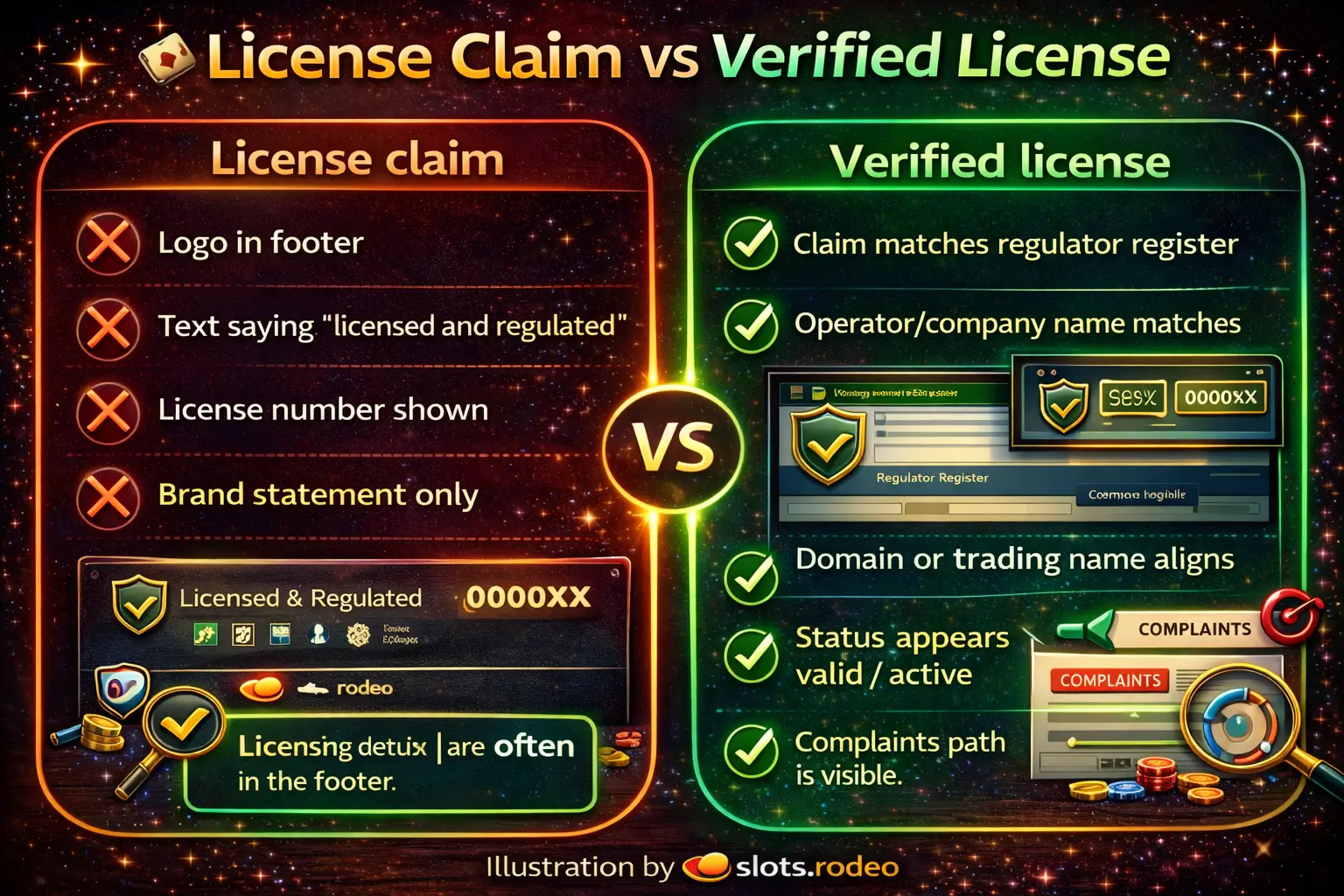
Step 5: Distinguish a license claim from a verified license
This is one of the most important parts of the process.
A casino site can claim it is licensed. That is not the same as a license being clearly verified.
A basic difference looks like this:
| Type | What it looks like |
|---|---|
| License claim | The site says it is licensed |
| Verified license | The site gives enough exact information to check the claim against official or regulator-linked data |
License claim
What it looks like
The site says it is licensed
Verified license
What it looks like
The site gives enough exact information to check the claim against official or regulator-linked data
A footer statement alone is a claim.
A statement with:
- operator name
- jurisdiction
- license number
- consistent legal wording
- verifiable detail
is much stronger.
Step 6: Check whether the wording is precise or vague
The wording itself matters.
Stronger wording usually includes:
- operator name
- license number
- regulator name
- legal entity wording
- jurisdiction
Weaker wording often includes:
- "safe and licensed"
- "fully regulated"
- "internationally certified"
- logo-only claims with no supporting details
Marketing phrases are not verification.
A trust-focused review should prefer exact legal information over broad reassurance language.
Step 7: Check whether the licensing details match the rest of the site
A licensing claim should fit the rest of the casino's legal presentation.
Check whether the site also provides:
- clear Terms and Conditions
- clear KYC / verification rules
- responsible gambling section
- complaint or contact path
- jurisdiction restrictions
- payment terms
- withdrawal rules
A site that claims to be licensed but has weak or missing legal pages raises more concern than a site with a full legal structure.
Step 8: Watch for mismatch problems
Some of the most useful checks are consistency checks.
Look for mismatches such as:
- one company name in the footer, another in the Terms
- one jurisdiction in the footer, none in legal pages
- old licensing text copied across pages
- broken links to legal documents
- licensing badge with no supporting text
- vague wording around the operator
These do not always prove the license is false, but they do reduce confidence.
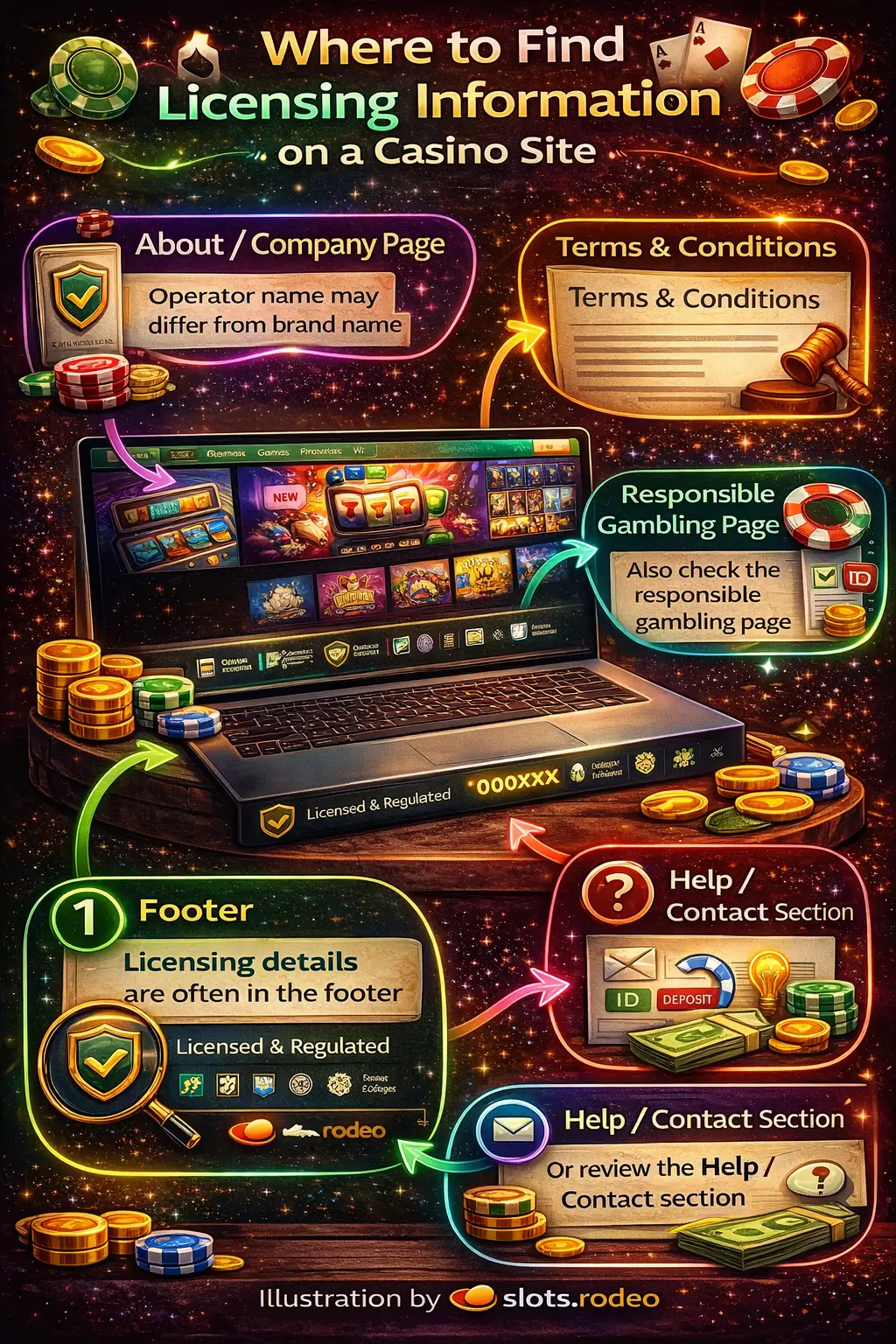
Where to find licensing information on a casino site
The most common places are:
| Site area | What you may find there |
|---|---|
| Footer | Regulator, operator, license number, company details |
| Terms and Conditions | Legal entity, jurisdiction, operational wording |
| About Us | Corporate overview, sometimes simplified operator info |
| Responsible Gambling page | Regulator references, complaint guidance |
| Contact page | Company address or support jurisdiction clues |
| Registration page | Country restrictions or jurisdiction wording |
Footer
What you may find there
Regulator, operator, license number, company details
Terms and Conditions
What you may find there
Legal entity, jurisdiction, operational wording
About Us
What you may find there
Corporate overview, sometimes simplified operator info
Responsible Gambling page
What you may find there
Regulator references, complaint guidance
Contact page
What you may find there
Company address or support jurisdiction clues
Registration page
What you may find there
Country restrictions or jurisdiction wording
If the only licensing mention appears in a graphic banner or promotional block, that is not enough.
License claim vs verified license
A useful rule is this:
A claim says "we are licensed."
A verified-looking claim says "here is exactly who operates the site, under which jurisdiction, and under which license reference."
That difference is practical, not theoretical.
Green flags to look for
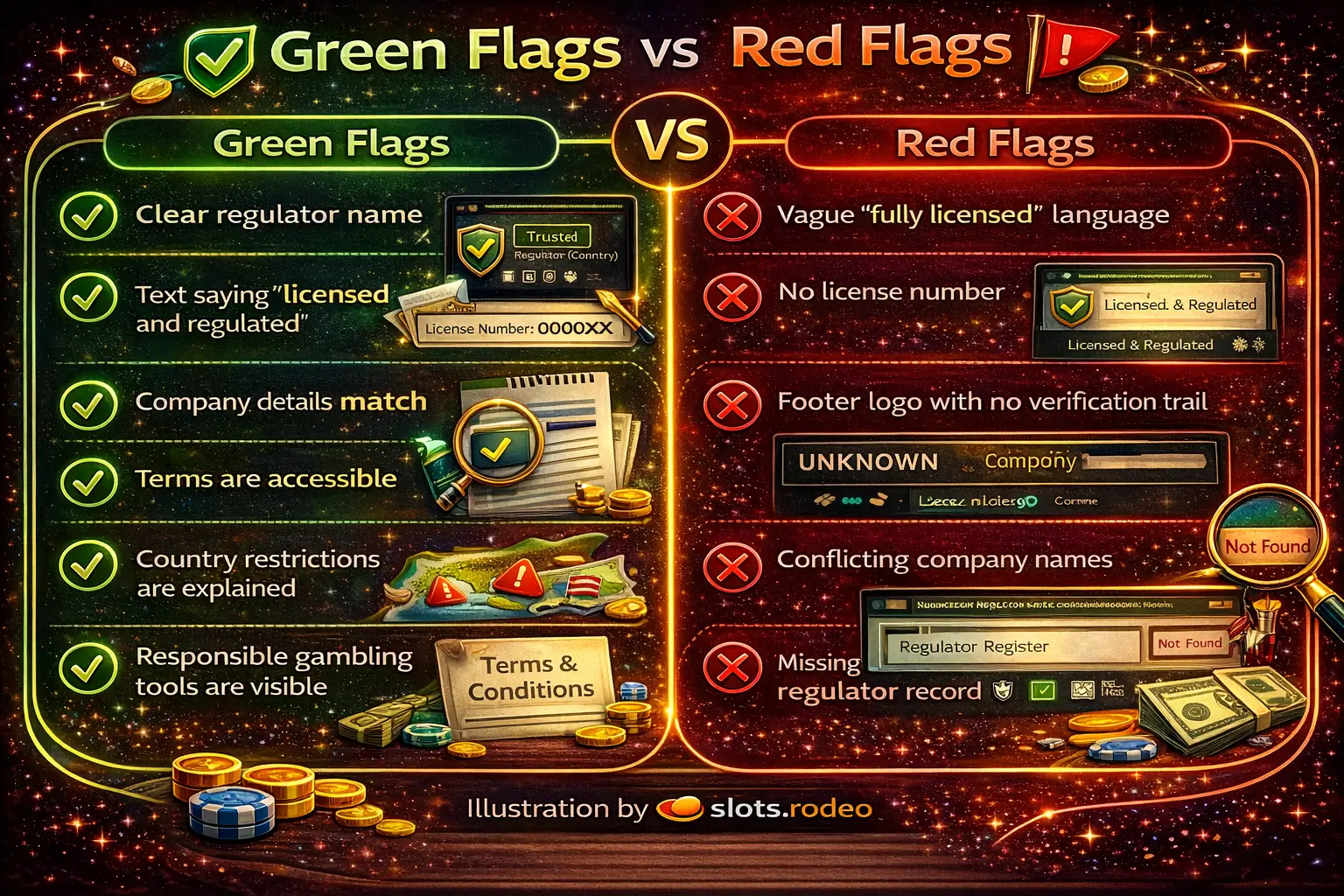
Some signs make a licensing claim more credible.
Green flags
- full operator name is shown
- license number is shown
- regulator name is shown clearly
- legal pages repeat the same information consistently
- country restrictions are explained
- terms and complaint rules are easy to find
- responsible gambling section exists
- the site uses clear legal wording rather than only sales language
These signs do not prove the casino is good in every other area, but they support the licensing claim.
Red flags to watch for
Some signs should make you more cautious.
Red flags
- no operator name
- no license number
- only a badge image with no details
- vague "licensed and secure" wording
- inconsistent company names across pages
- broken or missing legal pages
- no country restriction details
- no clear legal entity behind the brand
- copied or low-quality footer text that looks unfinished
These problems do not always mean the site is unlicensed, but they weaken trust.
A license is important, but it is not the whole review
A beginner mistake is to treat the word "licensed" as the final answer.
That is too simple.
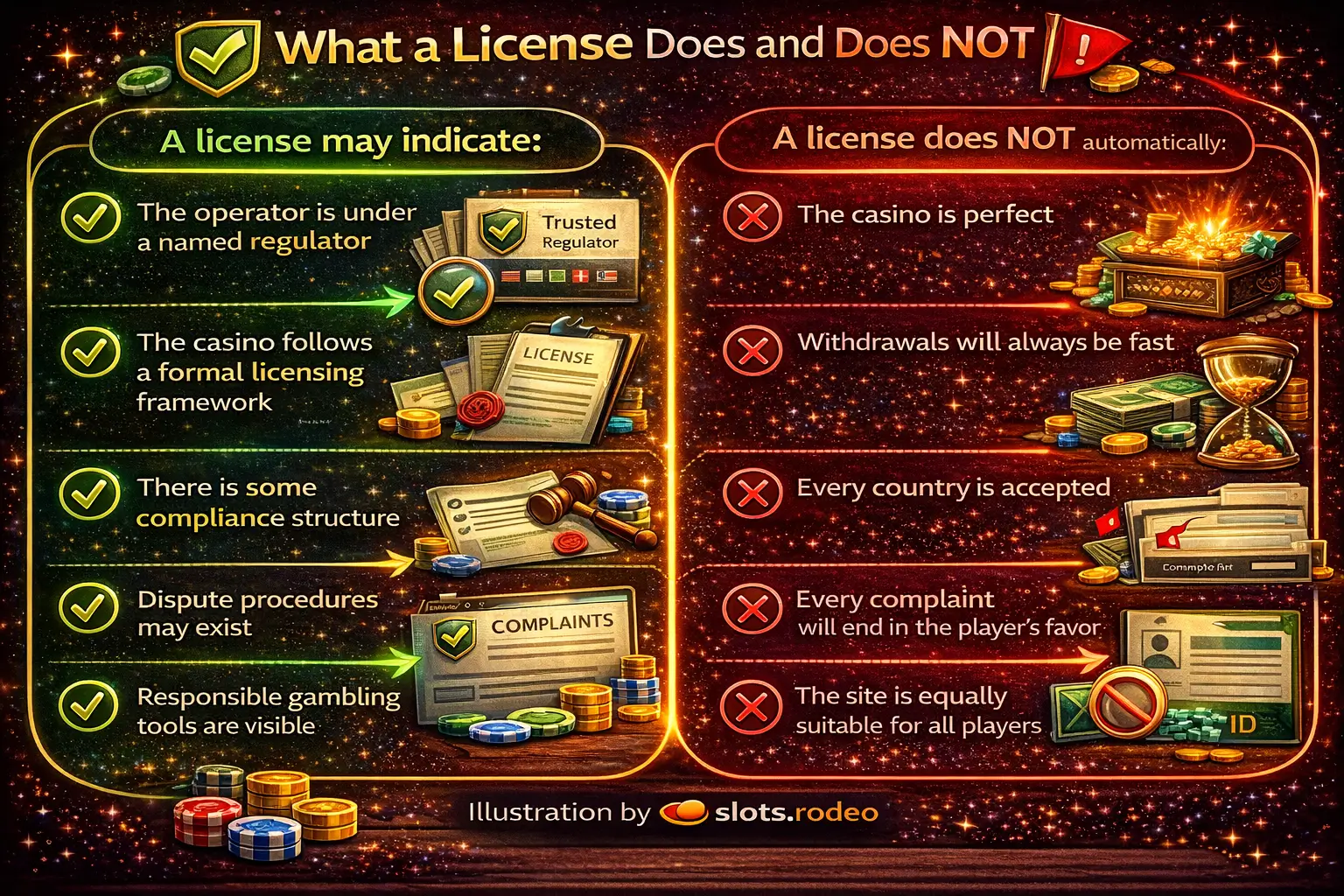
A license can help show that the site is operating under a formal legal structure, but it does not automatically tell you:
- how fast withdrawals are handled
- how support behaves in disputes
- how strict KYC checks may feel in practice
- whether bonus terms are fair
- whether the casino is easy to use
- whether the complaint process works well for every case
This is why licensing should be one review layer, not the only one.
What a license does and does not mean
| A license may help show | A license does not automatically prove |
|---|---|
| There is a stated operator | Fast withdrawals |
| There is a stated legal jurisdiction | Good customer support |
| The site provides formal legal details | Fair bonus value |
| The casino follows some regulatory structure | Smooth complaint handling in every case |
| The operator is presenting itself in a traceable way | High overall product quality |
There is a stated operator
A license does not automatically prove
Fast withdrawals
There is a stated legal jurisdiction
A license does not automatically prove
Good customer support
The site provides formal legal details
A license does not automatically prove
Fair bonus value
The casino follows some regulatory structure
A license does not automatically prove
Smooth complaint handling in every case
The operator is presenting itself in a traceable way
A license does not automatically prove
High overall product quality
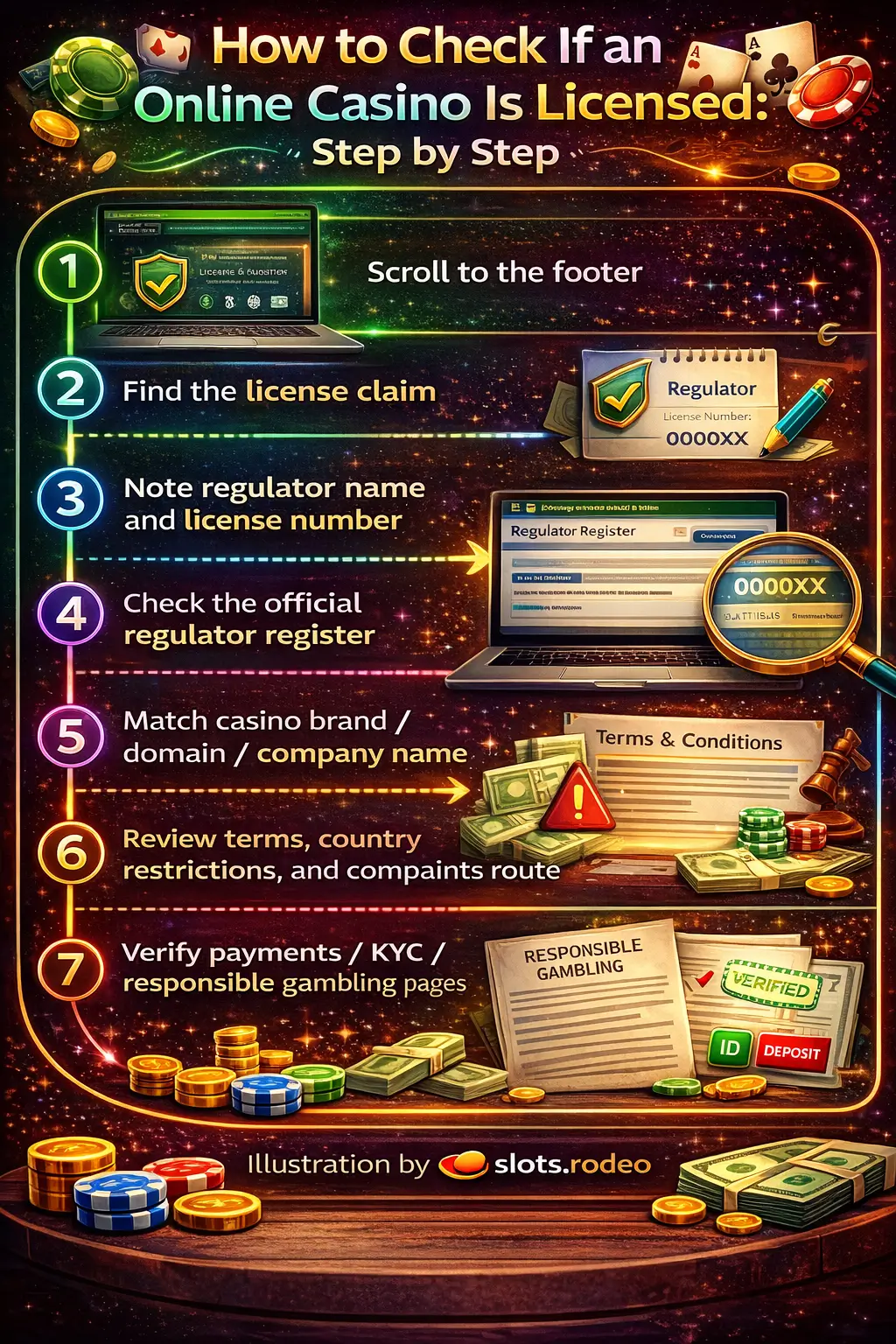
A simple step-by-step method
Use this order if you want a clean process:
- check the footer
- note the operator name
- note the regulator name
- note the license number
- open the Terms and Conditions
- confirm the same legal details appear there
- check whether the wording is precise or vague
- look for country restrictions and legal consistency
- separate the license claim from actual verifiable detail
This is enough for a strong first-pass check.
Common beginner mistakes
Trusting the logo alone
A regulator logo or badge is not enough without text details.
Confusing brand name with operator name
The brand may be different from the licensed legal entity.
Stopping at the homepage footer
The legal pages matter just as much.
Treating "licensed" as proof of overall quality
Licensing is important, but it does not answer every trust question.
Ignoring contradictions between pages
Inconsistency is one of the strongest warning signs.
What to check before calling a casino "licensed"
Before making that judgment, make sure you can answer these questions:
| Question | Why it matters |
|---|---|
| Who operates the casino? | The license belongs to the operator, not just the brand |
| Which jurisdiction is named? | Shows where the license claim is based |
| Is there an exact license number? | Stronger than a vague claim |
| Do legal pages match the footer? | Consistency is a core trust signal |
| Are legal and responsible gambling pages present? | Supports the seriousness of the legal setup |
| Is the claim precise enough to verify? | This is the real dividing line |
Who operates the casino?
Why it matters
The license belongs to the operator, not just the brand
Which jurisdiction is named?
Why it matters
Shows where the license claim is based
Is there an exact license number?
Why it matters
Stronger than a vague claim
Do legal pages match the footer?
Why it matters
Consistency is a core trust signal
Are legal and responsible gambling pages present?
Why it matters
Supports the seriousness of the legal setup
Is the claim precise enough to verify?
Why it matters
This is the real dividing line
FAQ
Common questions about this topic.
It is weak if the site uses vague wording, shows no operator name, or gives no specific license number.
No. The footer is the starting point. You should also check legal pages and consistency across the site.
Because the license usually belongs to the legal company operating the casino, not just the brand name.
No. A license is an important trust signal, but it does not automatically guarantee strong support, fast withdrawals, or fair bonus use.
One of the biggest red flags is vague licensing language with no exact operator details or no clear license number.


