

When a slot shows an RTP figure such as 96.20%, that number is not based on a few player sessions or a short live sample. It is usually based on mathematical analysis of the game model and, in regulated markets, supported by laboratory testing and certification before the game goes live.
That sounds simple, but many players misunderstand what is actually being verified.
The key point is this: RTP is a theoretical long-run return of the game configuration being tested. It is not a promise for one session, one day, or one player. Verification is about checking that the game logic and payout model match the declared settings, not about guaranteeing that your next 100 spins will land near the published percentage.
What Exactly Is Being Verified
When RTP is verified, the process usually focuses on the game version and its payout model. That normally includes:
- reel or symbol configuration
- paytable values
- bonus feature logic
- wild, scatter, multiplier, or respin behavior
- weighting of outcomes in the RNG-driven result system
- the final theoretical return produced by that configuration
In other words, the verified RTP figure comes from the actual game math, not from a marketing claim and not from short-term player history.
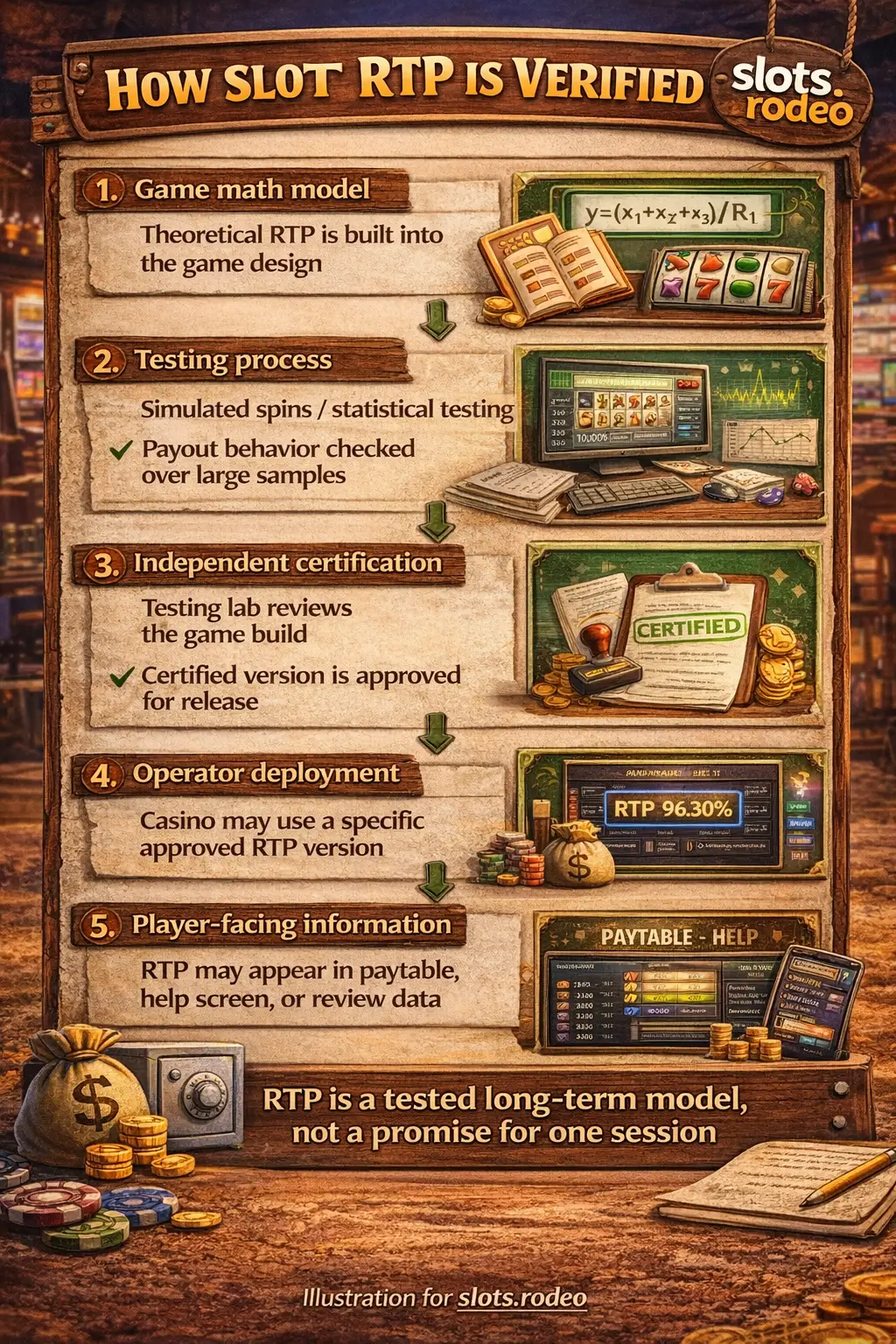
Where Slot RTP Figures Usually Come From
A published RTP figure usually sits at the end of a chain. The provider defines the game math, a test process checks the configuration, and the final value is then attached to a specific release or RTP version.
That is why the same slot title can exist with different RTP settings in different markets or at different operators. The title may be the same, but the tested configuration may not be.
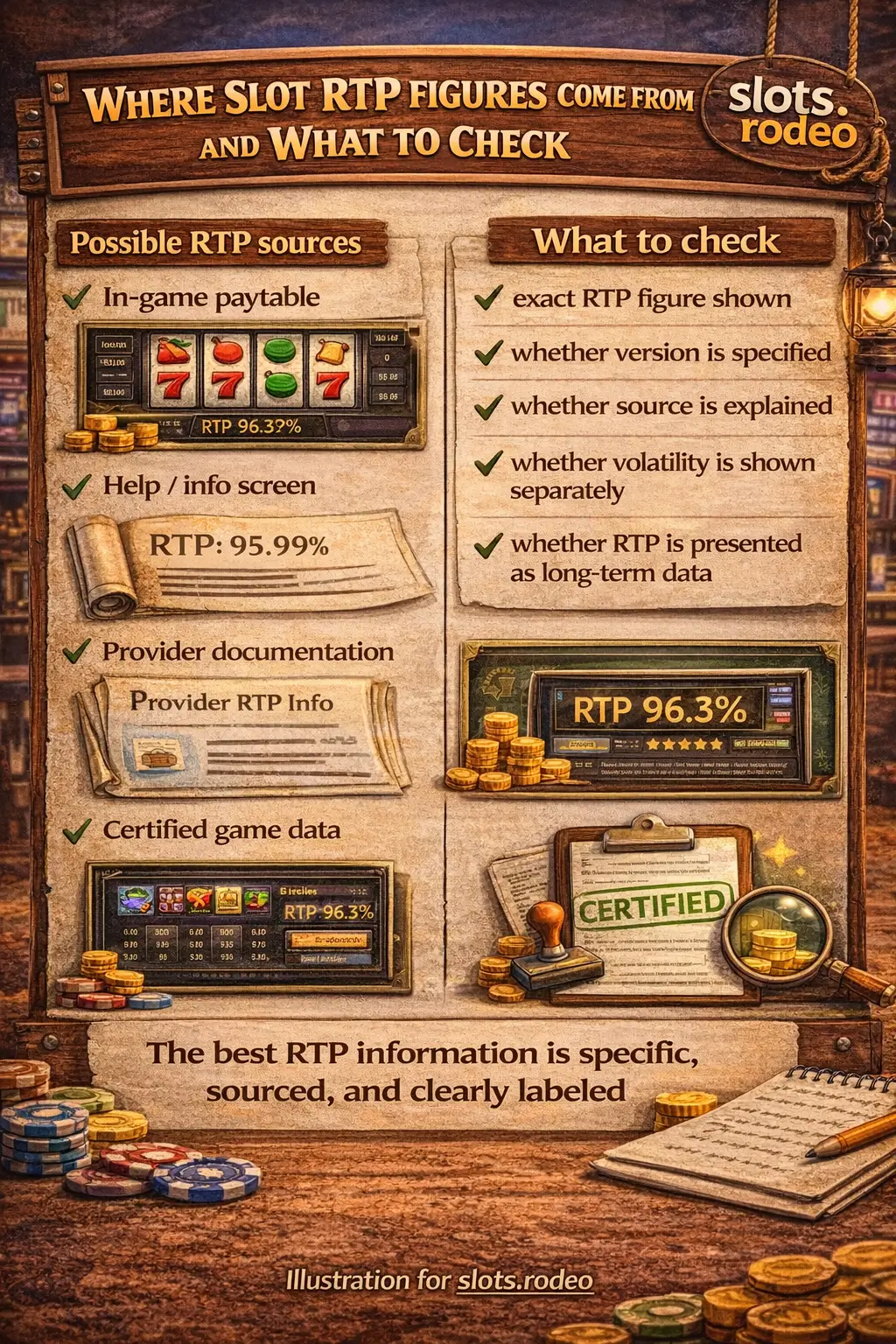
Typical RTP Verification Chain
| Stage | What happens | Why it matters |
|---|---|---|
| Game design | The provider defines reels, symbols, bonus logic, and payout rules | RTP starts at the math-model level |
| Theoretical calculation | The game model is used to calculate expected long-run return | This produces the target RTP for that version |
| Testing and review | The configured game build is checked against declared behavior | Confirms the version behaves as specified |
| Certification | In regulated environments, the tested build is certified for release | Adds external control and audit trail |
| Deployment | The operator launches a specific approved version | The live RTP depends on the version actually deployed |
| Display to player | RTP may be shown in help files, paytable, or game info | This is the number players can compare, if disclosed clearly |
Game design
What happens
The provider defines reels, symbols, bonus logic, and payout rules
Why it matters
RTP starts at the math-model level
Theoretical calculation
What happens
The game model is used to calculate expected long-run return
Why it matters
This produces the target RTP for that version
Testing and review
What happens
The configured game build is checked against declared behavior
Why it matters
Confirms the version behaves as specified
Certification
What happens
In regulated environments, the tested build is certified for release
Why it matters
Adds external control and audit trail
Deployment
What happens
The operator launches a specific approved version
Why it matters
The live RTP depends on the version actually deployed
Display to player
What happens
RTP may be shown in help files, paytable, or game info
Why it matters
This is the number players can compare, if disclosed clearly
Testing Does Not Mean "The Game Will Pay This Today"
This is the part players often get wrong.
A verified RTP figure does not mean:
- your session should return close to that number
- every 100 or 500 spins should "balance out"
- a game is overdue to pay because recent results were low
- one streamer session or one forum post can confirm the real RTP
A slot can be correctly tested at 96.20% RTP and still produce a much lower or much higher result in a short session. That is normal, not evidence that the RTP is false.
The reason is simple: RTP is a long-run expectation across a very large number of outcomes, while a real session is only a tiny sample.
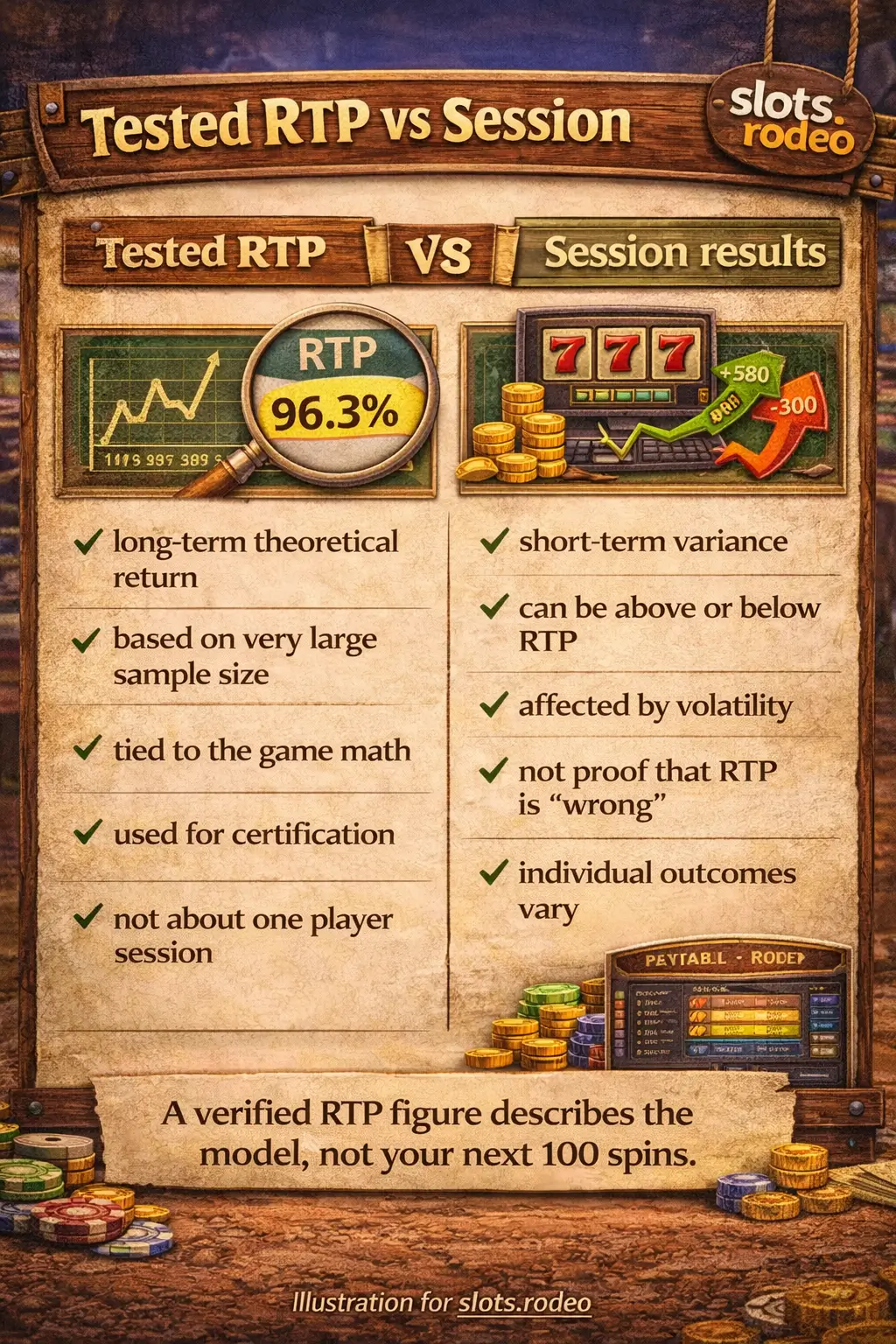
Theoretical RTP vs Real Session Results
The easiest way to understand RTP verification is to separate two different ideas: tested game return and observed session outcome.
| Concept | What it means | What it does not mean |
|---|---|---|
| Theoretical RTP | Expected long-run return of the tested game configuration | A guarantee for your personal result |
| Certified RTP figure | The percentage attached to the approved version | Proof that every short session will match it |
| Real session result | What happened in your own play sample | Reliable evidence of the true long-run RTP |
| Community anecdotes | Reports from players, streamers, forums | A valid way to verify a slot's mathematical return |
Theoretical RTP
What it means
Expected long-run return of the tested game configuration
What it does not mean
A guarantee for your personal result
Certified RTP figure
What it means
The percentage attached to the approved version
What it does not mean
Proof that every short session will match it
Real session result
What it means
What happened in your own play sample
What it does not mean
Reliable evidence of the true long-run RTP
Community anecdotes
What it means
Reports from players, streamers, forums
What it does not mean
A valid way to verify a slot's mathematical return
How Labs and Regulators Fit In
In regulated environments, an independent test lab or compliance process usually checks whether the game version matches the declared logic and percentage. The exact workflow depends on the jurisdiction, but the purpose is generally the same:
- verify that the game behaves as documented
- confirm that the released build matches the approved configuration
- create a record that the tested version passed required checks
This is important because RTP verification is not just about one number on a screen. It is also about version control. If a slot exists in several RTP settings, each setting should correspond to a specific game configuration, not an undefined live adjustment in the middle of play.
What Players Usually See - and What They Often Do Not
Players do not normally see the full certification process. What they usually see is only the final output:
- an RTP percentage in the help file
- a value on a review page
- a note in the game rules
- sometimes no visible RTP at all, depending on market and operator practice
That limited visibility is why confusion happens. A player may assume the displayed number is a universal property of the slot title, when in reality it may belong to one specific version of that title.
So when comparing RTP, the practical question is not only "What is the RTP of this slot?" but also "Which RTP version is this operator using?"
What RTP Verification Is Actually Good For
Verified RTP is useful because it helps answer the right questions:
- whether the game version matches its declared return
- whether one version of a slot is lower or higher than another
- whether an operator is transparent about the version being offered
- whether a review page is describing the correct configuration
It is not a tool for predicting the next session. RTP is a structural property of the game model, not a forecast.
A Better Way to Read RTP as a Player
For practical use, RTP should be treated as a comparison metric, not a session expectation.
That means it is useful for:
- comparing two versions of the same slot
- checking whether a casino lists a lower-than-common RTP setting
- understanding the game's long-run return profile together with volatility and feature structure
It is much less useful for:
- judging whether your current session is "fair"
- deciding that a slot is due after a losing streak
- assuming a few hundred spins are enough to confirm the published RTP
What to Check If You Want RTP Information You Can Trust
Before relying on an RTP figure, check these points:
- Look for the figure in the game's own info or help section.
This is usually more reliable than a generic promotional block.
- Check whether the review names the exact RTP value, not just "high RTP."
Rounded or vague wording hides useful detail.
- See whether the site mentions multiple RTP versions.
Some slot titles are not distributed at one universal setting.
- Treat personal session results as noise, not proof.
Short samples do not verify or disprove RTP.
- Separate provider-level math from operator-level deployment.
A provider may support several versions, while the casino chooses which one it offers.
Why This Matters for Reviews and Comparisons
A strong slot review should not treat RTP as a decorative number. It should connect RTP to the actual question a player cares about:
- Is this figure tied to the version available here?
- Is it the standard version or a reduced one?
- How does it compare to the same game elsewhere?
- Does the slot also have high volatility, meaning the session path can still be rough even at a decent RTP?
That is where RTP verification becomes useful in real life. Not because it predicts your next result, but because it helps you compare game versions more accurately and avoid false assumptions about what the percentage means.
FAQ
Common questions about this topic.
No. It means the tested game configuration has that theoretical long-run return. Real sessions can land far above or below it.
Not in the usual sense. RTP is normally based on the game's mathematical model and tested configuration, not on a short sample of player outcomes.
Yes. The same slot title can exist in different RTP versions, so the number can differ between operators.
A licensed operator should not be switching the RTP configuration in the middle of an active session. The main issue is usually which preconfigured version was deployed in the first place.
Because RTP is a long-run expected return, while your session is a short and highly variable sample. That gap is normal, especially in higher-volatility games.

