

This is one of the most common questions in slots, and the short answer is:
A casino can sometimes offer a slot at a different RTP version, but it usually cannot change RTP freely spin by spin or in the middle of your session.
That distinction matters.
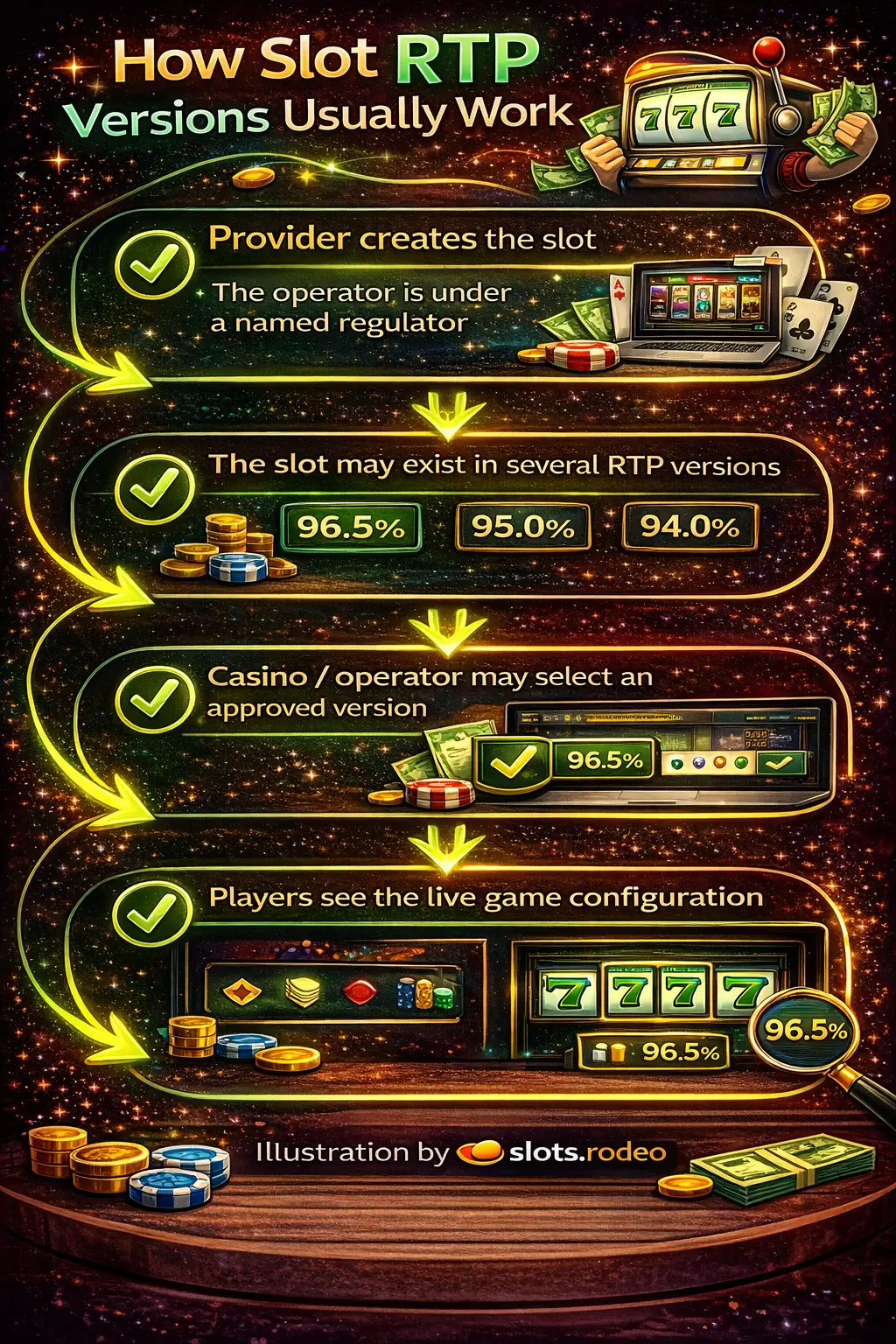
Many modern slots are released in more than one RTP configuration. The game provider may supply several approved versions of the same game, such as 96.5%, 95%, or 94%. A casino may then choose which approved version to use on its site, depending on its setup and commercial agreement.
That is very different from the idea that a casino can watch a player live and manually "turn RTP down" during play. Standard slot operation does not work like that.
What RTP means in this context
RTP, or Return to Player, is the long-term theoretical return built into a slot's math model.
If a slot version is set at:
- 96%
- 95%
- 94%
that percentage reflects the long-term theoretical return of that specific version.
The key point is that RTP belongs to the game configuration, not to one personal session.
So when people ask whether a casino can "change RTP," the real question is usually one of these:
- can the casino choose between different RTP versions of the same slot?
- can the casino lower RTP while I am playing?
- can the casino control RTP directly on its own?
These are not the same question.
The most accurate simple answer
A useful way to frame it is this:
| Question | Usual answer |
|---|---|
| Can the same slot exist in multiple RTP versions? | Yes, often |
| Can a casino choose which approved version to offer? | Often yes |
| Can RTP change in the middle of a spin? | No, that is not how standard slot operation works |
| Can a casino freely rewrite provider math on its own? | Usually no |
| Can one casino offer a lower RTP version than another casino for the same slot? | Yes, that can happen |
Can the same slot exist in multiple RTP versions?
Usual answer
Yes, often
Can a casino choose which approved version to offer?
Usual answer
Often yes
Can RTP change in the middle of a spin?
Usual answer
No, that is not how standard slot operation works
Can a casino freely rewrite provider math on its own?
Usual answer
Usually no
Can one casino offer a lower RTP version than another casino for the same slot?
Usual answer
Yes, that can happen
This is why two casinos can offer the same slot title but not necessarily the same theoretical return.
How slot RTP versions usually work
In many cases, the provider creates the slot in several preset RTP versions.
For example, the same title may exist as:
- 96.2%
- 95.1%
- 94.0%
The visual design, theme, paytable layout, and core feature logic may look almost identical, but the underlying math profile is adjusted to a different long-term return setting.
A casino may then launch one of those approved versions.
That means the casino is often choosing from available versions, not inventing a new RTP number on its own.
Provider vs casino: who controls what?
This is where many misunderstandings start.
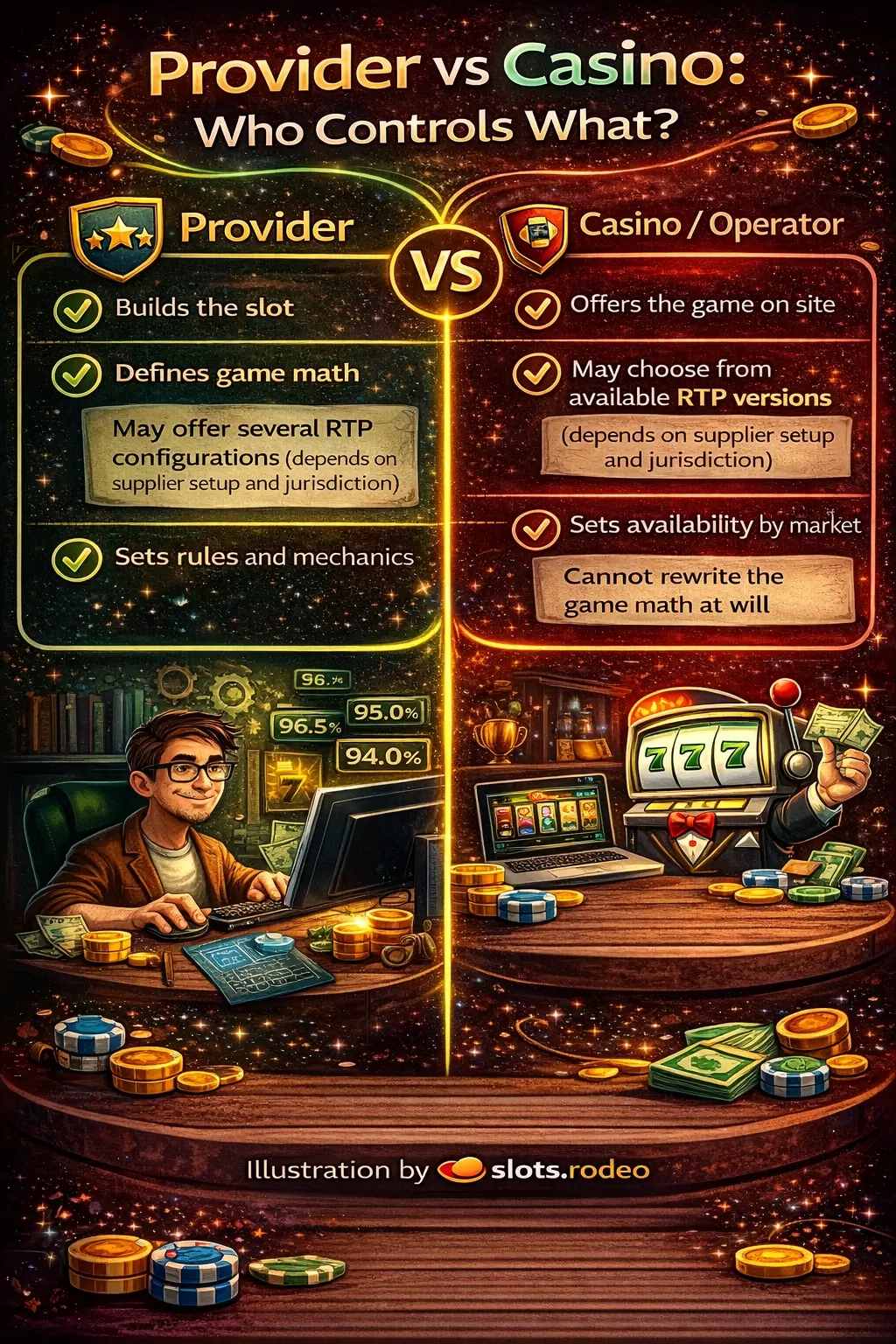
The provider and the casino do not usually control the same things.
| Area | Provider usually controls | Casino usually controls |
|---|---|---|
| Game math model | Yes | Usually no |
| Approved RTP versions | Yes | Usually no |
| Which approved version is offered | Sometimes no | Often yes |
| Live session outcomes | No manual control per player | No manual control per player |
| In-game feature logic | Yes | Usually no |
| Player-facing game availability | No | Yes |
Game math model
Provider usually controls
Yes
Casino usually controls
Usually no
Approved RTP versions
Provider usually controls
Yes
Casino usually controls
Usually no
Which approved version is offered
Provider usually controls
Sometimes no
Casino usually controls
Often yes
Live session outcomes
Provider usually controls
No manual control per player
Casino usually controls
No manual control per player
In-game feature logic
Provider usually controls
Yes
Casino usually controls
Usually no
Player-facing game availability
Provider usually controls
No
Casino usually controls
Yes
The provider usually supplies the game and its approved RTP configurations. The casino may choose which supplied version to publish, but that is not the same as directly editing the math whenever it wants.
Can a casino change RTP during play?
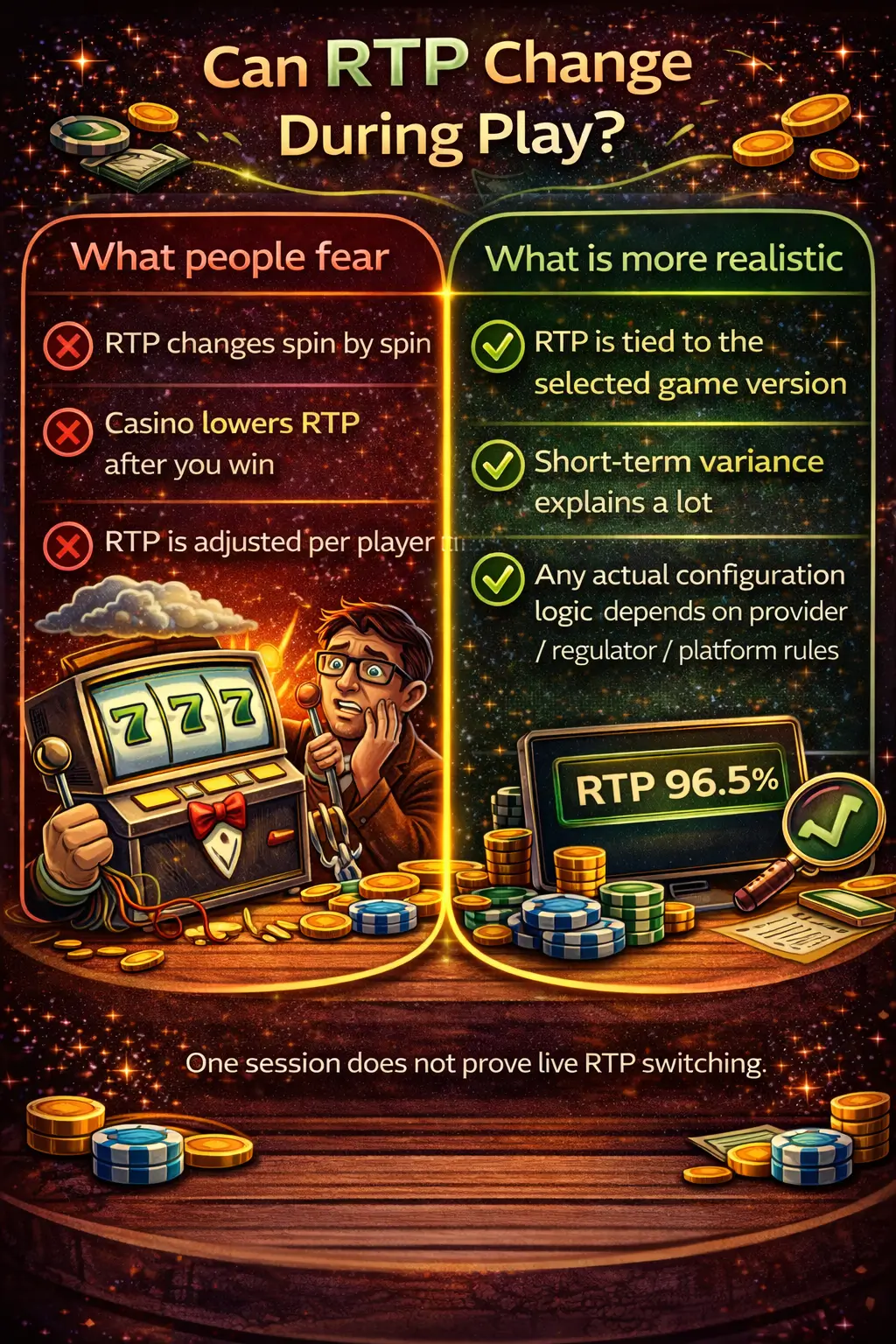
In normal slot operation, RTP is not supposed to change during your live play session like a volume slider.
That means:
- it should not be raised or lowered from spin to spin
- it should not react to whether you are winning or losing
- it should not be manually adjusted because a player is ahead
- it should not suddenly shift halfway through a bonus feature
This is one of the biggest myths in slot discussion.
A slot session does not work like this:
- player starts winning
- casino lowers RTP
- player starts losing
- casino raises RTP later
That is not how standard game configurations are designed to operate.
Why players think RTP changes during play
This belief usually comes from short-session variance.
A player may see:
- one strong session
- one weak session
- a bonus that pays very well once and badly the next time
- long dry stretches after earlier wins
That can make it feel as if the RTP changed live.
But RTP is a long-term theoretical metric. Short sessions can vary sharply without any RTP switch happening at all.
That is why session outcome and RTP version are not the same thing.
RTP version vs session outcome
This is one of the most important distinctions.
| Concept | What it means |
|---|---|
| RTP version | The long-term theoretical return setting of that slot version |
| Session outcome | What happened in your short sample of spins |
RTP version
What it means
The long-term theoretical return setting of that slot version
Session outcome
What it means
What happened in your short sample of spins
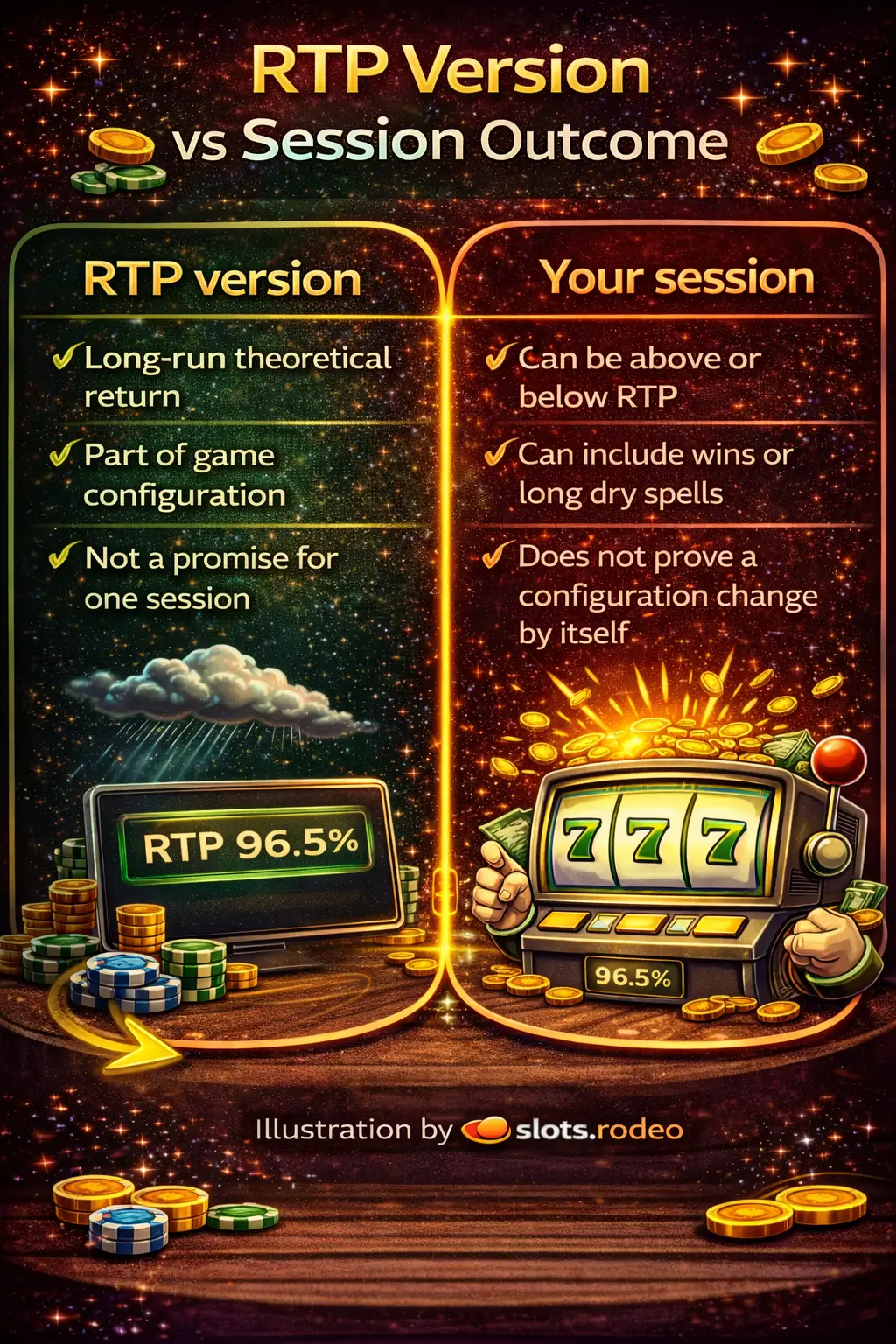
A weak session does not prove RTP was lowered.
A strong session does not prove the slot was on a higher setting.
A 96% slot can still produce a poor short session. A lower-RTP version can still produce a strong short session. Short-term results do not identify the configuration by themselves.
Can RTP change between casinos?
Yes. This is the practical part players should care about most.
The same slot title can sometimes appear:
- at one RTP version in Casino A
- at another RTP version in Casino B
The slot name may be the same, and the game may look almost identical, but the long-term theoretical return can differ if a different approved version is being used.
This is one of the reasons why comparing slots by title alone is not always enough.
Can RTP change between countries or brands?
Sometimes yes.
A provider may supply different versions depending on:
- casino choice
- regulated market rules
- brand strategy
- platform setup
- commercial configuration
The player may still see the same game title and the same visual presentation, even though the underlying RTP configuration is not identical everywhere.
That is why the in-game help screen matters more than reputation or guesswork.
What casinos usually cannot do
It helps to be precise here.
Casinos usually cannot do the following in normal operation:
- manually change RTP for one player because they are winning
- lower RTP halfway through your feature
- change the math one spin at a time
- rewrite provider logic directly from the lobby side
- use a live "tighten the slot now" control in a standard way
Those ideas are common myths, but they do not describe how standard slot deployment normally works.
What casinos may be able to do
What casinos may be able to do is much narrower.
They may be able to:
- choose from approved RTP versions supplied by the provider
- decide which version of a slot to publish on their site
- replace one slot version with another at a broader configuration level
- remove or add the game from the lobby
That is not the same as changing the RTP dynamically against a player during active play.
Can RTP change during play? The practical answer
The practical answer is:
A casino may offer a lower or higher approved version of a slot before you start playing, but that does not mean the RTP is being changed live during your session.
This is the core distinction that clears up most confusion.
Why the same slot can feel different without any RTP change
Players often compare two sessions and assume RTP changed because the slot felt different.
But a session can feel different because of:
- bonus timing
- multiplier connection
- hit rhythm
- variance in short play
- feature-heavy value concentration
- simple normal randomness within the game model
This is important because "felt different" is not evidence of a live RTP adjustment.
What to check if RTP matters to you
If RTP matters to you, focus on practical checks instead of myths.
| What to check | Why it matters |
|---|---|
| In-game help screen | This is often where the actual RTP is shown |
| Exact RTP figure, if displayed | Confirms the version more reliably than general reputation |
| Same slot at different casinos | Helps you see whether the title may be offered at different versions |
| Provider info and paytable screen | Useful for confirming that the game version is the one actually being played |
| Session claims vs actual displayed RTP | Prevents false conclusions from one short result |
In-game help screen
Why it matters
This is often where the actual RTP is shown
Exact RTP figure, if displayed
Why it matters
Confirms the version more reliably than general reputation
Same slot at different casinos
Why it matters
Helps you see whether the title may be offered at different versions
Provider info and paytable screen
Why it matters
Useful for confirming that the game version is the one actually being played
Session claims vs actual displayed RTP
Why it matters
Prevents false conclusions from one short result
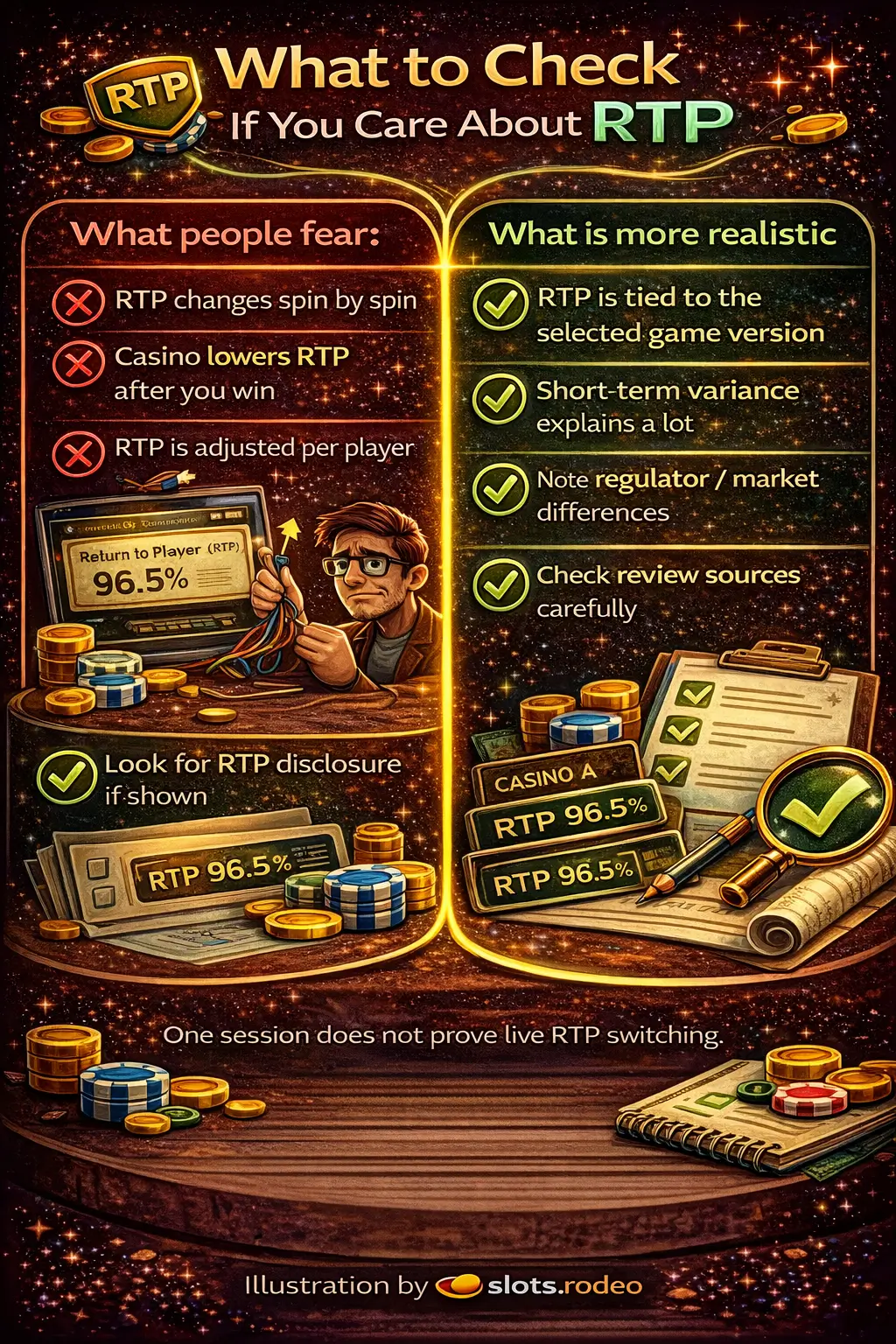
What not to rely on
If you want to understand RTP correctly, do not rely on these ideas:
- "the slot paid well yesterday, so RTP was higher"
- "my bonus was bad, so the casino changed the setting"
- "the slot got cold after a big win, so RTP dropped"
- "one short session proves the version used"
- "same slot title always means same RTP everywhere"
These are weak conclusions.
Common beginner mistakes
Confusing RTP version with session result
A weak run does not prove a lower configuration.
Assuming casinos control every part of slot math directly
Usually the provider controls the game math and approved versions.
Thinking RTP changes live during play
Standard slot operation does not work like a live adjustment dial.
Assuming the same slot title always has the same RTP
Different casinos can sometimes offer different approved versions.
Ignoring the in-game information screen
This is often the best place to check the actual value shown for that game.
A simple example
Imagine the same slot title exists in three approved versions:
- 96.1%
- 95.0%
- 94.0%
Casino A offers the 96.1% version.
Casino B offers the 94.0% version.
Now imagine a player gets a poor session at Casino A and a good session at Casino B.
That does not prove Casino B has the better RTP in practice for that player's short run. It only means short sessions vary. The actual configuration still matters, but the session result alone cannot identify it.
What this means in practice
The most accurate practical takeaway is:
- casinos may sometimes choose among provider-approved RTP versions
- the same slot can therefore differ between casinos
- this does not mean RTP is being changed dynamically during your play
- short-session outcomes are too noisy to prove live RTP changes
That is the correct framework.
FAQ
Common questions about this topic.
They can sometimes choose between approved RTP versions of a slot, but they usually do not freely change RTP live during your session.
Yes. The same slot title can sometimes be offered in different approved RTP versions across different casinos.
In standard operation, no. RTP is usually tied to the selected game configuration, not adjusted spin by spin during active play.
No. A bad short session is not evidence of a live RTP change.
The provider usually controls the game math and approved RTP versions. The casino may often choose which approved version to offer.


